
軍形第四
Core Insight: "To secure ourselves against defeat lies in our own hands, but the opportunity of defeating the enemy is provided by the enemy himself." — Sun Tzu, 軍形第四
「不可勝在己,可勝在敵。故善戰者,能為不可勝,不能使敵之必可勝。」
Invincibility depends entirely upon self-regulation, defensive discipline, and flawless positioning. Victory cannot be forced onto a rival; it emerges naturally when an unassailable position encounters an opponent's fatal mistake—a foundational perspective explored in Art of War Chapter 4 Translation. Discover how ancient strategy applies to modern competition in Why You Keep Feeling Certain About Decisions (While Walking Into Mistakes).
Art of War Chapter 4 Translation: Building an Unshakeable Foundation
Art of War Chapter 4 Translation (軍形第四) teaches that invincibility resides within our own discipline, while victory depends on recognizing the adversary's missteps. The truly skilled commander establishes an unassailable position first, ensuring zero vulnerability, and only moves when circumstances guarantee a decisive outcome.
Complete Chapter Translation: Modern Western Reading
Sun Tzŭ said: The good fighters of old first put themselves beyond the possibility of defeat, and then waited for an opportunity of defeating the enemy.
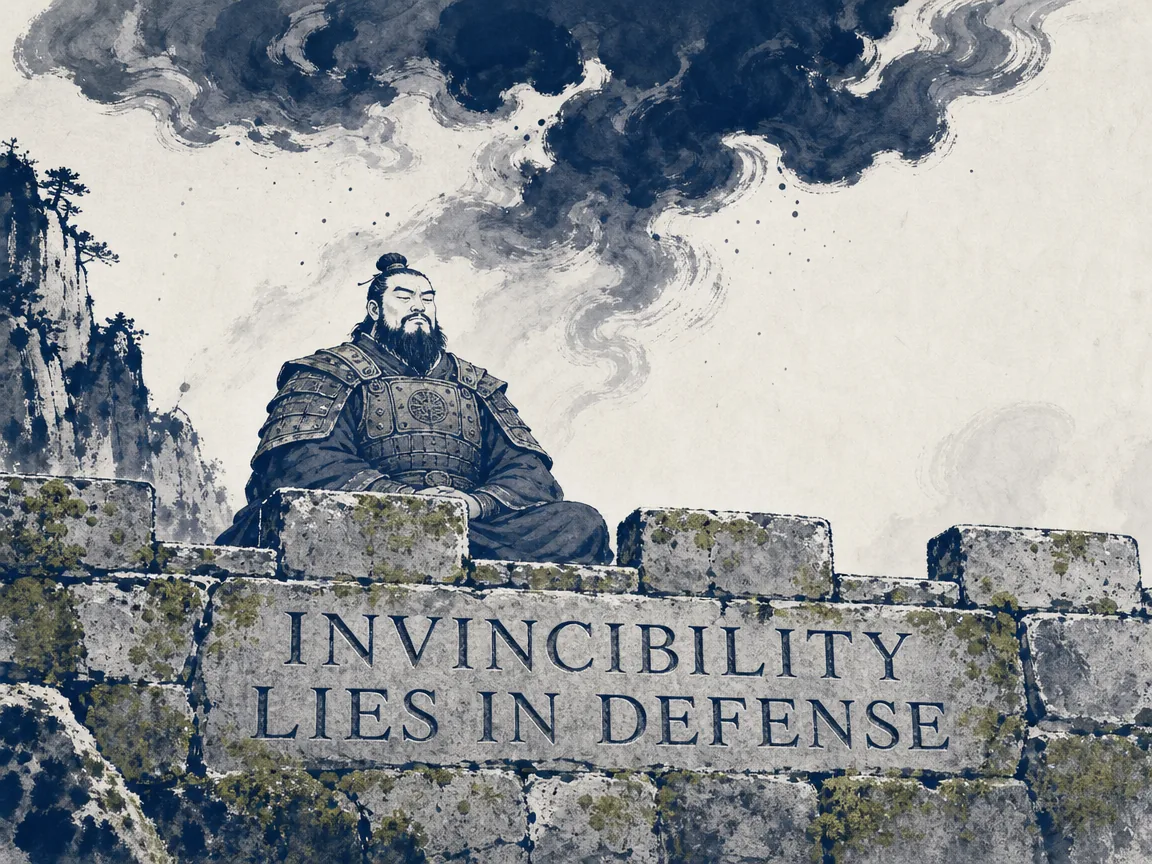
To secure ourselves against defeat lies in our own hands, but the opportunity of defeating the enemy is provided by the enemy himself. Thus the good fighter is able to secure himself against defeat, but cannot make certain of defeating the enemy. Hence the saying: One may know how to conquer without being able to do it. Security against defeat implies defensive tactics; ability to defeat the enemy means taking the offensive.
Standing on the defensive indicates insufficient strength; attacking, a superabundance of strength. The general who is skilled in defence hides in the most secret recesses of the earth; he who is skilled in attack flashes forth from the topmost heights of heaven. Thus on the one hand we have ability to protect ourselves; on the other, a victory that is complete.
To see victory only when it is within the ken of the common herd is not the acme of excellence. Neither is it the acme of excellence if you fight and conquer and the whole Empire says, "Well done!" to see sun and moon is no sign of sharp sight; to hear the noise of thunder is no sign of a quick ear. What the ancients called a clever fighter is one who not only wins, but excels in winning with ease.
Hence his victories bring him neither reputation for wisdom nor credit for courage. He wins his battles by making no mistakes. Making no mistakes is what establishes the certainty of victory, for it means conquering an enemy that is already defeated. Hence the skilful fighter puts himself into a position which makes defeat impossible, and does not miss the moment for defeating the enemy.
Thus it is that in war the victorious strategist only seeks battle after the victory has been won, whereas he who is destined to defeat first fights and afterwards looks for victory. The consummate leader cultivates the moral law, and strictly adheres to method and discipline; thus it is in his power to control success. In respect of military method, we have, firstly, Measurement; secondly, Estimation of quantity; thirdly, Calculation; fourthly, Balancing of chances; fifthly, Victory.
Measurement owes its existence to Earth; Estimation of quantity to Measurement; Calculation to Estimation of quantity; Balancing of chances to Calculation; and Victory to Balancing of chances. A victorious army opposed to a routed one, is as a pound’s weight placed in the scale against a single grain. The onrush of a conquering force is like the bursting of pent-up waters into a chasm a thousand fathoms deep. So much for tactical dispositions.

孙子兵法中文原文与对照
【文言原文】
孫子曰:昔之善戰者,先為不可勝,以待敵之可勝。不可勝在己,可勝在敵。故善戰者,能為不可勝,不能使敵之必可勝。故曰:勝可知,而不可為。
不可勝者,守也;可勝者,攻也。守則不足,攻則有餘。善守者,藏於九地之下;善攻者,動於九天之上,故能自保而全勝也。
見勝不過衆人之所知,非善之善者也;戰勝而天下曰善,非善之善者也。故舉秋毫不為多力,見日月不為明目,聞雷霆不為聰耳。
古之所謂善戰者,勝於易勝者也。故善戰者之勝也,無智名,無勇功。故其戰勝不忒。不忒者,其所措必勝,勝已敗者也。故善戰者,立於不敗之地,而不失敵之敗也。是故勝兵先勝而後求戰,敗兵先戰而後求勝。善用兵者,修道而保法,故能為勝敗之政。
兵法:一曰度,二曰量,三曰數,四曰稱,五曰勝。地生度,度生量,量生數,數生稱,稱生勝。故勝兵若以鎰稱銖,敗兵若以銖稱鎰。勝者之戰民也,若決積水於千仞之溪者,形也。
Follow the progression of the military treatise in the next tactical doctrine in Energy and Momentum: The Dynamic Interplay of Direct and Indirect Maneuver.
For a deeper comparative examination of these ideas, explore our related study on Sun Tzu’s Art of Asymmetrical Advantage: “Steep Drop, Short Trigger” (势险节短).






