
九地第十一
Core Insight: "Throw your soldiers into positions whence there is no escape, and they will prefer death to flight. For they will then put forth the utmost power of which they are capable." — Sun Tzu, 九地第十一
「投之亡地然後存,陷之死地然後生。夫眾沉陷,然後能為勝敗。」
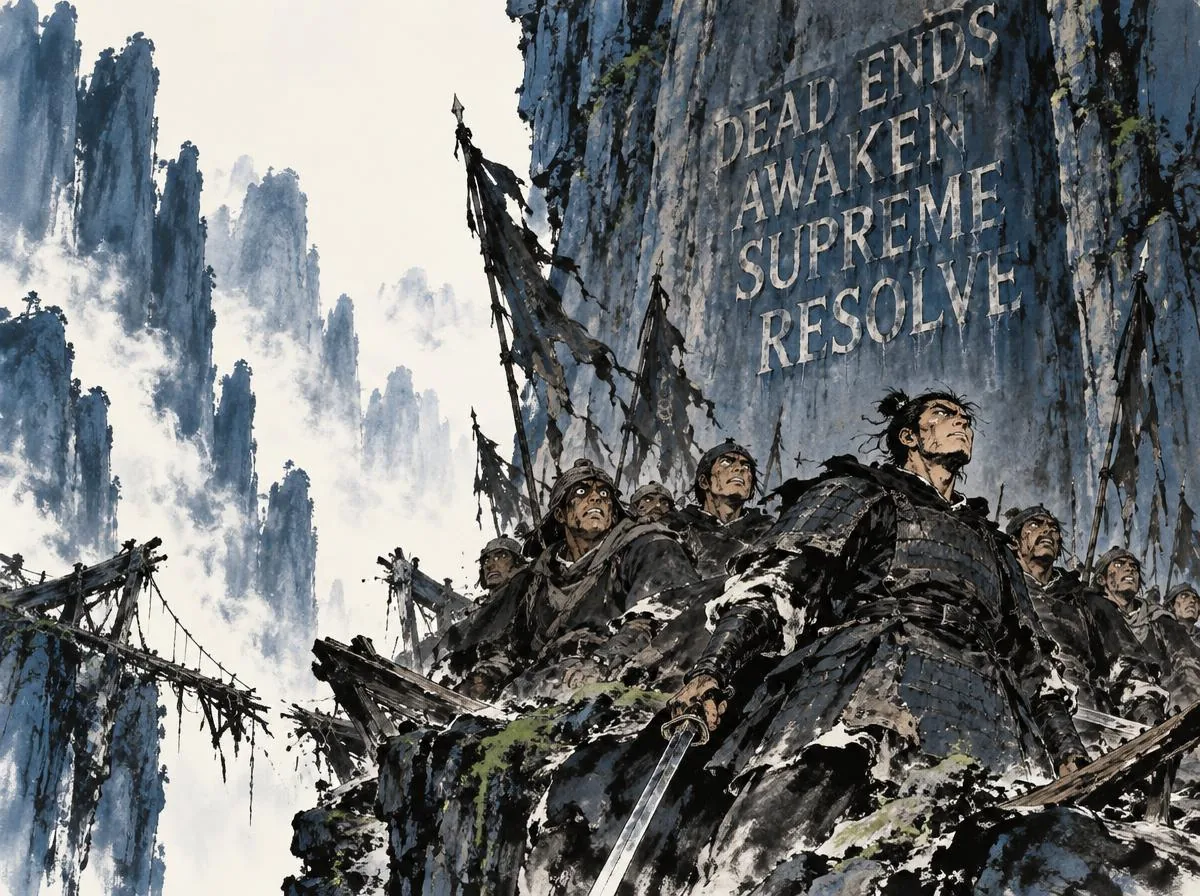
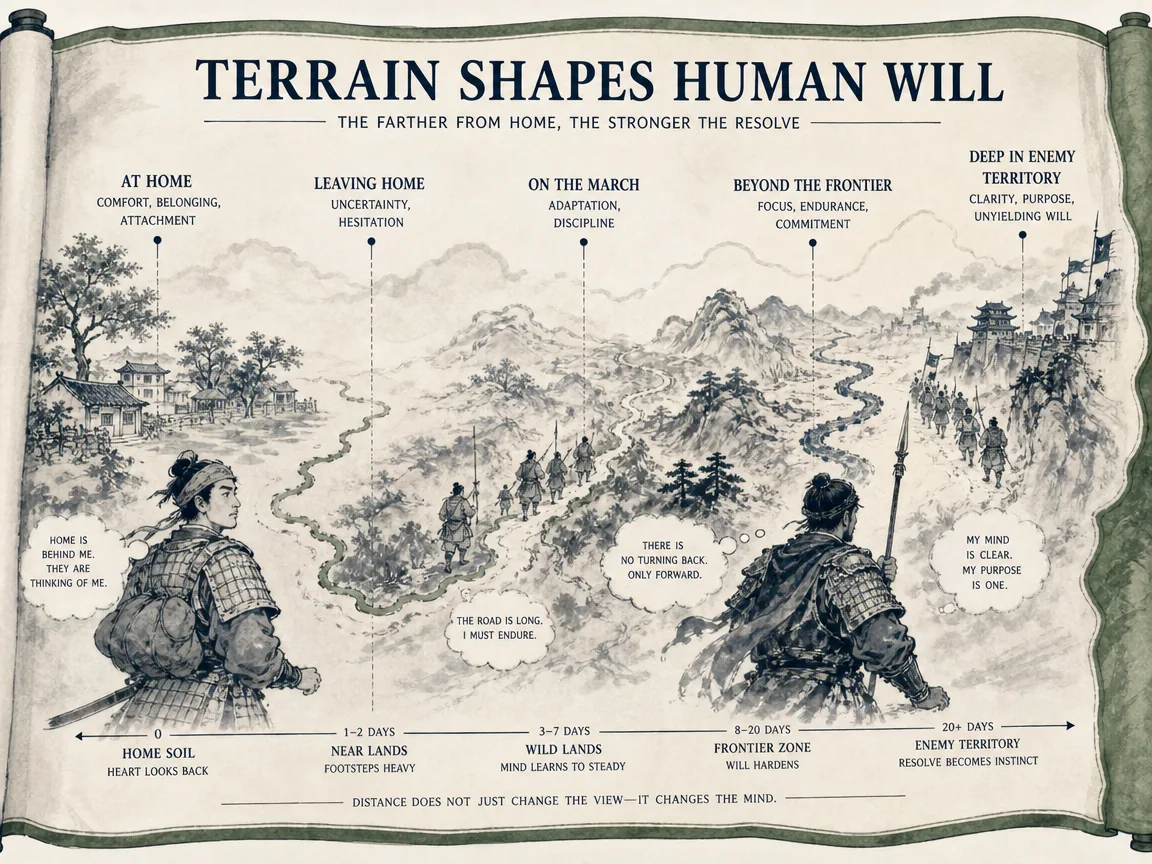
Behavior varies profoundly with geographic immersion. Deep penetration into hostile territory concentrates group cohesion, while desperation ground (Si Di) awakens supreme courage. An elite army moves in synchronized wholeness like the mythical Shuai-Jan serpent—a foundational perspective explored in Art of War Chapter 11. Discover how ancient strategy applies to modern competition in Shaping the Battlefield: How Ancient Chinese Strategy Teaches You to Design Your Competitor’s Choices.
Art of War Chapter 11: Cohesion Under Extreme Crisis
Art of War Chapter 11 (九地第十一) examines how psychological drive evolves across nine operational environments. By deliberately managing situational gravity, cutting off premature retreat, and guiding troops toward focused objectives, a leader inspires unity that operates as seamlessly as a single responsive body.
Complete Chapter Translation: Modern Western Reading
Sun Tzŭ said: The art of war recognises nine varieties of ground: (1) Dispersive ground; (2) facile ground; (3) contentious ground; (4) open ground; (5) ground of intersecting highways; (6) serious ground; (7) difficult ground; (8) hemmed-in ground; (9) desperate ground.
When a chieftain is fighting in his own territory, it is dispersive ground. When he has penetrated into hostile territory, but to no great distance, it is facile ground. Ground the possession of which imports great advantage to either side, is contentious ground. Ground on which each side has liberty of movement is open ground. Ground which forms the key to three contiguous states, so that he who occupies it first has most of the Empire at his command, is ground of intersecting highways.
When an army has penetrated into the heart of a hostile country, leaving a number of fortified cities in its rear, it is serious ground. Mountain forests, rugged steeps, marshes and fens—all country that is hard to traverse: this is difficult ground. Ground which is reached through narrow gorges, and from which we can only retire by tortuous paths, so that a small number of the enemy would suffice to crush a large body of our men: this is hemmed in ground.
Ground on which we can only be saved from destruction by fighting without delay, is desperate ground. . On dispersive ground, therefore, fight not. On facile ground, halt not. On contentious ground, attack not. On open ground, do not try to block the enemy’s way. On ground of intersecting highways, join hands with your allies. On serious ground, gather in plunder. Thus he won the hearts of all. In the present passage, then, I think that the true reading must be, not ‘plunder,’ but ‘do not plunder.’" Alas, I fear that in this instance the worthy commentator’s feelings outran his judgment. Tu Mu, at least, has no such illusions. He says: "When encamped on ‘serious ground,’ there being no inducement as yet to advance further, and no possibility of retreat, one ought to take measures for a protracted resistance by bringing in provisions from all sides, and keep a close watch on the enemy." In difficult ground, keep steadily on the march.
On hemmed-in ground, resort to stratagem. When night came on, bundles of twigs were fastened to the horns of some 2000 oxen and set on fire, the terrified animals being then quickly driven along the mountain side towards the passes which were beset by the enemy. The strange spectacle of these rapidly moving lights so alarmed and discomfited the Romans that they withdrew from their position, and Hannibal’s army passed safely through the defile. On desperate ground, fight.
Those who were called skilful leaders of old knew how to drive a wedge between the enemy’s front and rear; to prevent co-operation between his large and small divisions; to hinder the good troops from rescuing the bad, the officers from rallying their men. When the enemy’s men were scattered, they prevented them from concentrating; even when their forces were united, they managed to keep them in disorder.
When it was to their advantage, they made a forward move; when otherwise, they stopped still. If asked how to cope with a great host of the enemy in orderly array and on the point of marching to the attack, I should say: "Begin by seizing something which your opponent holds dear; then he will be amenable to your will." By boldly seizing the initiative in this way, you at once throw the other side on the defensive.
Rapidity is the essence of war: In 621 A.D., Li Ching was sent from K’uei-chou in Ssu-ch’uan to reduce the successful rebel Hsiao Hsien, who had set up as Emperor at the modern Ching-chou Fu in Hupeh. It was autumn, and the Yangtsze being then in flood, Hsiao Hsien never dreamt that his adversary would venture to come down through the gorges, and consequently made no preparations. But Li Ching embarked his army without loss of time, and was just about to start when the other generals implored him to postpone his departure until the river was in a less dangerous state for navigation. Li Ching replied: "To the soldier, overwhelming speed is of paramount importance, and he must never miss opportunities. Now is the time to strike, before Hsiao Hsien even knows that we have got an army together. If we seize the present moment when the river is in flood, we shall appear before his capital with startling suddenness, like the thunder which is heard before you have time to stop your ears against it. This is the great principle in war. Even if he gets to know of our approach, he will have to levy his soldiers in such a hurry that they will not be fit to oppose us. Thus the full fruits of victory will be ours." All came about as he predicted, and Hsiao Hsien was obliged to surrender, nobly stipulating that his people should be spared and he alone suffer the penalty of death. take advantage of the enemy’s unreadiness, make your way by unexpected routes, and attack unguarded spots.
The following are the principles to be observed by an invading force: The further you penetrate into a country, the greater will be the solidarity of your troops, and thus the defenders will not prevail against you. Make forays in fertile country in order to supply your army with food. Carefully study the well-being of your men, and do not overtax them. Concentrate your energy and hoard your strength. Keep your army continually on the move, and devise unfathomable plans.
Throw your soldiers into positions whence there is no escape, and they will prefer death to flight. If they will face death, there is nothing they may not achieve. Officers and men alike will put forth their uttermost strength. Soldiers when in desperate straits lose the sense of fear. If there is no place of refuge, they will stand firm. If they are in the heart of a hostile country, they will show a stubborn front. If there is no help for it, they will fight hard.
Thus, without waiting to be marshalled, the soldiers will be constantly on the qui vive; without waiting to be asked, they will do your will; without restrictions, they will be faithful; without giving orders, they can be trusted. Prohibit the taking of omens, and do away with superstitious doubts. Then, until death itself comes, no calamity need be feared.
If our soldiers are not overburdened with money, it is not because they have a distaste for riches; if their lives are not unduly long, it is not because they are disinclined to longevity. On the day they are ordered out to battle, your soldiers may weep, those sitting up bedewing their garments, and those lying down letting the tears run down their cheeks. But let them once be brought to bay, and they will display the courage of a Chu or a Kuei.
The skilful tactician may be likened to the shuai-jan. Now the shuai-jan is a snake that is found in the Ch‘ang mountains. Strike at its head, and you will be attacked by its tail; strike at its tail, and you will be attacked by its head; strike at its middle, and you will be attacked by head and tail both. Asked if an army can be made to imitate the shuai-jan, I should answer, Yes. For the men of Wu and the men of Yüeh are enemies; yet if they are crossing a river in the same boat and are caught by a storm, they will come to each other’s assistance just as the left hand helps the right.
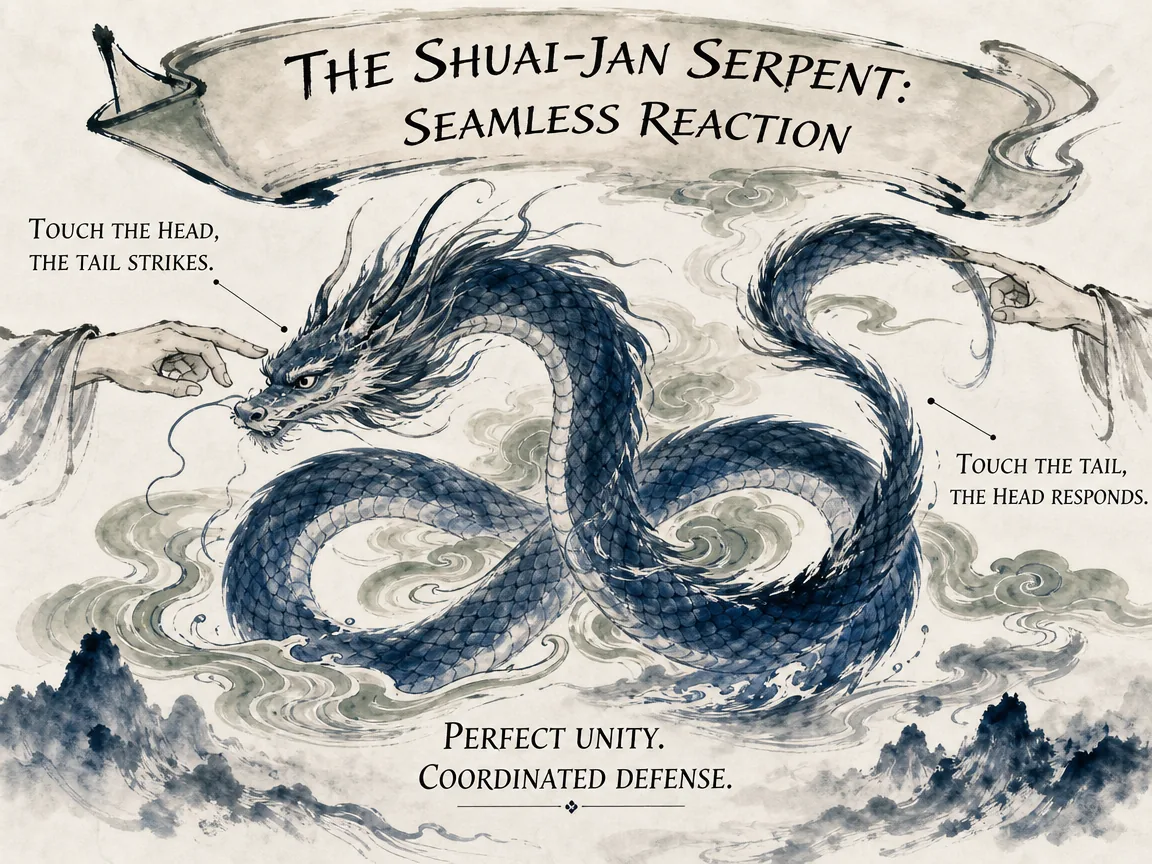
Hence it is not enough to put one’s trust in the tethering of horses, and the burying of chariot wheels in the ground. It is not enough, says Sun Tzŭ, to render flight impossible by such mechanical means. You will not succeed unless your men have tenacity and unity of purpose, and, above all, a spirit of sympathetic cooperation. This is the lesson which can be learned from the shuai-jan.
The principle on which to manage an army is to set up one standard of courage which all must reach. as though one." If the ideal army is to form a single organic whole, then it follows that the resolution and spirit of its component parts must be of the same quality, or at any rate must not fall below a certain standard. Wellington’s seemingly ungrateful description of his army at Waterloo as "the worst he had ever commanded" meant no more than that it was deficient in this important particular—unity of spirit and courage. Had he not foreseen the Belgian defections and carefully kept those troops in the background, he would almost certainly have lost the day.
How to make the best of both strong and weak—that is a question involving the proper use of ground. Thus the skilful general conducts his army just as though he were leading a single man, willy-nilly, by the hand. It is the business of a general to be quiet and thus ensure secrecy; upright and just, and thus maintain order. He must be able to mystify his officers and men by false reports and appearances, and thus keep them in total ignorance. In the year 88 A.D., as we read in ch. 47 of the Hou Han Shu, "Pan Ch’ao took the field with 25,000 men from Khotan and other Central Asian states with the object of crushing Yarkand. The King of Kutcha replied by dispatching his chief commander to succour the place with an army drawn from the kingdoms of Wen-su, Ku-mo, and Wei-t’ou, totaling 50,000 men. Pan Ch’ao summoned his officers and also the King of Khotan to a council of war, and said: ‘Our forces are now outnumbered and unable to make head against the enemy. The best plan, then, is for us to separate and disperse, each in a different direction. The King of Khotan will march away by the easterly route, and I will then return myself towards the west. Let us wait until the evening drum has sounded and then start.’ Pan Ch’ao now secretly released the prisoners whom he had taken alive, and the King of Kutcha was thus informed of his plans. Much elated by the news, the latter set off at once at the head of 10,000 horsemen to bar Pan Ch’ao’s retreat in the west, while the King of Wen-su rode eastward with 8000 horse in order to intercept the King of Khotan. As soon as Pan Ch’ao knew that the two chieftains had gone, he called his divisions together, got them well in hand, and at cock-crow hurled them against the army of Yarkand, as it lay encamped. The barbarians, panic-stricken, fled in confusion, and were closely pursued by Pan Ch’ao. Over 5000 heads were brought back as trophies, besides immense spoils in the shape of horses and cattle and valuables of every description. Yarkand then capitulating, Kutcha and the other kingdoms drew off their respective forces. From that time forward, Pan Ch’ao’s prestige completely overawed the countries of the west." In this case, we see that the Chinese general not only kept his own officers in ignorance of his real plans, but actually took the bold step of dividing his army in order to deceive the enemy.
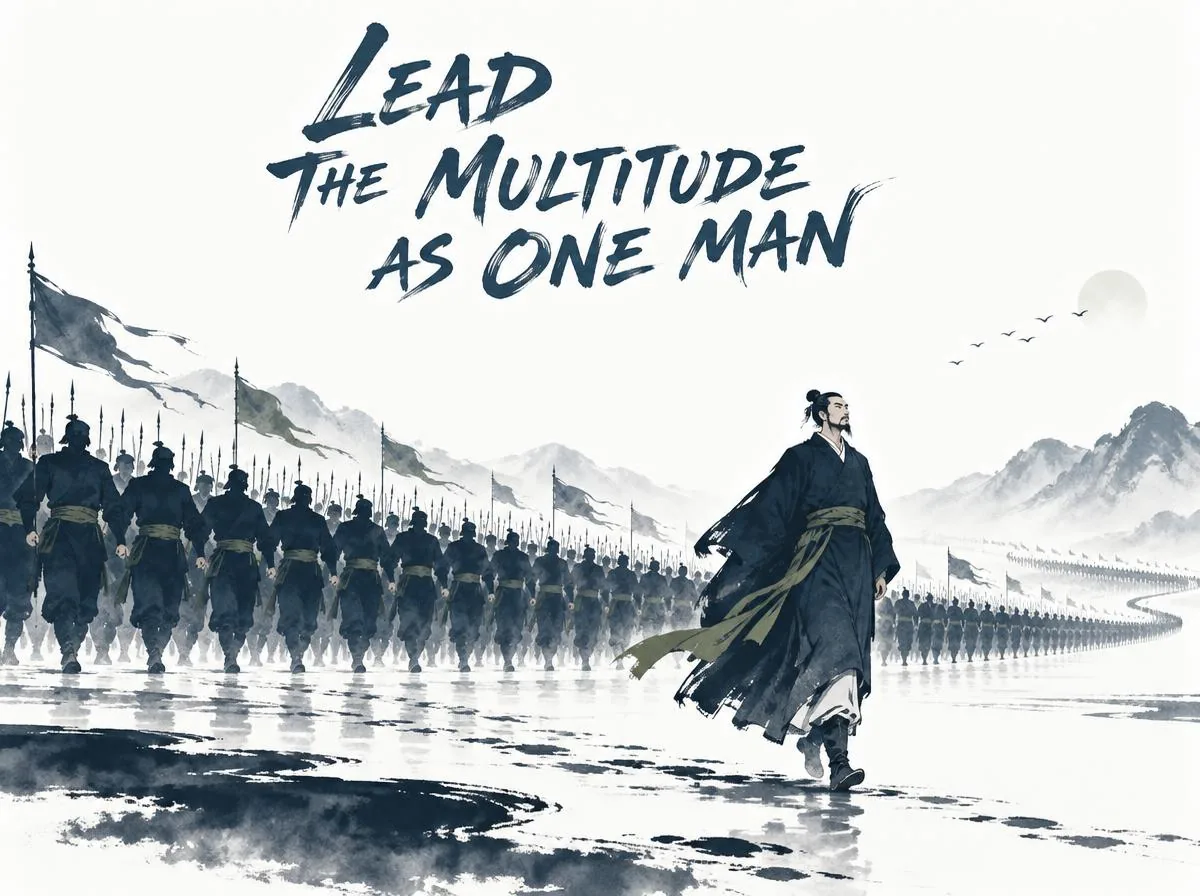
By altering his arrangements and changing his plans, he keeps the enemy without definite knowledge. By shifting his camp and taking circuitous routes, he prevents the enemy from anticipating his purpose. At the critical moment, the leader of an army acts like one who has climbed up a height and then kicks away the ladder behind him. He carries his men deep into hostile territory before he shows his hand.
He burns his boats and breaks his cooking-pots; like a shepherd driving a flock of sheep, he drives his men this way and that, and none knows whither he is going. To muster his host and bring it into danger:—this may be termed the business of the general. The different measures suited to the nine varieties of ground; the expediency of aggressive or defensive tactics; and the fundamental laws of human nature: these are things that must most certainly be studied.
When invading hostile territory, the general principle is, that penetrating deeply brings cohesion; penetrating but a short way means dispersion. When you leave your own country behind, and take your army across neighbourhood territory, you find yourself on critical ground. When there are means of communication on all four sides, the ground is one of intersecting highways.
When you penetrate deeply into a country, it is serious ground. When you penetrate but a little way, it is facile ground. When you have the enemy’s strongholds on your rear, and narrow passes in front, it is hemmed-in ground. When there is no place of refuge at all, it is desperate ground. Therefore, on dispersive ground, I would inspire my men with unity of purpose. On facile ground, I would see that there is close connection between all parts of my army.
On contentious ground, I would hurry up my rear. On open ground, I would keep a vigilant eye on my defences. On ground of intersecting highways, I would consolidate my alliances. On serious ground, I would try to ensure a continuous stream of supplies. On difficult ground, I would keep pushing on along the road. On hemmed-in ground, I would block any way of retreat. On desperate ground, I would proclaim to my soldiers the hopelessness of saving their lives.
For it is the soldier’s disposition to offer an obstinate resistance when surrounded, to fight hard when he cannot help himself, and to obey promptly when he has fallen into danger. We cannot enter into alliance with neighbouring princes until we are acquainted with their designs. We are not fit to lead an army on the march unless we are familiar with the face of the country—its mountains and forests, its pitfalls and precipices, its marshes and swamps. We shall be unable to turn natural advantages to account unless we make use of local guides.
To be ignorant of any one of the following four or five principles does not befit a warlike prince. When a warlike prince attacks a powerful state, his generalship shows itself in preventing the concentration of the enemy’s forces. He overawes his opponents, and their allies are prevented from joining against him. Hence he does not strive to ally himself with all and sundry, nor does he foster the power of other states. He carries out his own secret designs, keeping his antagonists in awe. Thus he is able to capture their cities and overthrow their kingdoms.
Bestow rewards without regard to rule, issue orders without regard to previous arrangements; and you will be able to handle a whole army as though you had to do with but a single man. Confront your soldiers with the deed itself; never let them know your design. When the outlook is bright, bring it before their eyes; but tell them nothing when the situation is gloomy.
Place your army in deadly peril, and it will survive; plunge it into desperate straits, and it will come off in safety. You, on the contrary, ordered us to draw up our troops with the river at our back. Under these conditions, how did you manage to gain the victory?" The general replied: "I fear you gentlemen have not studied the Art of War with sufficient care. Is it not written there: ‘Plunge your army into desperate straits and it will come off in safety; place it in deadly peril and it will survive’? Had I taken the usual course, I should never have been able to bring my colleague round. What says the Military Classic—‘Swoop down on the market-place and drive the men off to fight.’ If I had not placed my troops in a position where they were obliged to fight for their lives, but had allowed each man to follow his own discretion, there would have been a general débandade, and it would have been impossible to do anything with them." The officers admitted the force of his argument, and said: "These are higher tactics than we should have been capable of."
For it is precisely when a force has fallen into harm’s way that is capable of striking a blow for victory. Success in warfare is gained by carefully accommodating ourselves to the enemy’s purpose. By persistently hanging on the enemy’s flank, we shall succeed in the long run in killing the commander-in-chief. This is called ability to accomplish a thing by sheer cunning.
On the day that you take up your command, block the frontier passes, destroy the official tallies, and stop the passage of all emissaries. Be stern in the council-chamber, so that you may control the situation. If the enemy leaves a door open, you must rush in. Forestall your opponent by seizing what he holds dear, and subtly contrive to time his arrival on the ground.
Walk in the path defined by rule, and accommodate yourself to the enemy until you can fight a decisive battle. At first, then, exhibit the coyness of a maiden, until the enemy gives you an opening; afterwards emulate the rapidity of a running hare, and it will be too late for the enemy to oppose you. Giles’ Biographical Dictionary, no. 399. "The Science of War," p. 333. "Stonewall Jackson," vol. I, p. 421.
孙子兵法中文原文与对照
【文言原文】
孫子曰:凡用兵之法,有散地,有輕地,有爭地,有交地,有衢地,有重地,有圮地,有圍地,有死地。諸侯自戰其地者,為散地;入人之地而不深者,為輕地;我得則利,彼得亦利者,為爭地;我可以往,彼可以來者,為交地;諸侯之地三屬,先至而得天下之衆者,為衢地;入人之地深,背城邑多者,為重地;山林、險阻、沮澤,凡難行之道者,為圮地;所由入者隘,所從歸者迂,彼寡可以擊吾之衆者,為圍地;疾戰則存,不疾戰則亡者,為死地。是故散地則無戰,輕地則無止,爭地則無攻,交地則無絕,衢地則合交,重地則掠,圮地則行,圍地則謀,死地則戰。
所謂古之善用兵者,能使敵人前後不相及,衆寡不相恃,貴賤不相救,上下不相收,卒離而不集,兵合而不齊。合於利而動,不合於利而止。敢問︰「敵衆整而將來,待之若何?」曰:「先奪其所愛,則聽矣。」故兵之情主速,乘人之不及,由不虞之道,攻其所不戒也。
凡為客之道,深入則專,主人不克。掠于饒野,三軍足食。謹養而勿勞,併氣積力,運兵計謀,為不可測。投之無所往,死且不北。死焉不得,士人盡力。兵士甚陷則不懼,無所往則固,深入則拘,不得已則鬥。是故其兵不修而戒,不求而得,不約而親,不令而信。禁祥去疑,至死無所之。吾士無餘財,非惡貨也;無餘命,非惡壽也。令發之日,士卒坐者涕沾襟,偃臥者淚交頤。投之無所往者,則諸、劌之勇也。
故善用兵者,譬如率然。率然者,常山之蛇也。擊其首則尾至,擊其尾則首至,擊其中則首尾俱至。敢問︰「兵可使如率然乎?」曰︰「可。夫吳人與越人相惡也,當其同舟而濟。遇風,其相救也,如左右手。」是故方馬埋輪,未足恃也;齊勇如一,政之道也;剛柔皆得,地之理也。故善用兵者,攜手若使一人,不得已也。
將軍之事,靜以幽,正以治。能愚士卒之耳目,使之無知;易其事,革其謀,使人無識;易其居,迂其途,使人不得慮。帥與之期,如登高而去其梯;帥與之深入諸侯之地,而發其機,焚舟破釜,若驅群羊。驅而往,驅而來,莫知所之。聚三軍之衆,投之於險,此謂將軍之事也。九地之變,屈伸之利,人情之理,不可不察也。
凡為客之道,深則專,淺則散。去國越境而師者,絕地也;四達者,衢地也;入深者,重地也;入淺者,輕地也;背固前隘者,圍地也;無所往者,死地也。是故散地,吾將一其志;輕地,吾將使之屬;爭地,吾將趨其後;交地,吾將謹其守;衢地,吾將固其結;重地,吾將繼其食;圮地,吾將進其途;圍地,吾將塞其闕;死地,吾將示之以不活。故兵之情:圍則禦,不得已則鬥,過則從。
是故不知諸侯之謀者,不能豫交;不知山林、險阻、沮澤之形者,不能行軍;不用鄉導者,不能得地利。四五者,不知一,非霸王之兵也。夫霸王之兵,伐大國,則其衆不得聚;威加於敵,則其交不得合。是故不爭天下之交,不養天下之權,信己之私,威加於敵,則其城可拔,其國可隳。施無法之賞,懸無政之令。犯三軍之衆,若使一人。犯之以事,勿告以言;犯之以利,勿告以害。投之亡地然後存,陷之死地然後生。夫衆陷於害,然後能為勝敗。故為兵之事,在於佯順敵之意,併敵一向,千里殺將,是謂巧能成事者也。
是故政舉之日,夷關折符,無通其使;厲於廊廟之上,以誅其事。敵人開闔,必亟入之,先其所愛,微與之期,踐墨隨敵,以決戰事。是故始如處女,敵人開戶;後如脫兔,敵不及拒。
Follow the progression of the military treatise in the next tactical doctrine in The Attack by Fire: External Catalysts, Environmental Timing, and Emotional Restraint.
For a deeper comparative examination of these ideas, explore our related study on The Army on the March: Reading Terrain, Observing Signs, and Psychological Leadership.






