
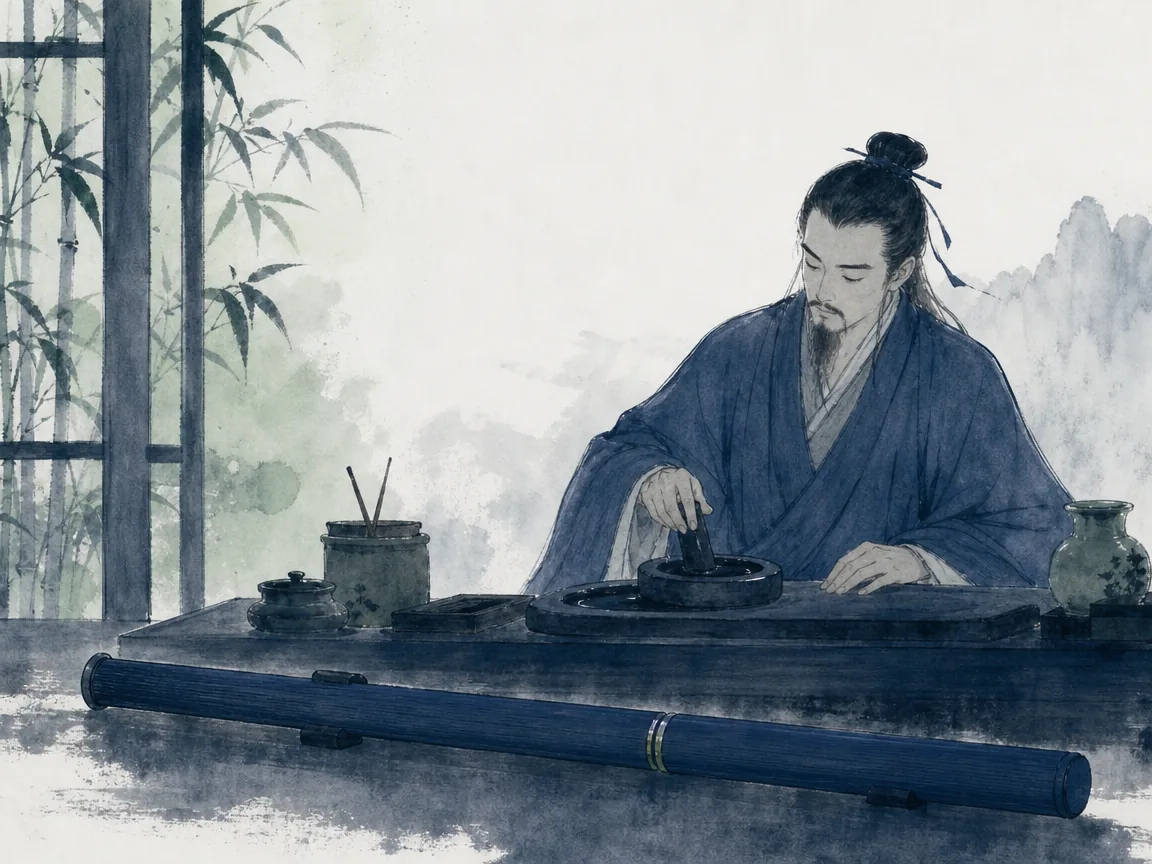
In an era where personal branding is treated as a survival skill and every achievement demands a polished post, the pressure to constantly announce oneself has become exhausting. We curate highlight reels, compete for attention, and measure our worth by visible metrics—likes, titles, followers, public recognition. The result is a peculiar modern fatigue: we are more seen than ever, yet increasingly anxious, brittle, and drained. Beneath the surface of this culture lies a quiet question many of us feel but rarely ask—what would happen if I stopped performing?
Centuries ago, Chinese thinkers faced similar tensions, though their stakes were often literally matters of life and death. Out of those conditions emerged a principle known as “concealing one’s edge” (cáng fēng, 藏锋). It is not the same as hiding one’s ability, nor is it cowardice. Rather, it is the deliberate practice of sheathing what could easily cut: your sharpness, your achievements, your need to be right. In a world that rewards visibility, this ancient wisdom asks something counterintuitive—what if strength does not need to prove itself to be real? This principle is central to Concealing Your Edge Chinese Philosophy.
This is not a call to disappear. It is an invitation to reconsider how we carry ourselves through life. The following explores a philosophy that has shaped Chinese thought for millennia, what it looks like in practice, and why it may be exactly what we need right now.
Concealing Your Edge Chinese Philosophy: What Is “Concealing One’s Edge” (Cáng Fēng, 藏锋)?
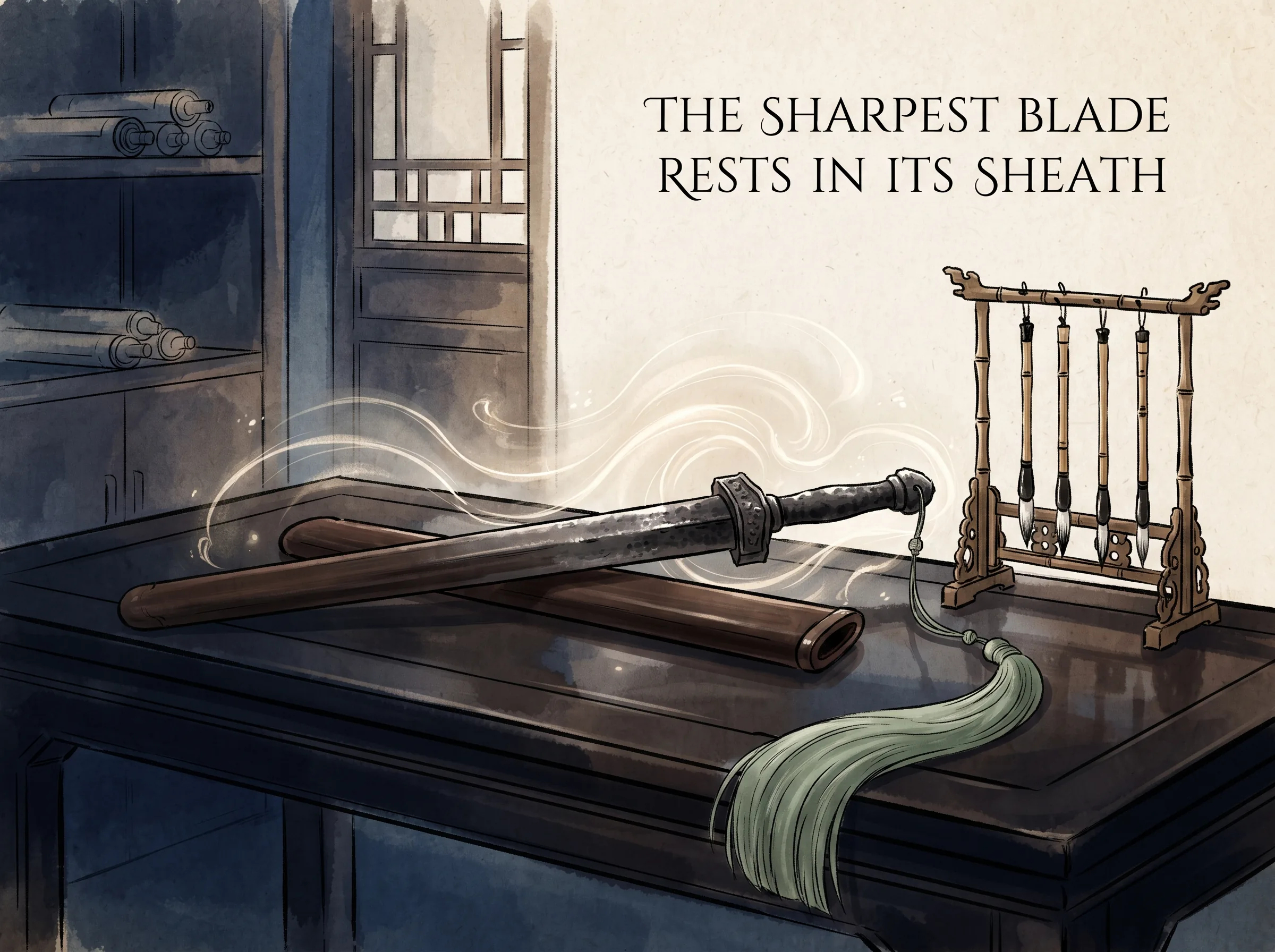
The first character means “to hide or store away” (cáng, 藏), while the second refers to the sharp point or edge of a blade (fēng, 锋). Together, they describe the act of keeping the cutting edge covered. The concept appears across multiple Chinese arts—in calligraphy, the brush tip is deliberately drawn back into the stroke rather than left exposed; in sword-making, the finest blades are sheathed in plain wood rather than ornate scabbards that announce their presence. The underlying principle is consistent: true sharpness does not require constant display.
This idea runs through Daoist and broader Chinese philosophical traditions as a kind of strategic humility. It is not about repression or self-denial. It is about recognizing that an exposed blade cuts indiscriminately—sometimes itself—and that a sheathed blade retains its full capability while avoiding unnecessary conflict.
The Philosophy Behind Concealing Your Edge
Ancient Chinese thinkers observed that rigidity tends to break while flexibility endures. This observation appears in foundational texts where the soft and yielding are described as more durable than the hard and forceful. While interpretations of such passages vary across scholarly traditions, the general insight has influenced Chinese thought for centuries: what bends survives what cannot.
The psychology behind concealing one’s edge (cáng fēng, 藏锋) is straightforward enough to observe in daily life. When someone constantly signals their superiority—through boasts, interruptions, or the need to correct others—they create friction. Not because they are intentionally harmful, but because visible sharpness triggers defense in others. Systems, whether social circles or workplaces, tend to resist what disrupts their equilibrium. Being the most impressive person in every room may feel validating, but it also makes you a target for resentment, comparison, and isolation.
There is a distinction worth holding: showing off is instinct. Concealing is discipline. Anyone can flash their edge. It takes intentionality to decide when not to.
Historical Lives That Illustrate the Principle
Chinese history offers several figures whose choices illustrate concealing one’s edge (cáng fēng, 藏锋) in action, each in different circumstances. For broader philosophical context, consult our related exploration on What a Leaf Can Teach You: Ancient Chinese Wisdom in the Art of Tea.
Zhang Liang, a chief strategist for the founding of the Han dynasty, is one of the most frequently discussed examples. After helping Liu Bang establish the empire, he was offered an enormous enfeoffment—30,000 households (sān wàn hù, 三万户) in the state of Qi. Instead, he declined and requested only a small territory called Liu, the place where he had first encountered Liu Bang [1]. He later expressed a wish to abandon worldly pursuits and retreat from public life. Scholars have interpreted this move as a deliberate strategy of self-preservation in a political environment where meritorious officials (gōng chén, 功臣) often met tragic ends, but the exact motivations remain a subject of historical interpretation.
Su Shi (also known as Su Dongpo) experienced a very different kind of edge-concealing. In his youth, his literary brilliance was flamboyant and uncompromising. His career changed dramatically in 1079, when he was implicated in the Wutai Poetry Incident—a case in which officials scrutinized his writings and found grounds to accuse him of criticizing the government. He was imprisoned and nearly executed before being demoted to Huangzhou, where he served as a low-ranking military administrator [4]. It was during this exile that his writing transformed. The sharp polemics of his earlier years gave way to works like the Former Ode on the Red Cliff, composed after a boat trip in 1082, which reflect a deepened, more contemplative voice [4]. Su Shi did not lose his talent during this period; he learned to carry it differently.
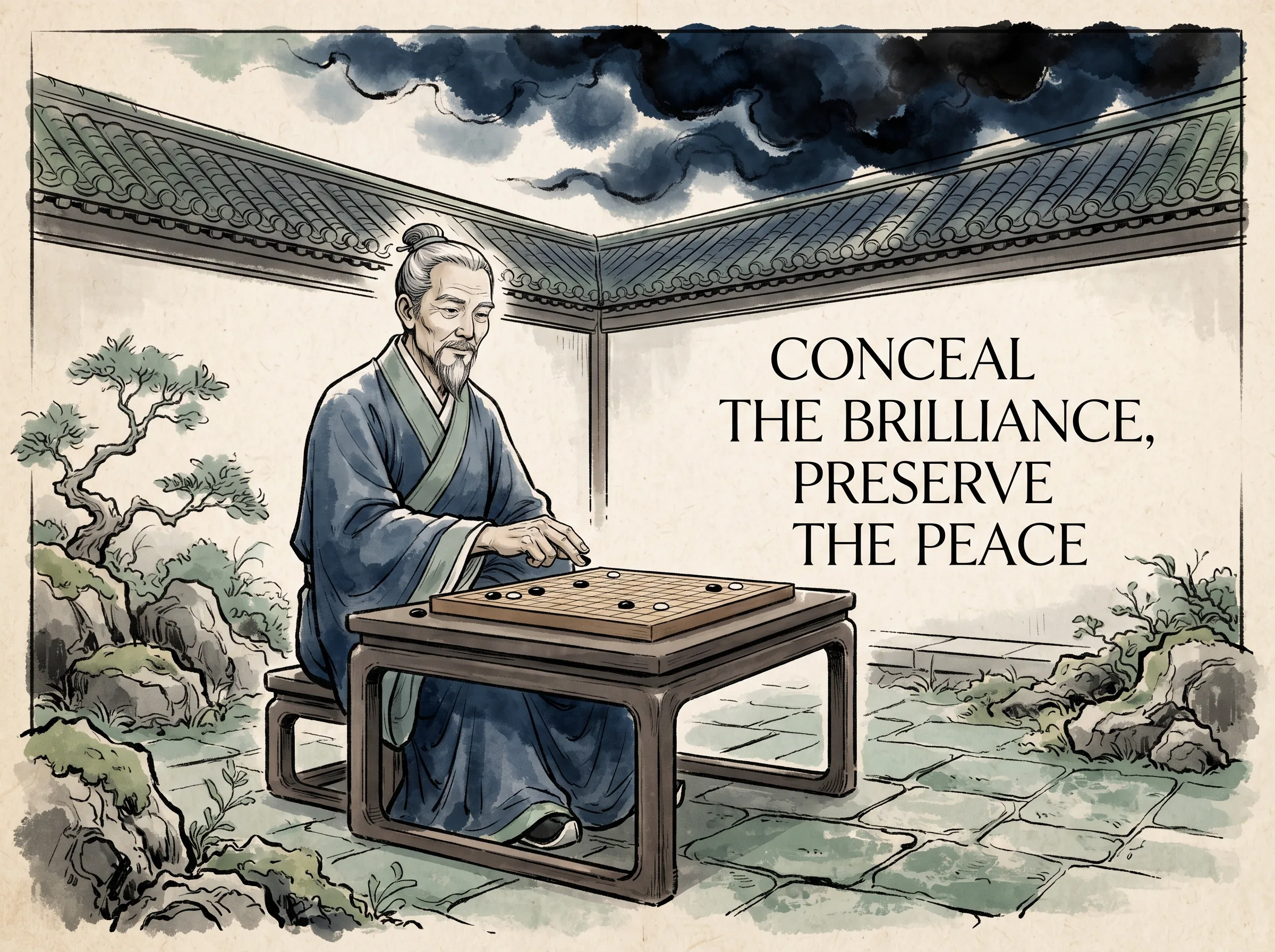
These examples are not meant to suggest that all suffering leads to wisdom, nor that concealment guarantees safety. History is complicated. But the pattern remains instructive: lives that survive sustained pressure often involve moments when choosing restraint was wiser than choosing to shine, reflecting the enduring wisdom of Concealing Your Edge Chinese Philosophy.
For broader philosophical context, consult our related exploration on Why We Call Ancient Chinese Art “Ugly” — And What Aesthetic Humility Can Teach Us.
What the Sources Say About Visibility and Risk
The tension between standing out and staying safe has been noted across Chinese literary tradition. A well-known passage attributed to Li Kang, a writer of the Three Kingdoms period, states: “The tree that stands tallest in the forest invites the strongest wind; the mound that projects beyond the shore invites the swiftest current; the person whose conduct rises above others invites universal criticism” [3]. Whether read as advice, warning, or simple observation, the passage captures something empirically true: visibility attracts attention, and attention is not always benevolent.
This does not mean the talented should hide forever. It means recognizing that an unguarded edge creates reactions beyond your control. The question raised by concealing one’s edge (cáng fēng, 藏锋) is not “Should I be good?” but “How do I carry my goodness without making others feel diminished?”
Four Practical Benefits for Modern Readers
The value of concealing your edge is not only philosophical. It has tangible effects on how people live.
Energy conservation. Performance is costly. Every carefully crafted message, every calculated self-presentation, every moment spent monitoring how you appear drains mental resources. When you stop performing constantly, that energy becomes available for thinking, creating, resting—activities that do not require an audience.
Freedom from reputation anxiety. The higher you place yourself, the harder it falls. People who cultivate a flawless public image live under constant surveillance—from others and from themselves. The smallest mistake becomes evidence that the persona was fraudulent. Concealing your edge removes the pedestal and the fear of falling from it.
Genuine relationships. People gravitate toward those who do not make them feel inadequate. Quiet competence is disarming in a way that overt brilliance often is not. Friendships built on authenticity outlast those built on admiration or competition.
Deep accumulation. Time spent not performing becomes time spent growing. The person who hides their blade to preserve it is still sharpening it—in private, at their own pace.
Six Ways to Practice Concealing Your Edge (Cáng Fēng, 藏锋)
These are not rules but invitations. You may adopt one, all, or none, depending on your circumstances.
- In success, hide arrogance. When something goes well, share credit. Acknowledge luck. Self-deprecation is not weakness—it is a way of making space for others.
- In debate, hide the urge to win. The reverse-fire effect shows that proving someone wrong often strengthens their commitment to their position. Allowing others to be wrong is sometimes the most persuasive move.
- In hardship, hide the need to broadcast suffering. Complaining publicly does not always invite empathy. Sometimes it invites fatigue in those around you. Private resilience builds a different kind of respect.
- In expression, hide the habit of constant output. Reserve your sharpest insights for moments that matter. A kitchen knife is useful every day; a treasured sword is drawn only when necessary.
- In daily life, hide the hunger for external validation. Cultivate interests and practices that do not require an audience. Inner fullness reduces dependency on applause.
- In competition, hide the inability to celebrate others. True confidence does not need to dim other people’s light. If you can genuinely applaud someone else’s success, you have already freed yourself from the need to outrank them.
The Deeper Freedom of Concealing Your Edge
The ultimate gift of this practice is not strategy but freedom. When you no longer need to prove yourself, you are no longer hostage to other people’s opinions. You can act from conviction rather than reaction. You can enter a room without calculating how you will be perceived. You can leave a conversation without rehearsing what you should have said.
This is not the freedom of invisibility. It is the freedom of choice. You can reveal yourself when it matters. You can stay hidden when it serves you. The difference between a person who must always be seen and a person who can choose when to be seen is the difference between compulsion and agency.
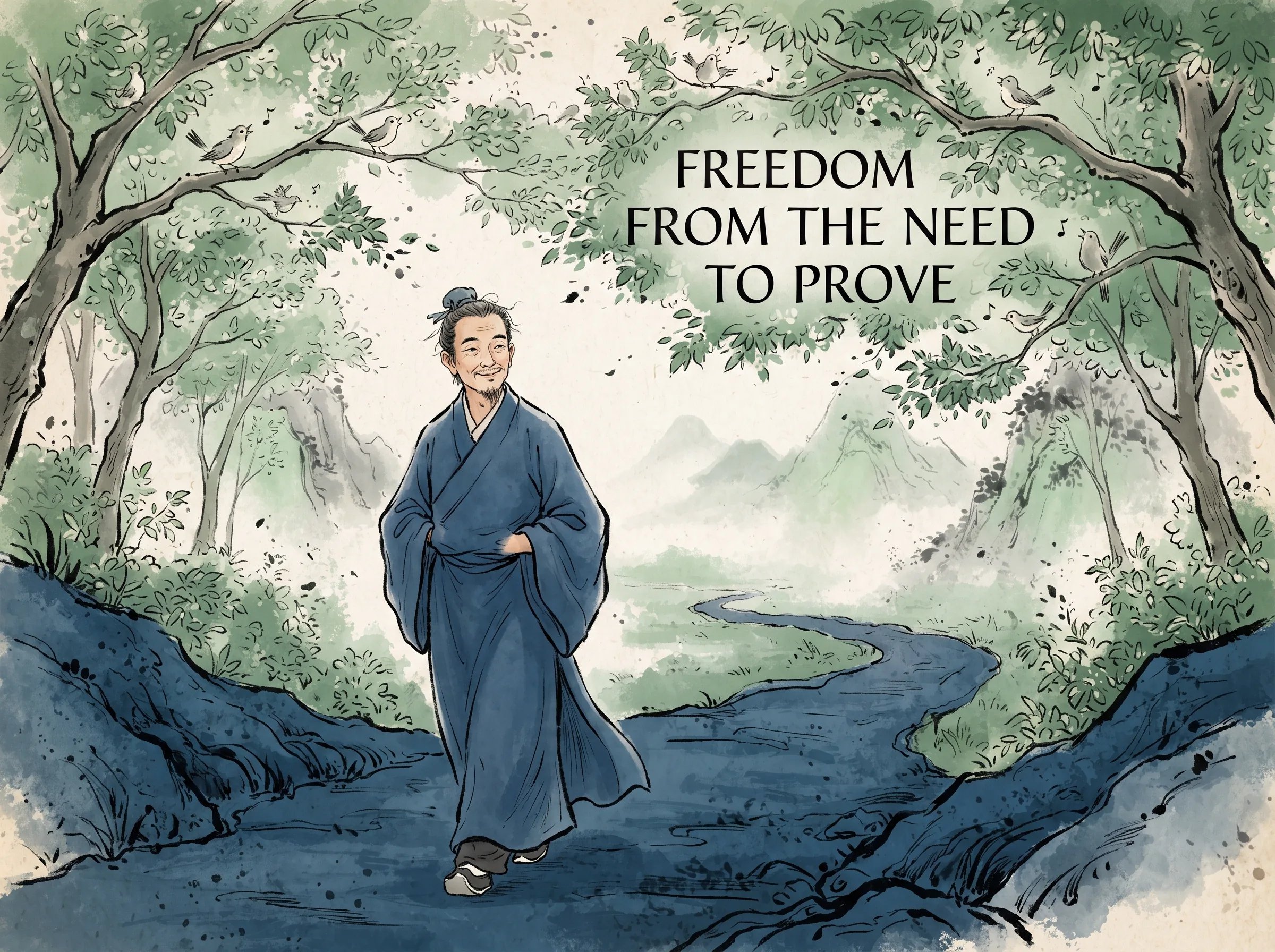
A final reflection: living with capability held in reserve—“contained rather than exposed” (hán ér bù lù, 含而不露)—is perhaps the quietest form of courage. It requires trusting that your value does not depend on your visibility. The blade in the scabbard is still sharp. The person who does not need to announce themselves is often the one who needs no one to convince them they matter.
FAQ
Is concealing one’s edge (cáng fēng, 藏锋) the same as being shy or lacking confidence?
No. Concealing your edge is a conscious choice, not a default condition. Shyness is often driven by fear; concealing one’s edge is driven by discipline. One withdraws because it is afraid to be seen. The other remains partially unseen because it has nothing to prove.
Does practicing concealing one’s edge (cáng fēng, 藏锋) mean I should never share my achievements?
Not at all. The practice is about timing and intention, not silence. Sharing is appropriate when it serves others, when it builds community, or when honesty requires it. The concern is not sharing itself but the compulsion to share for validation or to elevate oneself above others.
Can concealing your edge make you overlooked or passed over for opportunities?
It can, in environments that reward self-promotion over substance. In such contexts, concealing one’s edge may require occasional strategic disclosure. The principle is not absolute—it is a balance. The goal is not to disappear but to avoid the costs of constant exposure.
How do I know when to reveal my edge and when to keep it concealed?
A useful question is not “Will this make me look good?” but “Will this help, or will it simply display?” If the purpose is service, clarity, or genuine connection, revealing your ability (néng lì, 能力) may be appropriate. If the purpose is dominance, validation, or competition, concealment may serve you better.
Sources & Further Reading
[1] Records of the Grand Historian, “The Hereditary House of the Marquis of Liu” (《史记·留侯世家》) — background on Zhang Liang.
[2] Li Kang, Discourse on Destiny (李康《运命论》) — source of the passage on visibility and criticism.
[3] National Palace Museum, Former Ode on the Red Cliff by Su Shi (苏轼《前赤壁赋》) — collection record and background on the work.
Further Reading
- Daoist texts such as the Dao De Jing (Dào Dé Jīng, 《道德经》) by Laozi contain passages on softness, flexibility, and the virtues of non-action that are often discussed in relation to concealing one’s edge, though these connections are interpretive and vary among scholars.
- The biographies of Han dynasty figures in the Records of the Grand Historian (Shǐ Jì, 《史记》) offer additional historical context on court politics and survival strategies.
- Studies on Su Shi’s Huangzhou period provide deeper literary and biographical background on his transformation as a writer and thinker.






