
Many people reach what the world calls success and still feel exhausted. They have the title, the income, the visibility — and yet something inside them feels crowded, drained, or quietly unraveling. The problem is rarely that they achieved too little. It is that they kept pushing without understanding when to stop.
Laozi, a central figure in Chinese philosophical tradition, addressed this paradox more than two thousand years ago in what is now known as the Dao De Jing, or Laozi In the ninth chapter, he wrote five brief lines that remain strikingly relevant. Rather than warning against success itself, Laozi warned against the human habit of filling everything to the absolute limit — wealth, ambition, sharpness, status — and then holding on past the point where holding becomes self-sabotage. His insight is not about rejecting achievement but about recognizing that systems, including human lives, have natural carrying capacities. Push them beyond those capacities and you do not find greater strength. You find instability—a foundational perspective explored in Daodejing Chapter 9.
What follows is an exploration of that chapter, not as ancient moralizing, but as a practical lens for understanding why overfilling, over-sharpness, and the refusal to let go often produce the very exhaustion people are trying to escape.
Daodejing Chapter 9: The Paradox of Modern Success
Modern culture trains us to escalate. The default instruction is always more: work more, achieve more, display more, optimize more. Success itself is treated as a floor, not a ceiling. And so many who reach the top discover that reaching it did not bring relief — it brought a new kind of pressure to stay there, to defend what was gained, and to climb again.
This pattern is not a personal failure. It is structural. The WHO has noted that burnout is a syndrome resulting from chronic workplace stress that has not been successfully managed, and it has been included in the International Classification of Diseases as an occupational phenomenon rather than a medical condition A WHO and ILO review found that working long hours — defined as at least 55 hours per week compared with 35 to 40 hours — may have led to a moderate increase in the risk of ischaemic heart disease and stroke, with an estimated 745,000 deaths globally attributable to long working hours in 2016 alone These figures do not prove that every successful person is exhausted, but they do show that relentless expansion carries real physiological and psychological cost.
Laozi observed the same dynamic long before modern medicine documented it. His point was never that effort is bad or that prosperity is dangerous. His point was that humans tend to mistake transitional (jiēduànxìng, 阶段性) success for permanent security, and that when they do, they push themselves into positions that exceed their capacity to sustain them.
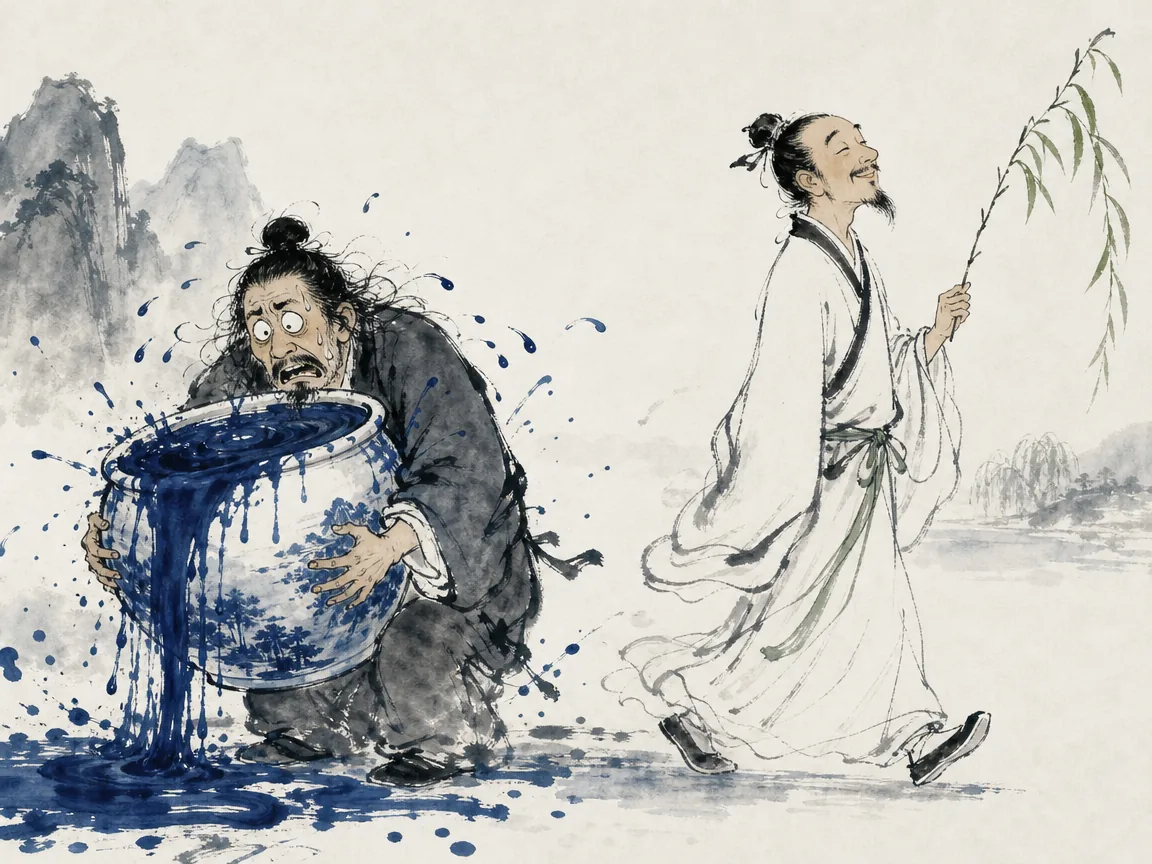
Better to Stop Than Fill to the Brim (Chí Ér Yíng Zhī, Bù Rú Qí Yǐ, 持而盈之,不如其已) — Fullness Has a Breaking Point
The opening line of Daodejing Chapter 9 states: "Holding and filling beyond capacity is worse than knowing when to stop" (Chí ér yíng zhī, bù rú qí yǐ, 持而盈之,不如其已) — holding and filling beyond capacity is worse than knowing when to stop.
The Chinese term for ceasing (yǐ, 已) means to stop or to cease, and traditional commentaries have consistently interpreted it this way. This line is not a condemnation of abundance. It is a warning about overfilling. A cup that is full and then kept pouring into will spill. A system that is at capacity and then pushed further will not grow stronger — it will strain.
In modern life, this appears as the habit of never allowing a phase to close. Work expands until there is no room for rest. Relationships are constantly negotiated, managed, and intensified until there is no breathing space. The inner life is scheduled so tightly that even reflection feels like another task. People confuse fullness with fulfillment, assuming that if something is packed, it must be meaningful. But a completely full vessel has no room to receive, no room to adjust, and no room to recover.
Practical angle: Look at where you are currently overfilling. Is it your calendar? Your inbox? Your sense of obligation to others? Your conviction that you must always be productive? Laozi does not ask you to do less because less is noble. He asks you to stop because exceeding your carrying capacity produces collapse, not growth.
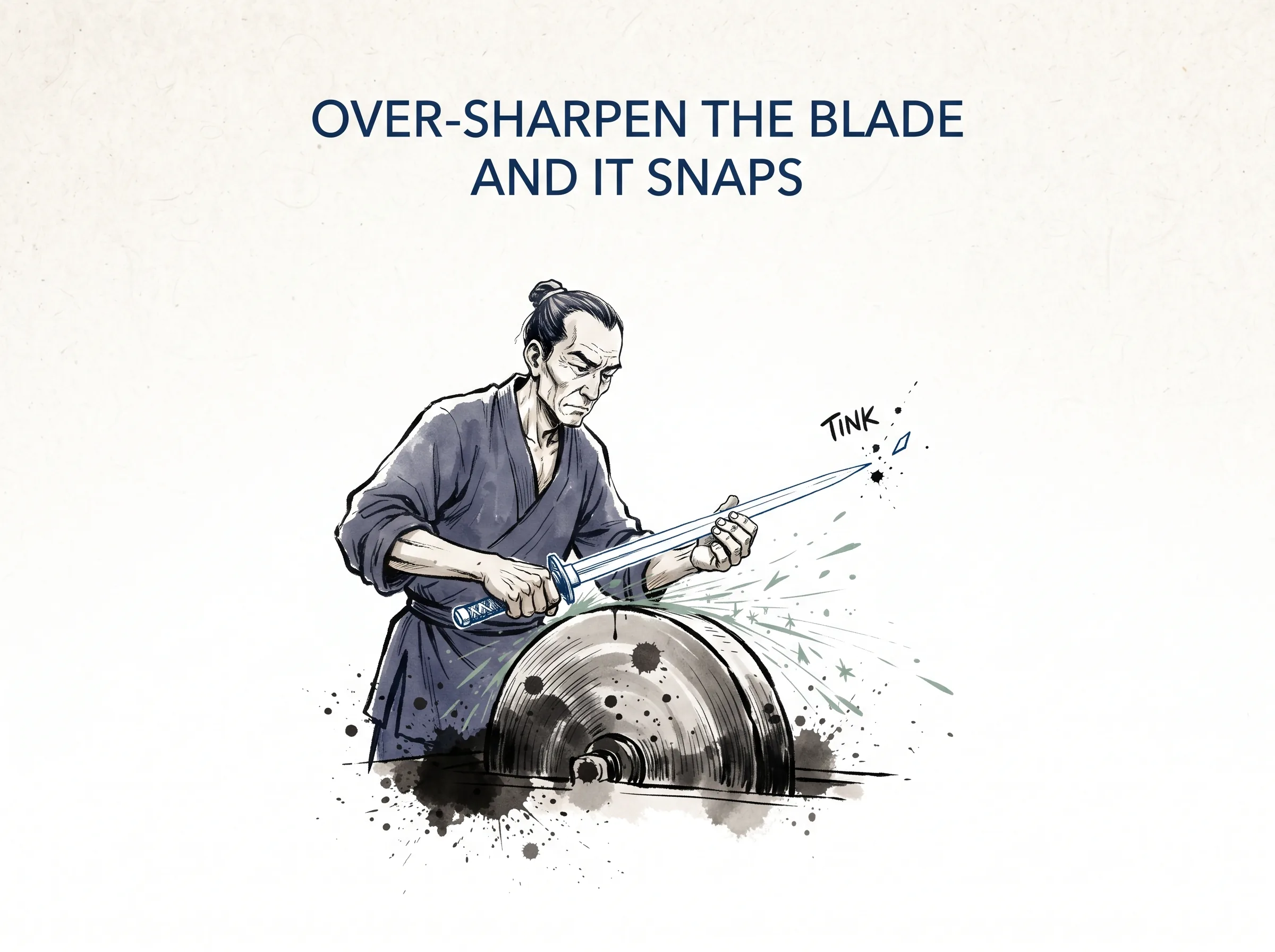
Extreme Sharpness Cannot Be Kept (Chuāi Ér Ruì Zhī, Bù Kě Cháng Bǎo, 揣而锐之,不可长保) — Sharpness Wears Itself Down
The second line reads: "Sharpening an edge to the limit cannot long be preserved" (Chuāi ér ruì zhī, bù kě cháng bǎo, 揣而锐之,不可长保) — constantly sharpening and exposing one's edge cannot be maintained over time.
Note that the standard received text uses to hone (chuāi, 揣), not to chase (zhuī, 追). This wording appears in authoritative editions of the Laozi, though some versions vary slightly The meaning remains clear: a blade that is continuously ground to an extreme point will chip. A person who must always be sharp, always visible, always proving themselves will eventually exhaust their own spirit.
Laozi is not advising people to become blunt or unremarkable. He is advising them to recognize that constant exposure of one's capabilities is unsustainable. A sword kept perpetually drawn loses its resilience. A person who needs to win every exchange, demonstrate superiority in every room, and remain perpetually "on" burns through their energy faster than they realize. For the word-for-word source text and commentary, consult the complete classical translation and commentary of Holding Back in Equilibrium: Knowing When to Stop and Stepping Away.
Modern culture magnifies this tendency. Social media rewards performative intensity. Competitive environments reward the loudest and the most visible. The result is a kind of spiritual fatigue that looks like success from the outside but feels like depletion from within.
Practical angle: Ask yourself where you are keeping your blade out unnecessarily. Is there a conversation where you could speak less and listen more? A project where your presence does not need to be constantly demonstrated? A relationship where proving your worth is replacing actual connection? Laozi's counsel is simple: true strength includes the discipline of sheathing, not just the power to draw.
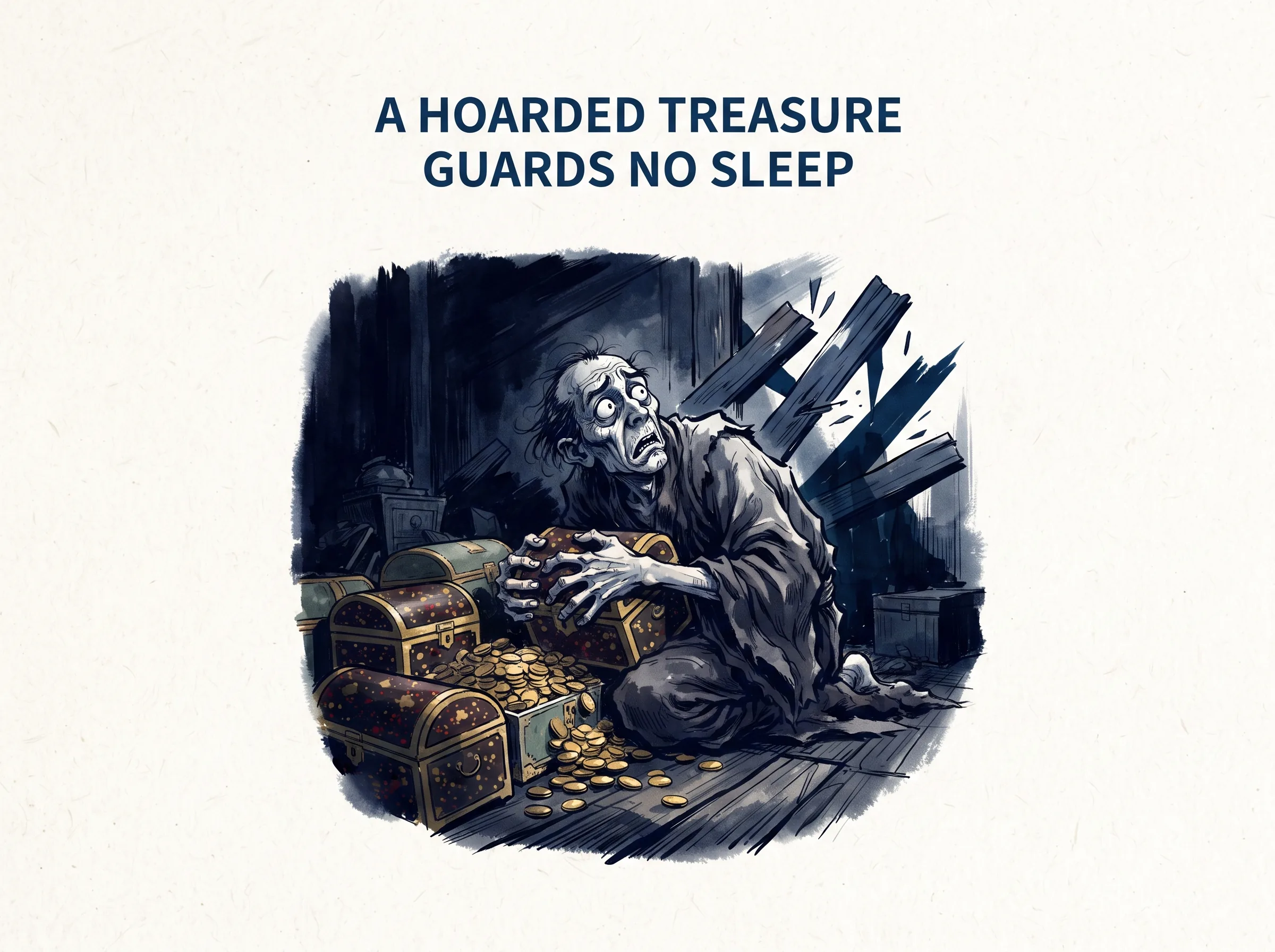
A Hall Full of Gold and Jade Cannot Be Guarded (Jīnyù Mǎntáng, Mò Zhī Néng Shǒu, 金玉满堂,莫之能守) — Possession Can Become a Prison
The third line states: "When gold and jade fill the hall, none can protect it" (Jīnyù mǎntáng, mò zhī néng shǒu, 金玉满堂,莫之能守) — even a house full of gold and jade cannot be permanently guarded.
This line is often misunderstood as anti-wealth. It is not. Laozi is not saying that having resources is wrong. He is saying that external possession without internal order creates anxiety rather than peace. The more you have to protect, the more energy you spend protecting it. The more visible your success, the more eyes turn toward it — and with those eyes come comparison, competition, and the fear of loss.
Having wealth, status, or influence is not the problem. The problem is believing these things can be permanently secured. When people anchor their sense of safety entirely to external conditions, they make themselves vulnerable to every shift in circumstance. Money flows. Titles change. Relationships evolve. Bodies age. Anything built solely on what can be held will eventually face the reality that holding requires more effort than release.
Practical angle: Consider what would happen if your sense of safety came from within rather than from what you own. Laozi's deeper point is that internal order — a calm mind, a steady character, a grounded sense of self — is far more durable than any external accumulation. When the inside is ordered, the outside can change without causing internal collapse.
Arrogance from Wealth and Honor Brings Disaster (Fùguì Ér Jiāo, Zì Yí Qí Jiù, 富贵而骄,自遗其咎) — Arrogance After Success Is Self-Sabotage
The fourth line is perhaps the sharpest in the chapter: "Arrogance brought by wealth and honor invites one's own undoing" (Fùguì ér jiāo, zì yí qí jiù, 富贵而骄,自遗其咎) — wealth and status followed by arrogance bring disaster upon oneself.
Crucially, Laozi does not blame wealth or status alone. He blames arrogance (jiāo, 骄), the attitude that arises when success is mistaken for personal permanence. The text says the trouble is not having, but forgetting how having was achieved. Many who rise to prominence eventually stop noticing the conditions, relationships, luck, and systems that supported their ascent. They begin to believe their position is entirely self-made and therefore irreplaceable. This loss of humility disrupts judgment, damages relationships, and narrows the perspectives that once helped them succeed.
Laozi's warning is counterintuitive: the greatest risks often appear after the greatest victories, not before them. At the bottom, people are cautious. At the top, they can become careless. Success without reflection is the most dangerous form of success because it removes the very checks that kept the person grounded in the first place.
Practical angle: When you have achieved something significant, ask yourself what you might be overlooking. Whose support did you take for granted? What constraints did you previously respect that now feel optional? Where has confidence turned into conviction that you cannot be wrong? Recognizing these patterns is not self-criticism. It is self-preservation.
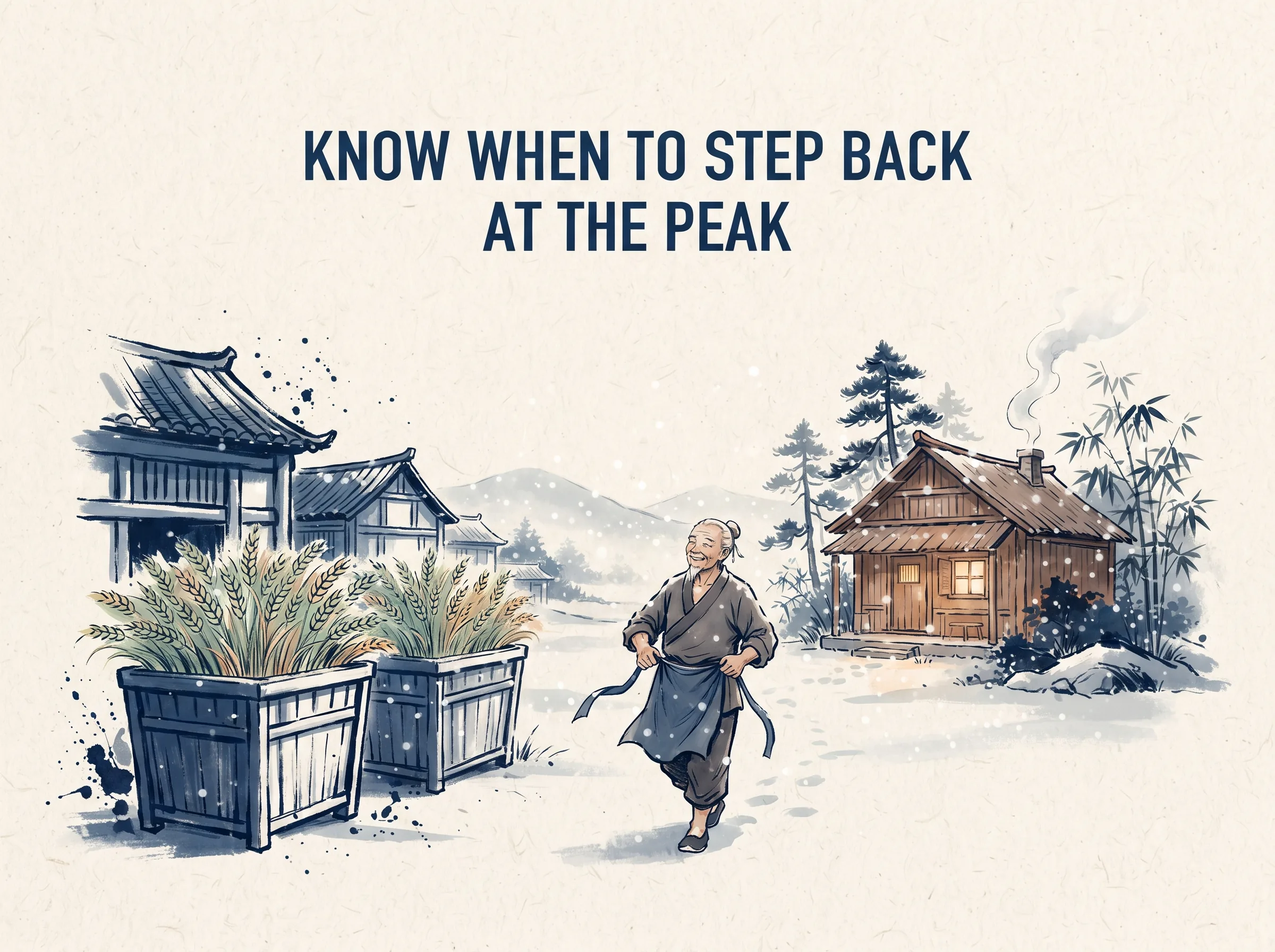
Stepping Back Once the Work Is Done Is the Way of Heaven (Gōng Suì Shēn Tuì, Tiān Zhī Dào, 功遂身退,天之道) — Stepping Back Is Part of the Way
The final line of Chapter 9 reads: "Retiring when work is accomplished is the Way of Heaven" (Gōng suì shēn tuì, tiān zhī dào, 功遂身退,天之道) — when the work is done, stepping back is the way of heaven.
Some editions phrase this as completing the task, achieving fame, and retiring (gōng chéng míng suì shēn tuì, 功成名遂身退), but the essential meaning remains the same across versions This line is frequently misunderstood as advocating retreat or passivity. It is neither. Laozi is describing a natural rhythm: seasons change, rivers flow, and each phase completes itself. Spring does not cling to summer. A task that is finished should not be kept alive out of reluctance to let it go.
The deeper message is that mastery includes knowing when a phase is over. People who cannot finish what they start often do so because they are attached to the identity the unfinished task gives them. People who cannot let go of past achievements do so because they have confused their history with their current capacity. True closure is not defeat. It is the recognition that completion is part of the process, not a failure of ambition.
Practical angle: What role, identity, or achievement are you holding onto that no longer serves you? It might be a title you outgrew, a business model that worked but no longer fits, a version of yourself that was useful at one stage but is now limiting. Laozi would not call this quitting. He would call it aligning with the natural order.
Connection to Chapter 8 — Water as the Model
Chapter 8 of the Laozi opens with one of the most quoted lines in Chinese philosophy: "Highest good is like water" (shàng shàn ruò shuǐ, 上善若水) — the highest good is like water. Water benefits all things without competing, settles in low places that others disdain, and thereby approaches the Dao
Chapter 9 extends this imagery. If water teaches us to begin without forcing, to flow downward rather than upward, to nourish without claiming, then Chapter 9 teaches us what to do after we have flowed: do not force yourself to remain at the highest point. Do not hold on past completion. Let the season change.
These two chapters together form a complete picture. Begin like water — humble, adaptable, uncontentious. End with release — knowing when to let go, when to step back, when to allow the work to complete itself. The Daoist thread runs consistently from non-contention to knowing when to stop.
Why This Matters for Modern Readers
We live in a culture of perpetual optimization. The assumption is that more effort always leads to better results, that rest is a reward earned only after maximum output, and that stopping is equivalent to giving up. Laozi offers a corrective: sustainability over intensity, boundaries over boundlessness, and wisdom over relentless expansion.
The wise person can rise, hold, and release — each in its proper time. This is not passivity. It is strategic clarity. People who understand limits are not weaker than those who ignore them. They are often more durable, because they have not pushed themselves past the point of repair.
What You Can Do Next
- Identify one area where you are currently overfilling — work, relationships, or inner expectations — and ask whether you could leave some space intentionally.
- Notice where you are keeping your "blade" drawn unnecessarily. Practice restraint not as suppression but as preservation.
- Reflect on what you are holding onto that has already completed its role. Completion is not failure.
- When you achieve something significant, pause to acknowledge the conditions that made it possible. Gratitude is the antidote to arrogance.
- Consider what "stepping back" might look like in your current situation. It may not mean leaving everything. It may mean allowing a phase to finish before starting the next one.
FAQ
Q: Does Laozi's teaching mean I should avoid ambition or success? No. Laozi does not oppose achievement. He opposes the habit of pushing success beyond its natural limits and then treating temporary gains as permanent. Success itself is not the problem; refusing to recognize when enough is enough is.
Q: What does stepping back (shēn tuì, 身退) actually mean — is it about quitting or retiring? In traditional interpretation, stepping back (shēn tuì, 身退) does not mean escaping responsibility or giving up entirely. It means not letting completed work define or confine you. It is the ability to finish a phase without being trapped by it, similar to how water flows through a channel without clinging to any particular stretch of it.
Q: How is Laozi's warning about long working hours relevant today? Research from WHO and ILO suggests that working long hours — particularly 55 or more per week — is associated with increased risks of heart disease and stroke compared with standard working hours While Laozi did not write about modern employment, his observation that pushing beyond natural capacity leads to exhaustion and collapse aligns with what contemporary data shows about sustained overwork.
Q: Can knowing when to stop be learned, or is it just intuition? It is a skill that can be developed. Laozi presents it as part of a broader practice of self-awareness — paying attention to where you are in a cycle, recognizing signs of strain, and allowing yourself to adjust before reaching the breaking point. The chapter is an invitation to cultivate that awareness deliberately rather than waiting for collapse to teach the lesson.
Summary
Laozi's ninth chapter is not a manifesto against success. It is a mirror held up to the human tendency to overextend, over-hold, and over-identify with what has been achieved. The exhaustion many high-achievers feel is rarely caused by having too much. It is caused by holding on too tightly to what was once useful, pushing past natural limits, and forgetting that every phase has its end.
The path Laozi points toward is not emptiness but equilibrium. It is the recognition that a full cup spills, a sharpened blade chips, wealth without inner order becomes anxiety, and arrogance after success is the earliest signal of coming imbalance. The highest form of clarity is not relentless expansion. It is the wisdom to know when to stop, when to release, and when to let completed work rest.
If you are feeling the weight of your own achievements, ask yourself not how to push harder but whether you have allowed each accomplishment to complete itself before loading the next one on top. The answer may be simpler than you think.
Discover the historical and philosophical roots in the classical foundation in Caring for Oneself: When People Do Not Fear Coercive Power.
Deepen your understanding of these principles in our reflection on Why Good Things Go Wrong When Pushed Too Far.
Sources & Further Reading
[1] Laozi (Stanford Encyclopedia of Philosophy/Spring 2026 Edition)
[2] Burn-out an "occupational phenomenon" — International Classification of Diseases
[4] Further Reading (not cited as evidence in this article):
[5] Laozi (Dao De Jing), Chapter 8 and Chapter 9 — various translations by D.C. Lau, Arthur Waley, and Roger Ames & David Hall
[6] Traditional commentaries on the Laozi including Wang Bi and Heshang Gong editions
[7] (interpretive commentary; not a primary source)






