
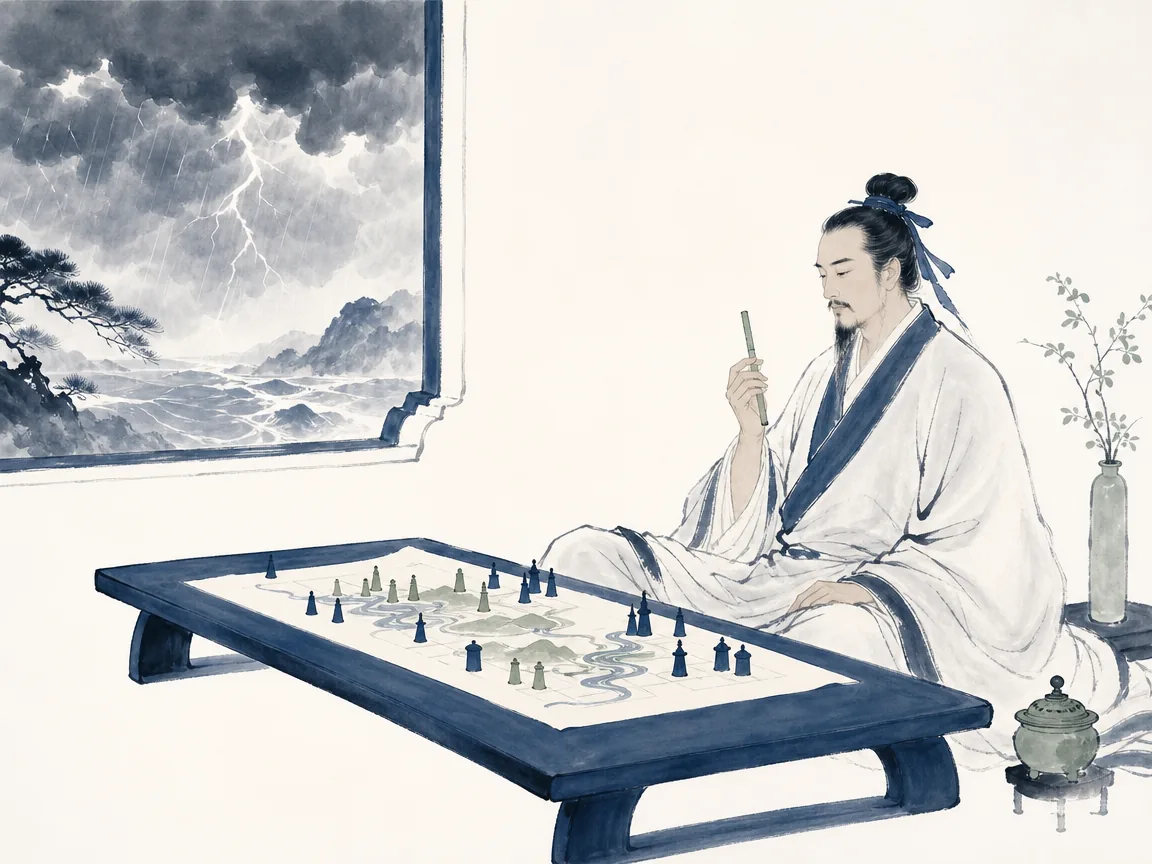
You've felt it: a meeting where you prepare thoroughly, but under pressure you say the wrong thing. A negotiation where hours of strategy dissolve in seconds. A career decision that, in hindsight, seems obvious — but in the moment, felt impossible to get right. We assume that smart, capable people should make better decisions when it matters most. Yet the pattern repeats — not because people lack intelligence, but because intelligence alone does not protect us from the way our minds actually work under stress.
Two and a half millennia ago, an ancient Chinese military strategist observed this same truth and wrote one of the most enduring texts on human decision-making under uncertainty. His advice was not about finding the perfect move in chaos. It was about designing conditions in which chaos could no longer decide for you. The question is not simply how to think better under pressure, but how to engineer your environment so that pressure loses its power to distort judgment—a foundational perspective explored in Sun Tzu Decision Making.
Sun Tzu Decision Making: Why Smart People Make Terrible Decisions
Research consistently shows that acute stress impairs decision-making. A 2024 systematic review of 44 studies found that biological responses to acute stress — particularly activity in the sympathetic-adrenal-medullar (SAM) and hypothalamic-pituitary-adrenal (HPA) axes — predominantly impair several domains of cognitive, motivational, affective, and predictive decision-making [2]. The effects are not uniform across all situations, but the overall direction is clear: under pressure, the human mind does not simply slow down — it changes its operating system in ways that favor pattern-driven shortcuts over deliberate analysis.
This finding aligns with a broader psychological insight: human beings are not stable rational machines. We carry systematic biases — overconfidence, loss aversion, confirmation bias — that surface most powerfully when stress is high and cognitive resources are depleted. Under acute pressure, information processing narrows. The brain prioritizes speed over accuracy, certainty over nuance. The result is that even well-trained, intelligent people can make decisions that seem wildly out of character — the seasoned executive who panics, the calm partner who snaps, the disciplined planner who improvises poorly.
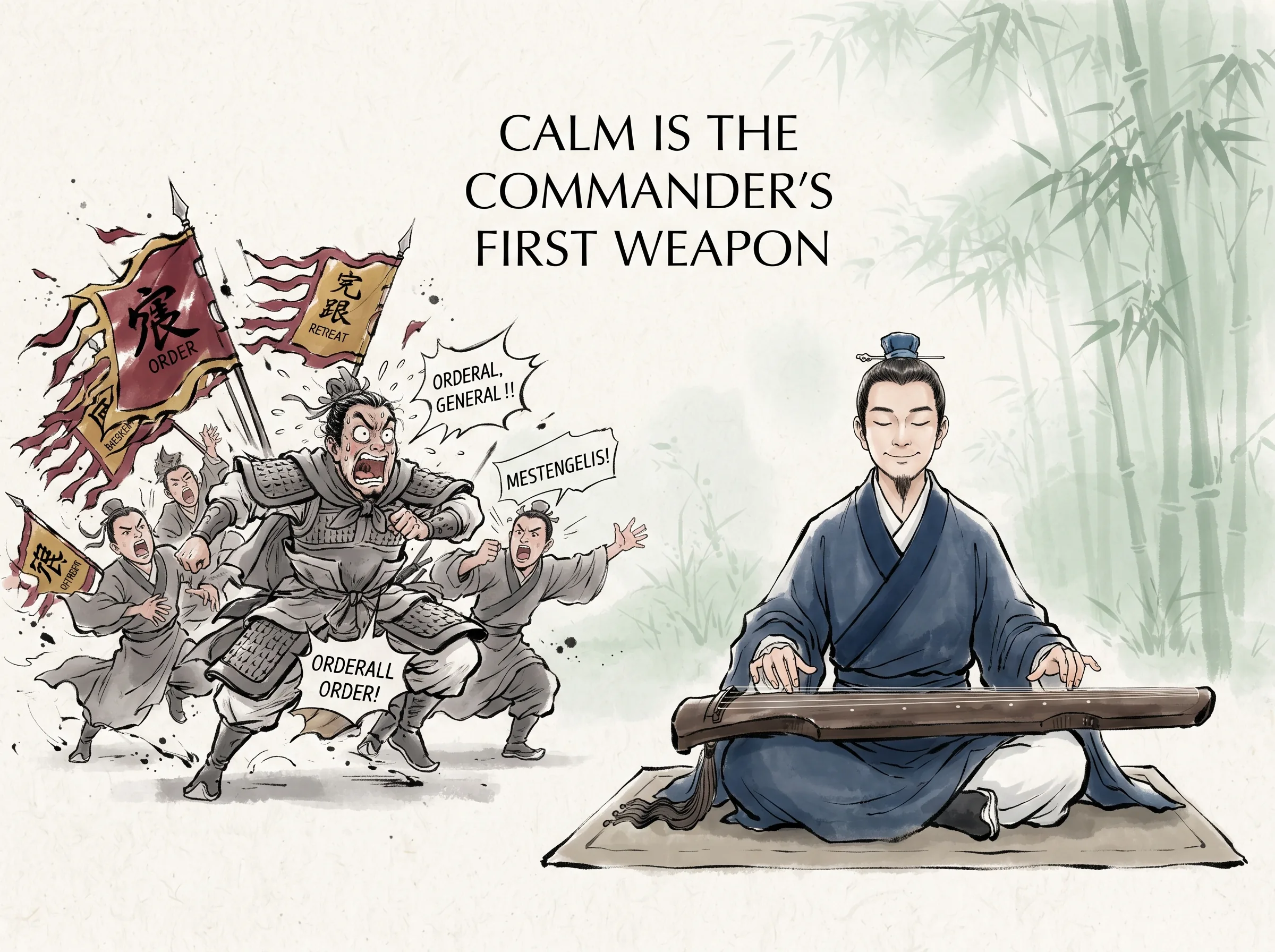
What follows from this is not a message of pessimism but of design. If we cannot count on perfect rationality in the moment of crisis, then the rational response is to stop building systems that require perfect rationality. This is the foundational insight that connects ancient strategic thought to modern decision science.
The Art of Pre-Designing Victory
One of the most frequently cited principles attributed to Sun Tzu is the idea that victory can be made — that success is not stumbled upon in the heat of conflict, but constructed beforehand through preparation and structural advantage. While classical interpretations of this concept vary, the essential idea is straightforward: the person who wins is not necessarily the one who executes the best tactic under pressure, but the one who shapes the conditions so that favorable outcomes become more probable before pressure ever arrives.
This shifts the focus from finding the right answer inside chaos to designing conditions before chaos arrives. In practical terms, it means asking different questions:
- Instead of How do I react to this crisis?, ask What structures could prevent this crisis from derailing me?
- Instead of How do I outperform my competition?, ask What advantages have I built that are independent of anyone else's mistakes?
- Instead of What move will save this situation?, ask What preparation would have made this situation less likely to arise?
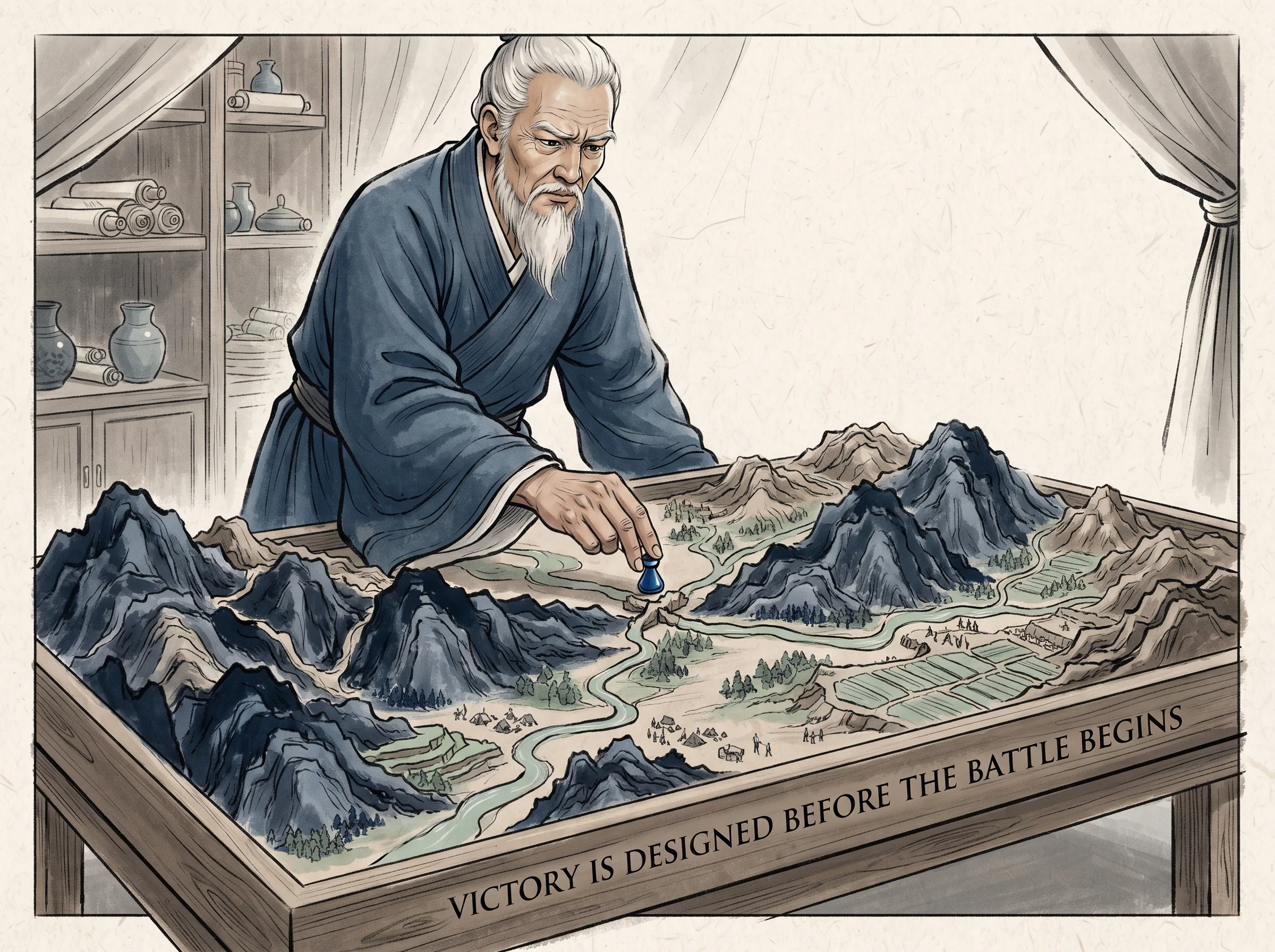
This approach reframes risk management not as insurance against bad luck, but as active engineering of favorable conditions. It is not about being passive or avoidant — it is about being strategically disciplined in the choices you make when nobody is watching and no one is applying pressure.
Knowing Yourself and Knowing the Other
A principle often summarized as "know yourself and know your opponent, and you will never be defeated" appears in classical Chinese strategic thought, though exact wording and chapter attribution across translations vary. What this principle points to is not a slogan, but a method: continuous, structured information-gathering about both your own position and the position of others involved in the interaction.
At a practical level, this involves three layers of reading:
1. Structure. What resources does the other side hold, and how are they organized? In business, this means understanding a competitor's financial position, team strengths, and market positioning. In relationships, it means understanding what each person values, fears, and is willing to compromise on.
2. Intent. Why is this move happening now? What is the other party trying to achieve? Intent is often revealed not in words but in patterns of behavior over time. For the original military treatise and commentary, read the complete strategic translation and classical commentary of Laying Plans: The Five Factors, Temple Calculations, and the Art of Deception.
3. Style. Is the other party aggressive, conservative, impulsive, patient? Style tends to be more revealing than any single action. A person's consistent patterns under pressure are often more informative than their stated positions.
A common modern mistake is to over-invest in internal analysis — studying your own plans, strengths, and weaknesses — while under-investing in understanding the actual behavior and capabilities of others. Knowledge of self without knowledge of context is incomplete. This is where the strategic tradition intersects with a broader theme of self-cultivation: understanding yourself is essential, but it is only the first step toward effective action in the world.
Attacking the Void: Strategic Efficiency Over Brute Force
Classical Chinese strategy also contains a principle commonly expressed as "avoid the solid and attack the void" — do not clash where an opponent is strongest; strike where they are weakest. This is not cowardice. It is the application of a deeper principle found across multiple traditions: the value of doing the minimum necessary at the point of maximum leverage.
In modern life, this translates into a simple but counter-intuitive practice: choose your battles deliberately, rather than fighting every engagement. Many people navigate careers, relationships, and competitions as though every conflict must be met head-on. But strategic efficiency asks: Where does my effort produce the greatest return? Where is my opponent most vulnerable? Where is the resistance weakest?
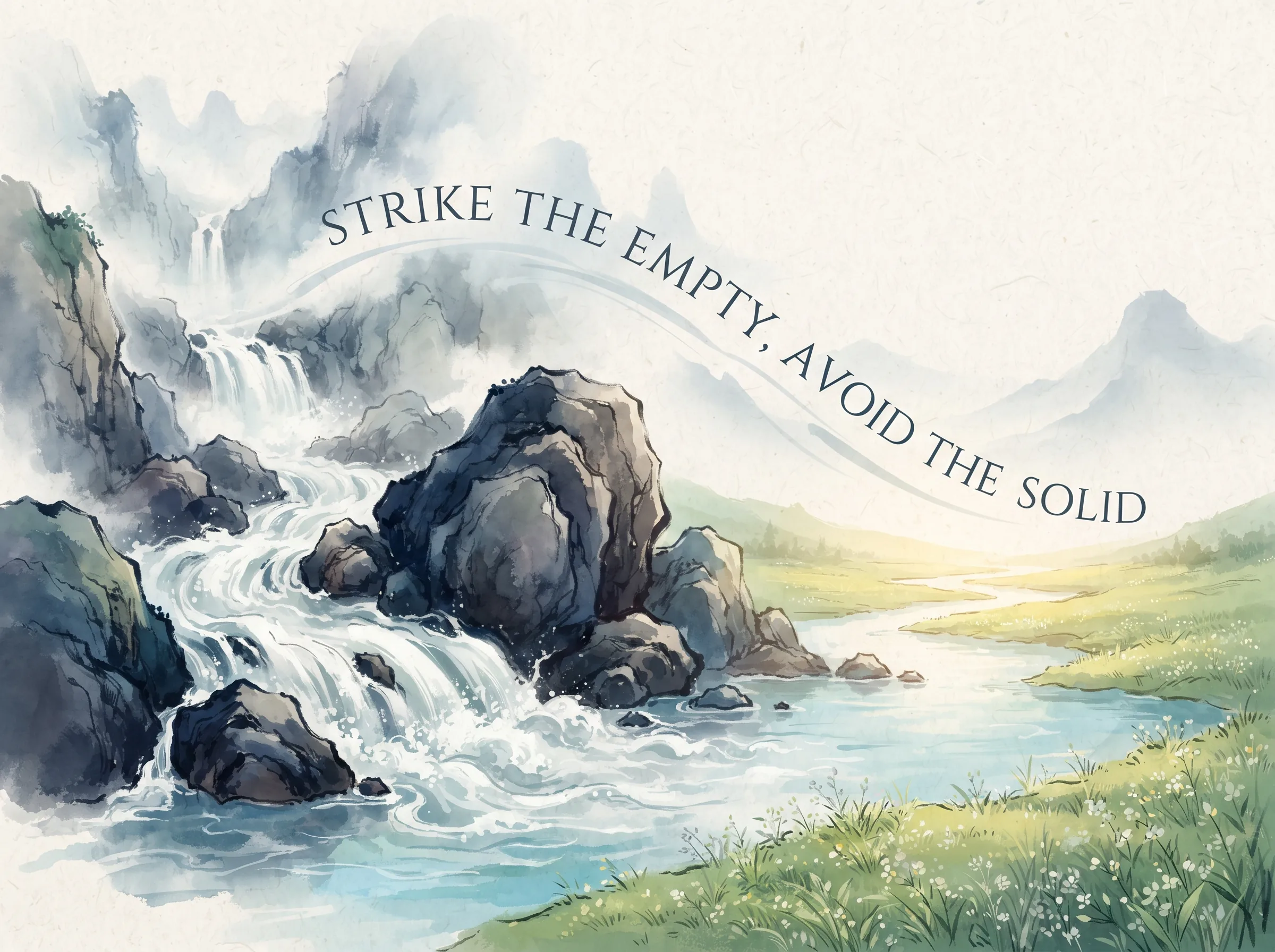
This principle also resonates with the Daoist concept of wu wei (often translated as "effortless action"), which in some interpretations describes action that aligns with natural flows rather than opposing them. Wu wei is not passivity — it is action taken at the most effective point, without unnecessary expenditure of energy. Applied to decision-making, it means: do not waste your strongest resources on problems that do not require them. Protect your capacity for the moments that genuinely matter.
The Rhythm of Decision: Speed Versus Control
There is a common misunderstanding about speed in strategic thinking. A principle sometimes rendered as "speed is essential" is often taken to mean that faster decisions are better decisions. But a closer reading suggests something more nuanced: rhythm control matters more than raw speed.
The question is not whether to move quickly or slowly, but whether the pace you choose serves the overall strategy — or merely your impulse to act. In business, the pressure to "move fast and break things" can produce worse long-term outcomes than deliberate pacing. In relationships, the urgency to resolve conflict immediately can prevent the space needed for genuine understanding. In career decisions, the compulsion to seize every opportunity can blind a person to the cost of scattering attention across too many fronts.
The disciplined approach asks: Is my current pace serving the larger structure I am building, or is it driven by anxiety, external pressure, or the reflex to be seen as active? Knowing when to accelerate and when to hold back is often a more valuable skill than knowing how to act quickly.
Alignment: Why Shared Purpose Wins
Another principle attributed to classical Chinese strategy — sometimes rendered as "those whose people share the same purpose will prevail" — points to a reality that applies well beyond the battlefield. In any multi-person system — a business, a partnership, a family — individual brilliance cannot compensate for misalignment. When people pull in different directions, even locally optimal decisions can produce collectively suboptimal outcomes.
This idea appears in various forms across philosophical traditions. In some interpretations of Confucian thought, harmony and collective responsibility are valued not as constraints on individual agency, but as conditions that make effective collective action possible. The warning is straightforward: a team in which every member optimizes for themselves may still lose, because local rationality does not automatically produce global success.
In practice, alignment means ensuring that the people working toward a shared goal understand not just what they are doing, but why they are doing it together — and that the systems and routines in place make cooperation easier than competition.
A Practical Framework for Modern Decision-Making
Putting these principles together, here is a framework you can apply to your own decisions — whether in business, relationships, or personal goals:
- Information is always incomplete. Gather continuously, but do not wait for certainty before acting.
- Multiple actors interact dynamically. Plan for complexity, not perfection. Expect that your decisions will trigger responses.
- Decisions unfold over time. Design favorable conditions in advance, so that future choices have more options available to them.
- Collaboration matters more than solo heroism. Align with the people around you — teammates, partners, colleagues — before the moment of crisis arrives.
- Rhythm beats raw speed. Control the tempo of your actions, and let pace serve strategy rather than impulse.
- Protect your downside first. Establish a floor beneath which failure cannot go, before pursuing upside.
The goal is not to become the person who makes the perfect last move under pressure. It is to become the person who designs the game so that perfect moves are no longer necessary — because the conditions for success were created long before the moment of truth arrived.
FAQ
Is this advice only relevant to competitive or high-stakes situations? No. The principles apply wherever decisions are made under uncertainty — which includes almost every meaningful area of life. Career transitions, relationship decisions, financial planning, and personal goals all involve incomplete information, multiple actors, and time pressure.
Does this mean we should avoid taking bold actions? Not at all. The framework is about timing and preparation, not caution for its own sake. Acting boldly after careful structural preparation is different from acting impulsively under pressure. The distinction lies in whether the boldness is part of a designed strategy or a reaction to stress.
Can these principles be applied without studying ancient texts? Yes. The value of classical strategic thought is not in memorizing passages but in recognizing that the problems it addresses — uncertainty, limited rationality, the dynamics of competition and cooperation — are enduring features of human experience. The principles can be practiced independently of any scholarly engagement with the sources.
How do I know when I am relying on luck versus engineering my own outcomes? A useful test: if your success depends primarily on external factors you cannot control (market shifts, other people's mistakes, fortunate timing), you are leaning on luck. If you can articulate the structures, preparations, and alignments you have built that make favorable outcomes more probable regardless of chance, you are engineering your position.
Summary
Smart people do not make terrible decisions because they lack intelligence. They make poor decisions because pressure activates patterns of thinking that no amount of raw cognition can override. The ancient strategic tradition addressed this insight directly: human judgment is unreliable under stress, so the wise approach is not to hope for better judgment in the moment, but to design structures in which better outcomes emerge naturally.
The practical takeaway is simple but demanding: invest more time in pre-designing favorable conditions than in hoping for brilliance under pressure. Gather information continuously. Understand both yourself and the context around you. Choose battles where your advantage is greatest. Control rhythm rather than racing ahead. Align with the people you work with. And always, first, protect your downside.
If you want to explore how these principles apply to a specific area of your life — a career decision, a business challenge, or a personal goal — consider starting with one question: What conditions can I shape today that will make tomorrow's decisions easier? This is the lasting lesson of Sun Tzu Decision Making.
To explore these themes from another angle, read our related reflection on The Smartest Strike Carries No Force: What Sun Tzu’s Fire Attack Teaches Modern Decision-Making.
For a deeper comparative examination of these ideas, explore our related study on Shaping the Battlefield: How Ancient Chinese Strategy Teaches You to Design Your Competitor’s Choices.
Sources & Further Reading
[1] Heightened SAM- and HPA-axis activity during acute stress impairs decision-making: A systematic review on underlying neuropharmacological mechanisms – PMC — 2024 systematic review of 44 studies on how acute stress affects decision-making across multiple domains.
Further Reading
- Daniel Kahneman, Thinking, Fast and Slow — exploration of the two systems of thinking and the cognitive biases that shape human judgment.
- Classical Chinese strategic texts, including Sun Tzu's Art of War and related commentaries — primary sources for the strategic principles discussed in this article.
- Research on stress and cognitive performance in psychology and neuroscience literature — supplementary evidence on the effects of acute stress on decision-making.






