
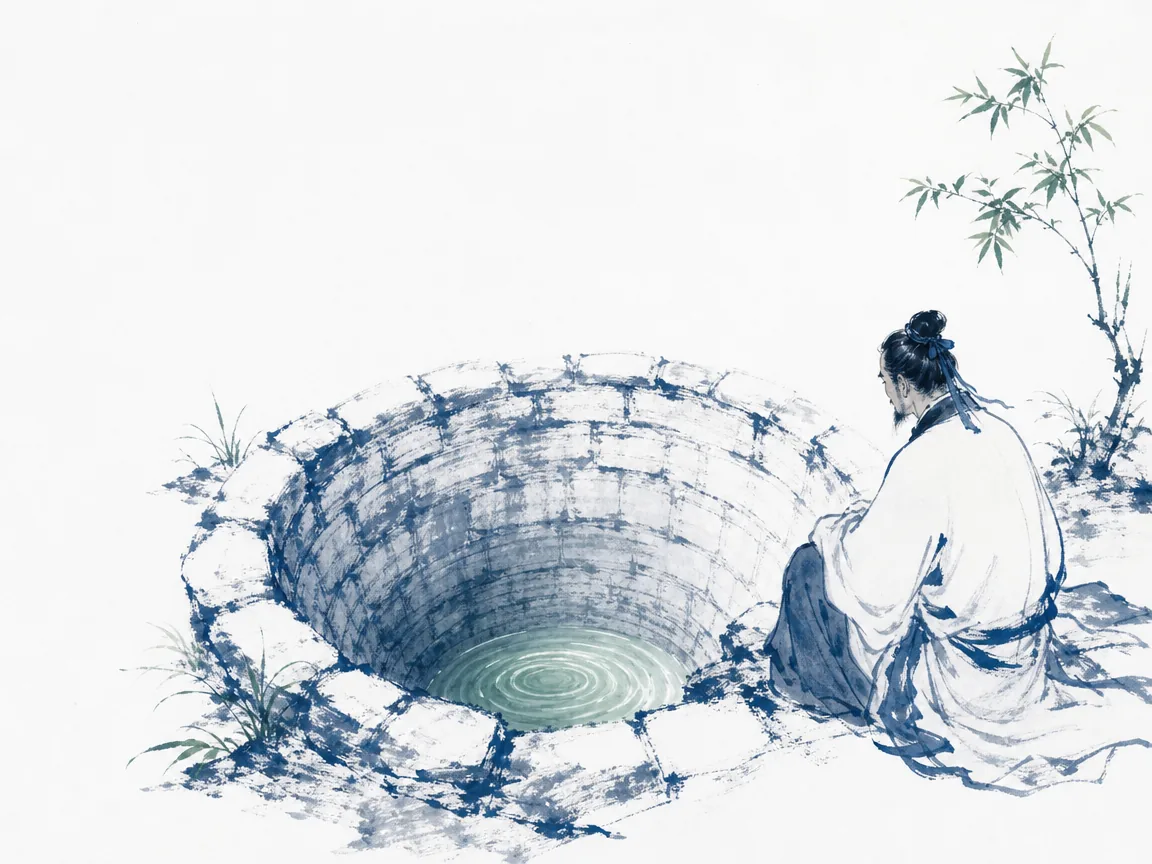
We live in a culture that rewards fullness. Fill your schedule. Fill your followers. Fill your résumé with achievements, your mind with opinions, your identity with credentials. The message is constant: you are only as valuable as what you have accumulated. And yet, for all this accumulation, many people feel increasingly hollow — not because they lack, but because they are packed so tightly with noise, comparison, and performative effort that there is no room for anything real to settle.
Laozi, the traditionally attributed author of the Tao Te Ching, offered a different vision more than two thousand years ago. In Daodejing Chapter 4, he writes: “The Dao is empty, But when using it, it is impossible to use it up. It is profound, and seems like the root of the myriad things. Blunts its own sharpness. Unravels its own fetters. Harmonises its own light. Mixes with its own dust. Profound is it, as though it were present. I do not know whose son it is, Maybe it was already created before the creator” This passage has been read in many ways across centuries — as cosmology, as governance advice, as ethical guidance — but it also contains a striking observation about where real strength comes from. Not from filling yourself up. From cultivating inner depth.
Scholars note that the text operates on multiple levels simultaneously — cosmological, ethical, political, and personal — and reducing it to any single frame misses its breadth. Still, the chapter offers a quiet counterpoint to a world that equates visibility with value and busyness with meaning.
Daodejing Chapter 4: Why Modern Life Feels So Exhausting
What the ancient text describes as the empty Dao (Dào Chōng, 道冲) — the Dao as hollow, as a vessel whose usefulness lies precisely in its emptiness — finds an eerie parallel in contemporary experience. Research on information overload confirms what many already feel: the constant influx of messages, notifications, opinions, and competing demands is associated with stress, fatigue, burnout, and impaired decision-making. The World Health Organization has formally classified burnout as an occupational phenomenon resulting from chronic workplace stress that has not been successfully managed, noting that the colloquial use of the term now extends well beyond clinical contexts. The feeling is recognizable even if the diagnosis is specific.
The metaphor of the full cup, often attributed to Zen but rooted in much older Chinese thought, captures the problem simply. When a cup is already filled to the brim, nothing more can enter. The same applies to attention, energy, and inner space. Modern life saturates both. Algorithms feed us content we did not ask for. Social comparison operates at scale. The pressure to self-brand, to perform productivity, to never appear idle — all of it fills the container until there is no room left for reflection, for patience, for the kind of quiet that allows genuine understanding to take root.
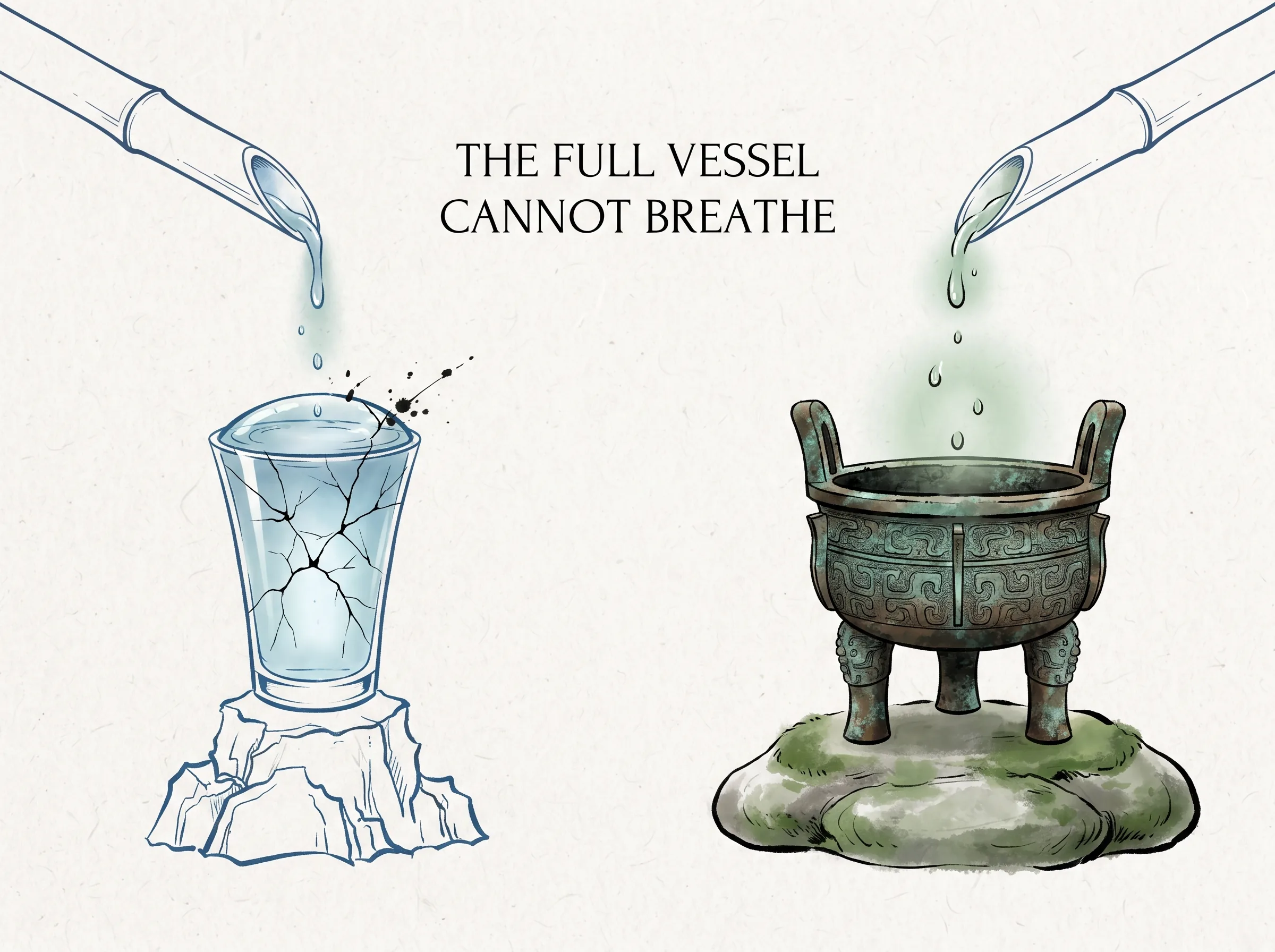
People who accumulate the most external markers of success often report the deepest sense of interior emptiness. This is not a moral failure. It is a structural one. A container that is always full cannot receive. A mind that is always occupied cannot think. The Dao, as Daodejing Chapter 4 describes it, gains its capacity to serve precisely because it is not already occupied by something else. Its emptiness is not a lack — it is a condition of possibility.
Profound Like the Ancestor of All Things (Yuān Xī Shì Wànwù Zhī Zōng, 渊兮似万物之宗): The Depth That Holds Everything
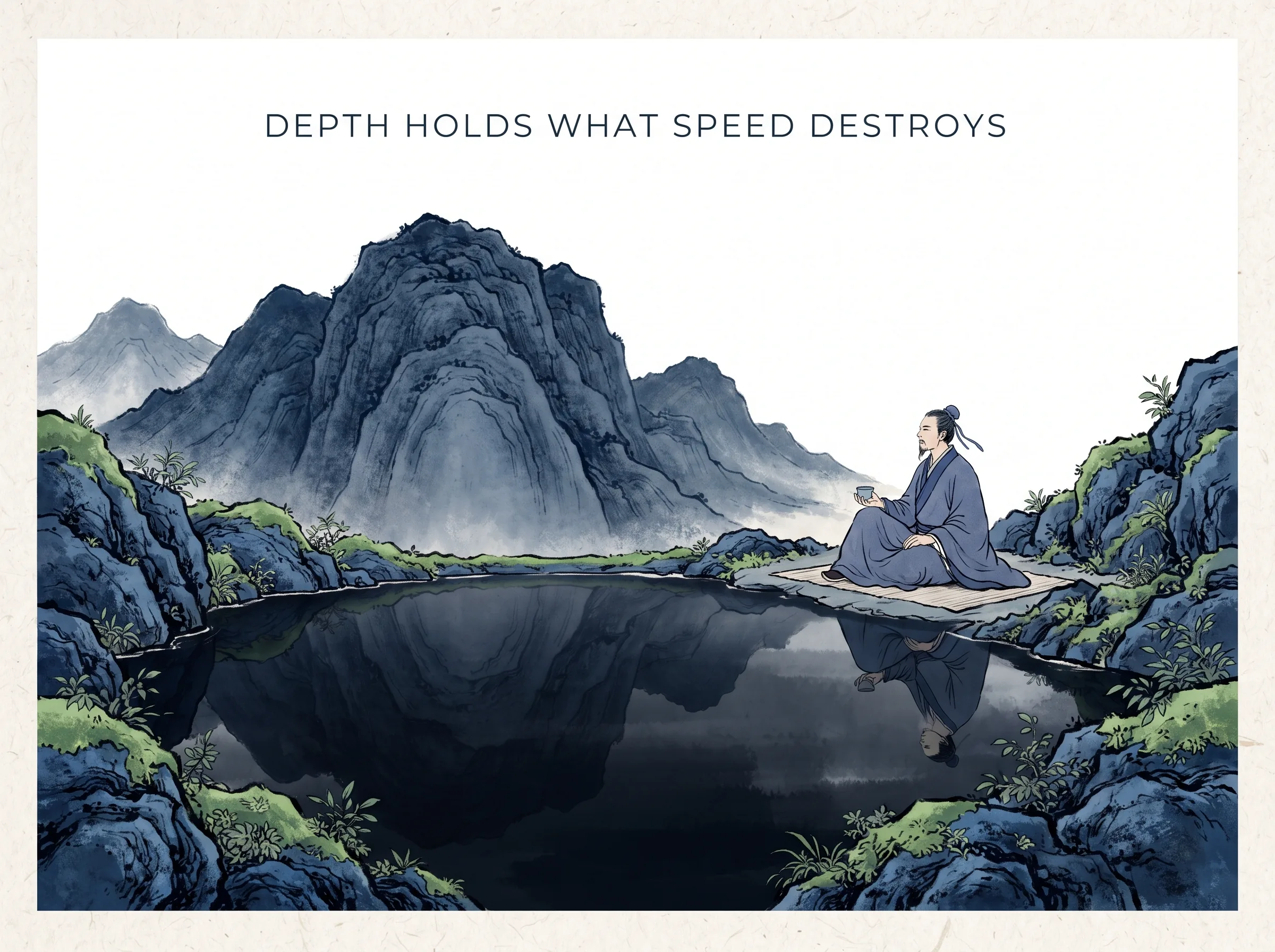
Laozi uses the image of the profound abyss (yuān, 渊) — an abyss, a deep pool — to describe the Dao. “It is profound, and seems like the root of the myriad things”. This is not a shallow body of water that ripples at the first breath of wind. It is something far deeper, something whose stability does not depend on surface conditions.
The metaphor extends naturally. Shallow water is easily disturbed. A gust of wind, a thrown stone, a passing shadow — and the surface is chaos. Deep water, by contrast, remains still even when the surface above it is turbulent. Its depth is invisible from the outside. What determines its calm is not what happens on top but what lies beneath.
Anxiety, in this frame, often arises not from external events themselves but from an unstable inner foundation. When a person’s sense of self rests on external validation — praise, metrics, comparisons, the approval of others — then every external shift becomes a threat. But when there is something deeper, something that does not depend on the weather of opinion, a different kind of stability becomes possible.
The question this raises is not whether you should abandon ambition or achievement. It is whether your inner root is made of something that can hold weight, or whether it is built on the surface alone.
Four Instructions for Cultivating Inner Strength
Chapter 4 contains four concise phrases that have been interpreted across traditions as guidance for personal cultivation. While scholars emphasize that the Tao Te Ching as a whole encompasses cosmology, ethics, governance, and self-cultivation simultaneously, these four instructions have a long interpretive history as practical guidance. Below is one reading that connects them to the modern condition without claiming they are the only possible interpretation.
Blunt the Sharpness (Cuò Qí Ruì, 挫其锐)
Sharpness is not inherently bad. A blade that is sharp can cut with precision. But a blade that is constantly extended, constantly ready to wound and be wounded, becomes exhausting — both for the holder and for everyone nearby. The modern self is trained to be sharp: to have the hottest take, the fastest rebuttal, the clearest position. Confidence is often performative aggression.
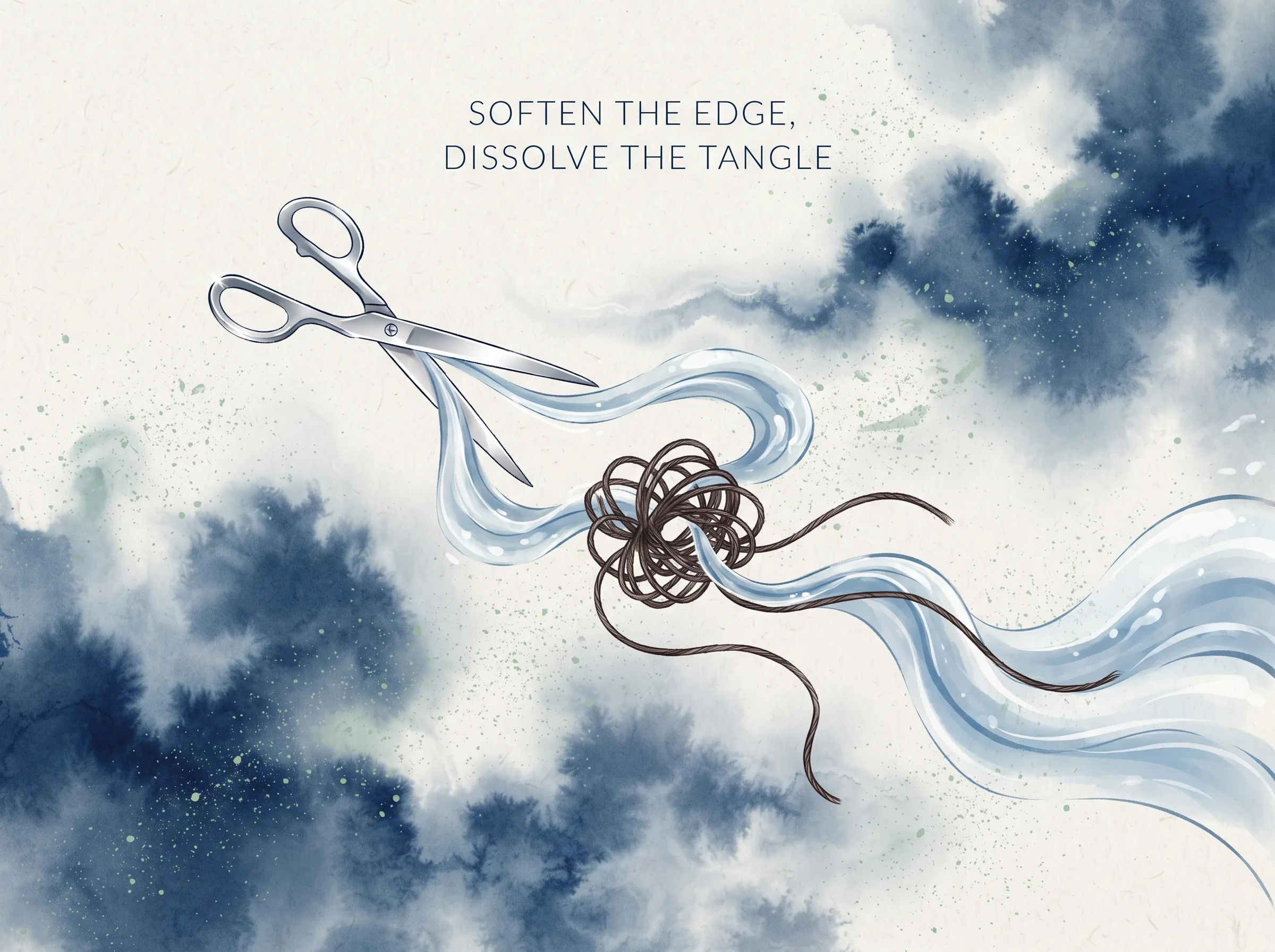
Blunting the sharpness (cuò qí ruì, 挫其锐) does not mean becoming blunt or losing your edge. It means recognizing when sharpness serves you and when it serves only your need to be right, to win, to dominate a conversation. A person who corrects everyone in meetings may appear impressive in the short term. Over time, that same behavior erodes trust and isolates. True precision does not need to announce itself at every opportunity.
Untangle the Knots (Jiě Qí Fēn, 解其纷)
The term entanglement (fēn, 纷) describes tangled disorder — threads pulled in every direction, a web that binds rather than connects. The modern mind is perhaps the most tangled in human history. Notifications, obligations, opinions, FOMO, the endless scroll — none of these are necessarily harmful in isolation. Together, they form a knot that no amount of productivity hacks can fully resolve, because the problem is not that you are doing too little but that your attention is scattered across too many fronts simultaneously. For the word-for-word source text and commentary, consult the complete classical translation and commentary of The Sourceless Origin: The Inexhaustible Depth of the Void.
Untangling the knots (jiě qí fēn, 解其纷) is the practice of loosening those knots. It is not about adding another system to your life. It is about discerning which threads to release. What would your attention look like if you stopped letting everything pull at you at once? The answer to that question may be simpler than you expect.
Soften Your Light (Hé Qí Guāng, 和其光)
Light (guāng, 光) represents talent, brilliance, visibility, success. Having light is not the problem. The problem arises when that light becomes blinding. There is a difference between illumination that warms and illumination that scorches. A person whose excellence makes others feel small is not practicing wisdom; they are practicing performance.
Softening your light (hé qí guāng, 和其光) means tempering that light so it does not overwhelm. It is the difference between a flashlight pointed directly in someone’s face and a lamp that illuminates a room without forcing anyone to squint. Mature presence does not demand attention. It earns trust by making others feel seen rather than diminished.
Merge with the Dust (Tóng Qí Chén, 同其尘)
This phrase is among the most discussed in the entire canon. Dust (chén, 尘) represents the ordinary, the mundane, the messy reality of daily life. Some readers interpret merging with the dust (tóng qí chén, 同其尘) as compromise or conformity, as lowering one’s standards to fit in. But a closer reading suggests the opposite: the person of depth does not flee from ordinary life into some elevated spiritual zone. They enter it fully, without being consumed by it.
A person who only exists in ideals has no real strength, because ideals tested only in theory are untested in practice. True cultivation happens in the friction of real life — in difficult conversations, in routine responsibilities, in the spaces between what you believe and what you actually do. The measure is not whether you can stay pure in isolation but whether you can remain grounded while fully engaged with an imperfect world.
Deep and Clear as if Enduring (Zhàn Xī Shì Huò Cún, 湛兮似或存): Profound Yet Nearly Invisible
After the four instructions, Chapter 4 returns to describing the Dao: “Profound is it, as though it were present” The Chinese term for deep clarity (zhàn, 湛) suggests clarity, depth, stillness — qualities that are barely perceptible. The Dao, in this image, is not dramatic. It does not announce itself. It operates below the surface, like roots beneath soil or currents beneath still water.
This stands in quiet contrast to a culture that equates presence with visibility. Social media rewards those who perform depth rather than cultivate it. The person who brands themselves as awake, as enlightened, as spiritually advanced often reveals, by that very branding, that they have not yet settled into what they claim to have found. Genuine depth does not need to prove itself. It simply is — and its effects become visible over time, in how a person holds themselves under pressure, in how they respond when no one is watching, in the steadiness that others notice without being able to name.
Beyond External Authority: Preceding the Supreme Ruler (Xiàng Dì Zhī Xiān, 象帝之先)
The final lines of Chapter 4 are perhaps the most philosophically striking: “I do not know whose son it is, Maybe it was already created before the creator”. The term for supreme ruler or sovereign (dì, 帝) has been interpreted variously across scholarly traditions — as a supreme deity, as a cosmic principle, as a symbol of ultimate authority. The precise meaning remains a matter of ongoing discussion among specialists.
What the phrase does clearly is point to something prior to every external standard. Every system of value — success metrics, cultural definitions of worth, algorithms that determine what we see and what we want — is constructed. None of them is fundamental. Laozi invites the reader to notice that the ground beneath all these constructed standards is deeper than the standards themselves.
This is liberating precisely because it is disorienting at first. If your worth is not defined by external measurement, then you are no longer playing someone else’s game. You can still participate in the world — work, earn, compete, achieve — but you are no longer required to treat those things as the ultimate source of meaning. They are instruments, not foundations.
Practical Steps: From Reading to Practice
The ideas in Chapter 4 are not abstract. They point toward a way of living. Here are three concrete practices you can begin today:
Daily attention audit. Once per day, ask yourself: what am I absorbing that I do not need? This is not about eliminating information but about discernment. Which notifications, conversations, or content streams add to your life versus draining it? One small reduction per day is more sustainable than a dramatic overhaul.
The five-minute silence. Before checking your phone in the morning, sit quietly for five minutes. Do not meditate in any formal sense. Simply sit. Notice what arises without reacting to it. This practice builds the inner spacing that Laozi describes — the hollow center that can receive without being overwhelmed.
Restraining sharp edges (fēngmáng shōushù, 锋芒收束) exercise. Once per week, review a recent interaction where you felt the urge to be sharp — to correct, to dominate, to prove. Ask yourself: was precision needed, or was ego? This is not about becoming passive. It is about distinguishing between the two.
FAQ
Is Laozi saying we should avoid ambition and achievement altogether?
No. Laozi does not advocate for laziness or withdrawal from the world. He challenges the assumption that accumulation equals strength. Achievement can be meaningful, but when it becomes the sole basis of self-worth, it creates fragility. The point is not to stop achieving but to root yourself in something deeper than achievement itself.
Does Chapter 4 only apply to spiritual or philosophical people?
The principles in this chapter are not limited to any particular worldview. Whether you approach them from a secular, spiritual, or religious perspective, the core observation — that inner emptiness can be a source of strength rather than a deficiency — is widely applicable. What matters is how you live, not what label you attach to your practice.
Can the concepts in this chapter really help with burnout and stress?
While the WHO defines burnout specifically as an occupational phenomenon linked to chronic workplace stress, the broader patterns described in Chapter 4 — information saturation, performative pressure, scattered attention — align with what many people experience as exhaustion in contemporary life. Research on information overload supports the connection between constant input and cognitive fatigue. Whether you frame Laozi’s teaching as philosophy, psychology, or practical wisdom, the underlying mechanism is the same: reducing what fills you creates space for what sustains you.
Is merging with the dust (tóng qí chén, 同其尘) the same as conforming to society or losing your principles?
Not necessarily. Merging with the dust (tóng qí chén, 同其尘) is commonly understood as entering ordinary life without being consumed by it — engaging with the world while maintaining inner stability. Conforming implies surrendering your values to fit in. Merging with the dust (tóng qí chén, 同其尘), read in context, suggests the opposite: holding your depth while participating fully in an imperfect world. The distinction matters.
Closing
Laozi’s Chapter 4 does not offer a quick fix. It offers something rarer — a way of standing in the world that does not depend on the world’s approval. In an age that rewards constant achievement and relentless self-promotion, the idea that the greatest strength lies in emptiness may feel counterintuitive. But the alternative is clear: a life lived as a container that is always full, always performing, always one step away from collapse.
The path forward is not to become less capable, less visible, or less engaged. It is to cultivate an inner depth that no external event can fill or drain. Start small. Reduce one distraction. Sit in silence for five minutes. Notice when your sharpness serves you and when it serves only your anxiety. These are not grand gestures. They are the work of a lifetime, done one day at a time.
If this resonated with you, consider exploring how other chapters of the Tao Te Ching speak to modern concerns — particularly Chapters 8, 11, and 22, which continue the theme of strength through softness and power through emptiness. The full text is widely available in translation, and reading it slowly, rather than consuming it quickly, is perhaps the best way to let its wisdom settle.
Discover the historical and philosophical roots in the classical foundation in Pure Virtue: The Ancient Masters Who Fostered Genuine Simplicity.
For a deeper comparative examination of these ideas, explore our related study on Why Lasting Power Never Needs Constant Force — Laozi’s Lesson for Modern Exhaustion.
Sources & Further Reading
[1] Tao Te Ching – Wikisource, the free online library
[2] Laozi (Stanford Encyclopedia of Philosophy)
[3] Dealing with information overload: a comprehensive review – PMC
[4] Burn-out an occupational phenomenon – WHO
[5] Further Reading (not cited as evidence in this article):
[6] Legge, James. The Chinese Classics: With a Translation, Critic and Exegetical Notes, Prefaces, and Introductory Matter. (Classic English translation of the Tao Te Ching and other Confucian classics.)
[7] Henricks, Robert G. Lao Tzu: The Tao Te Ching. (Scholarly translation with detailed commentary.)
[8] Le Guin, Ursula K. The Tao Te Ching: A New Translation. (Literary rendering emphasizing accessibility and poetic clarity.)
Prefer the complete edition?
Read the full text in a beautifully designed bilingual digital edition.






