
巧用章第二十七
Key Takeaway: "A good traveler leaves no tracks; a good speaker makes no slips; a good counter needs no tally." — Laozi, Daodejing Chapter 27
Good traveling leaves no tracks; good speech makes no flaws; good locking requires no bolts yet cannot be opened. The sage constantly excels at redeeming people, discarding nothing—a foundational perspective explored in Daodejing Chapter 27 Translation.
Daodejing Chapter 27 Translation: The Art of Not Abandoning a Single Being
The wisdom of Daodejing Chapter 27 Translation addresses a fundamental human dynamic: how we navigate ambition, quietude, and the natural flow of existence. In the classical tradition, this passage serves as both a metaphysical mirror and a practical compass for daily living and leadership. Explore how this principle translates into contemporary daily life in our guide to How to Stop Deciding Who Is Useful and Who Is Not — Laozi on True Judgment.
By shifting our focus from outer coercion to internal stillness, we uncover a more resilient way of relating to ourselves and the world around us.
Complete Chapter Translation: Modern Western Reading
Perfect activity leaves no track behind it; Perfect speech is like a jade-worker whose tool leaves no mark. The perfect reckoner needs no counting-slips; The perfect door has neither bolt nor bar, Yet cannot be opened.
The perfect knot needs neither rope nor twine, Yet cannot be united. Therefore the Sage Is all the time in the most perfect way helping men, He certainly does not turn his back on men; Is all the time in the most perfect way helping creatures, He certainly does not turn his back on creatures.
This is called resorting to the Light. Truly, “the perfect man is the teacher of the imperfect; But the imperfect is the stock-in-trade of the perfect man”. He who does not respect his teacher, He who does not take care of his stock-in-trade, Much learning through he may possess, is far astray.
This is the essential secret.
道德经中文原文与对照
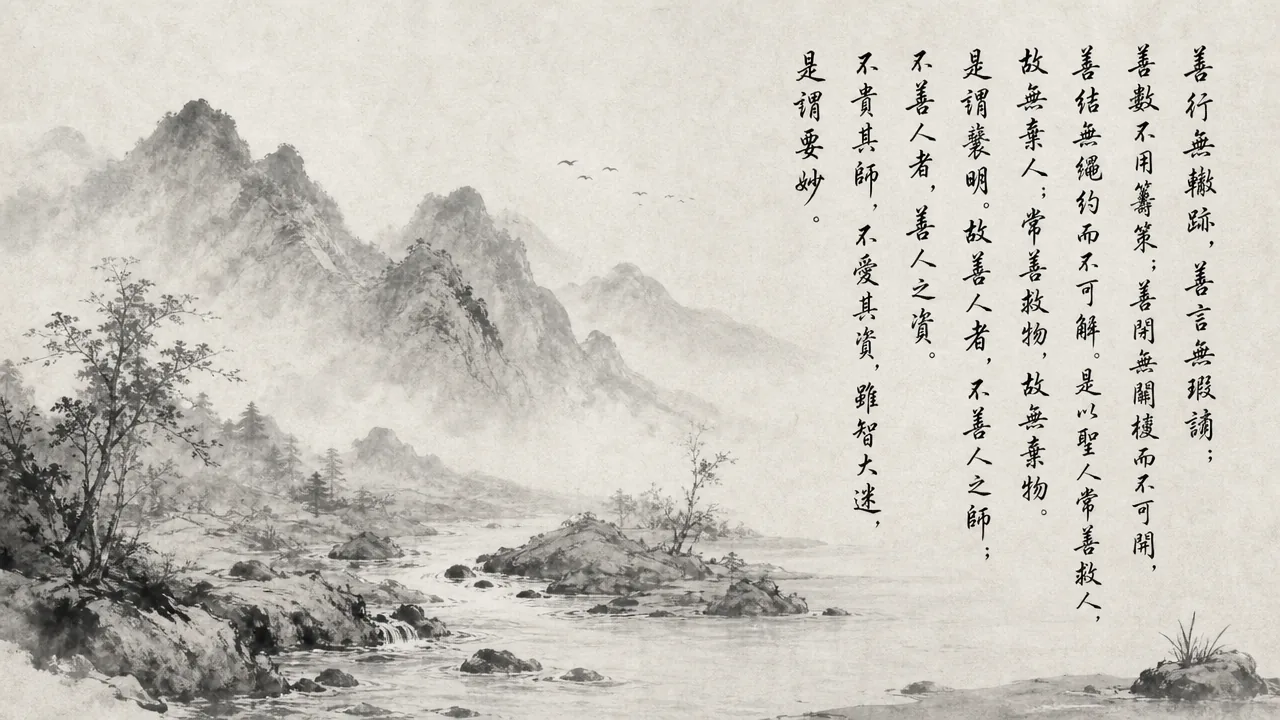
【原文】 善行無轍跡,善言無瑕謫;善數不用籌策;善閉無關楗而不可開,善結無繩約而不可解。是以聖人常善救人,故無棄人;常善救物,故無棄物。是謂襲明。故善人者,不善人之師;不善人者,善人之資。不貴其師,不愛其資,雖智大迷,是謂要妙。
核心要义解析 (Philosophical Insights)
- 道义发微:本章通过“巧用章第二十七”阐发了《道德经》的核心精髓。从“有”与“无”、“动”与“静”的辩证转化中,提醒我们在日用常行中摒弃过度的功利执念,回归纯粹本真的生命状态。
- 现代启示:当外界喧嚣与评判标准不断施加压力时,保持内心的虚静与不争,反而是最强大的定力与智慧。
Follow the sequential development of the text in Laozi’s next philosophical movement in Returning to Simplicity: Knowing the Male While Cleaving to the Female.
For a deeper comparative examination of these ideas, explore our related study on The Spirit of Simplicity: Governing with Uprightness and Non-Interference.






