
刻意第十五
Core Insight: "To be noble without high rank, rich without wealth, enduring without longevity—this is the Tao of Heaven and Earth, the virtue of the Sage." — Zhuangzi, 刻意第十五
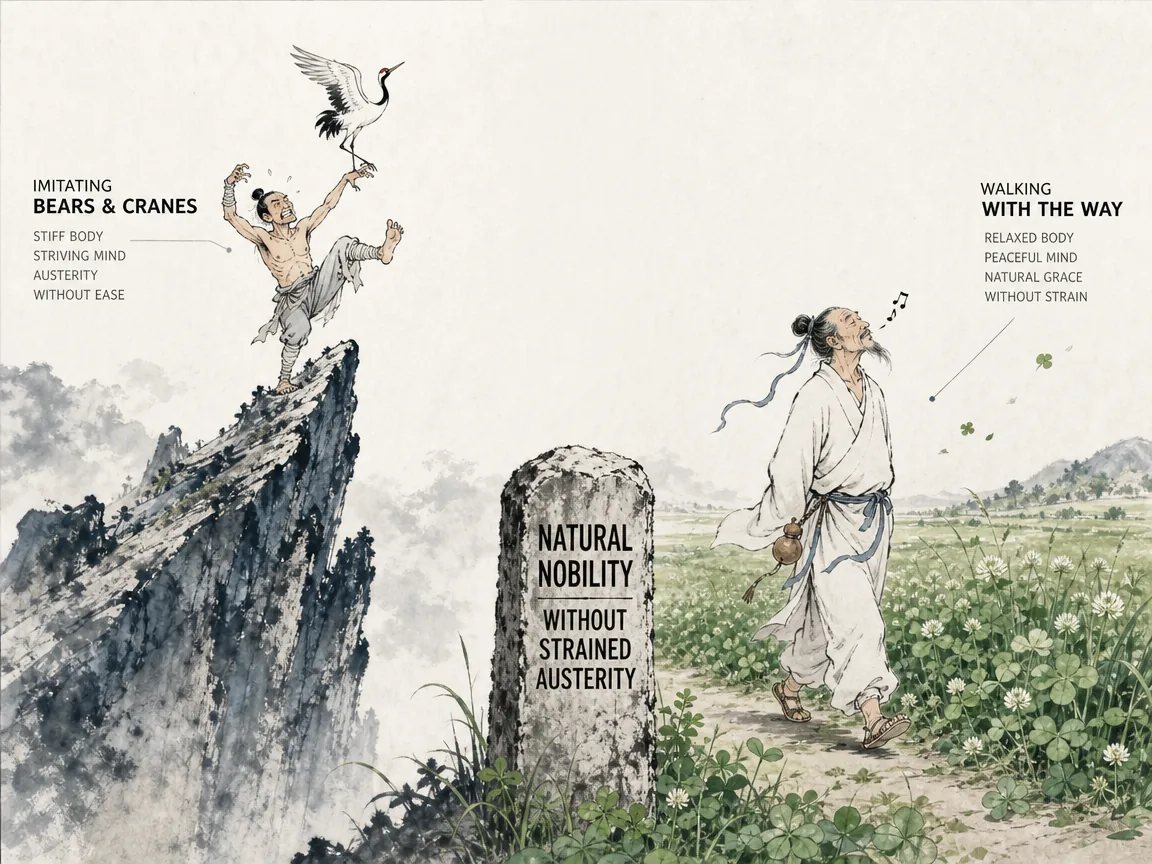
Those who cultivate strained ideas and self-conscious austerity climb lofty heights and breathe deeply, looking down upon the world. But the sage achieves exalted stature without deliberate cultivation, maintains moral integrity without preaching benevolence, and lives in tranquil quietness without retirement to caves. Simplicity, stillness, and plainness are the true nourishment of the spirit—a foundational perspective explored in Zhuangzi Chapter 15 Translation.
Zhuangzi Chapter 15 Translation: Pure Spirit Nourished in Effortless Ease
Zhuangzi Chapter 15 Translation (刻意第十五) invites us to step back from our everyday conditioned assumptions. For modern readers living in an achievement-driven world, Zhuangzi does not offer more techniques for self-improvement; instead, he asks what would happen if we stopped measuring our worth entirely by external usefulness and societal approval. To see how this ancient insight translates to everyday life, read our practical modern reflection on The Highest Cultivation Needs No Effort.
Complete Chapter Translation: Modern Western Reading
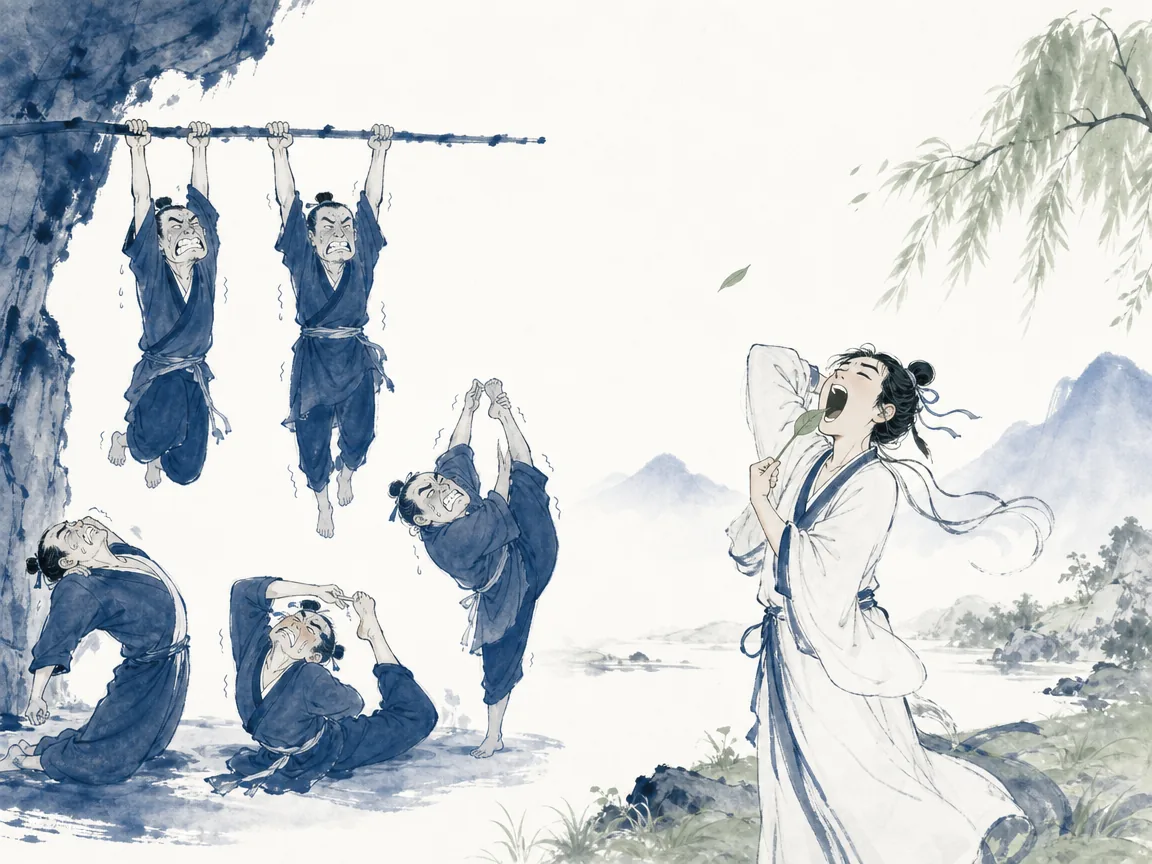
Ingrained ideas and a high estimate of their own conduct; leaving the world, and pursuing uncommon ways; talking loftily and in resentful disparagement of others – all this is simply symptomatic of arrogance. This is what scholars who betake themselves to the hills and valleys, who are always blaming the world, and who stand aloof like withered trees, or throw themselves into deep pools, are fond of. Discoursing of benevolence, righteousness, loyalty, and good faith; being humble and frugal, self-forgetful and courteous – all this is simply symptomatic of (self-)cultivation. This is what scholars who wish to tranquillise the world, teachers and instructors, men who pursue their studies at home and abroad, are fond of. Discoursing of their great merit and making a great name for themselves; insisting on the ceremonies between ruler and minister; and rectifying the relations between high and low – all this shows their one object to be the promotion of government. This is what officers of the court, men who honour their lord and would strengthen the state and who would do their utmost to incorporate other states with their own, are fond of. Resorting to marshes and lakes; dwelling in solitary places; occupying themselves with angling and living at ease – all this shows their one object to be to do nothing. This is what gentlemen of the rivers and seas, men who avoid the society of the world and desire to live at leisure, are fond of. Blowing and breathing with open mouth; inhaling and exhaling the breath; expelling the old breath and taking in new; passing their time like the (dormant) bear, and stretching and twisting (the neck) like a bird – all this simply shows the desire for longevity. This is what the scholars who manipulate their breath, and the men who nourish the body and wish to live as long as Peng Zu are fond of.
As to those who have a lofty character without any ingrained ideas; who pursue the path of self-cultivation without benevolence and righteousness; who succeed in government without great services or fame; who enjoy their ease without resorting to the rivers and seas; who attain to longevity without the management (of the breath); who forget all things and yet possess all things; whose placidity is unlimited, while all things to be valued attend them: such men pursue the way of heaven and earth, and display the characteristics of the sages.
Hence it is said, 'Placidity, indifference, silence, quietude, absolute vacancy, and non-action: these are the qualities which maintain the level of heaven and earth and are the substance of the Dao and its characteristics.'
In accordance with this it is said, 'The sage is entirely restful, and so (his mind) is evenly balanced and at ease. This even balance and ease appears in his placidity and indifference. In this state of even balance and ease, of placidity and indifference, anxieties and evils do not find access to him, no depraving influence can take him by surprise; his virtue is complete, and his spirit continues unimpaired.'
Therefore it is said, 'The life of the sage is (like) the action of Heaven; and his death is the transformation common to (all) things. In his stillness his virtue is the same as that of the Yin, and in movement his diffusiveness is like that of the Yang. He does not take the initiative in producing either happiness or calamity. He responds to the influence acting on him, and moves as he feels the pressure. He rises to act only when he is obliged to do so. He discards wisdom and the memories of the past; he follows the lines of his Heaven (-given nature); and therefore he suffers no calamity from Heaven, no involvement from things, no blame from men, and no reproof from the spirits of the dead. His life seems to float along; his death seems to be a resting. He does not indulge any anxious doubts; he does not lay plans beforehand. His light is without display; his good faith is without previous arrangement. His sleep is untroubled by dreams; his waking is followed by no sorrows. His spirit is guileless and pure; his soul is not subject to weariness. Vacant and without self-assertion, placid and indifferent, he agrees with the virtue of Heaven.'
Therefore it is said (further), 'Sadness and pleasure show a depraving element in the virtue (of those who feel them); joy and anger show some error in their course; love and hatred show a failure of their virtue. Hence for the mind to be free from sorrow and pleasure is the perfection of virtue; to be of one mind that does not change is the perfection of quietude; to be conscious of no opposition is the perfection of vacancy; to have no intercourse with (external) things is the perfection of indifference; and to have no rebellious dissatisfactions is the perfection of purity.'
Therefore it is said (still further), 'If the body be toiled, and does not rest, it becomes worn out; if the spirit be used without cessation, it becomes toiled; and when toiled, it becomes exhausted. It is the nature of water, when free from admixture, to be clear, and, when not agitated, to be level; while if obstructed and not allowed to flow, it cannot preserve its clearness – being an image of the virtue of Heaven.'
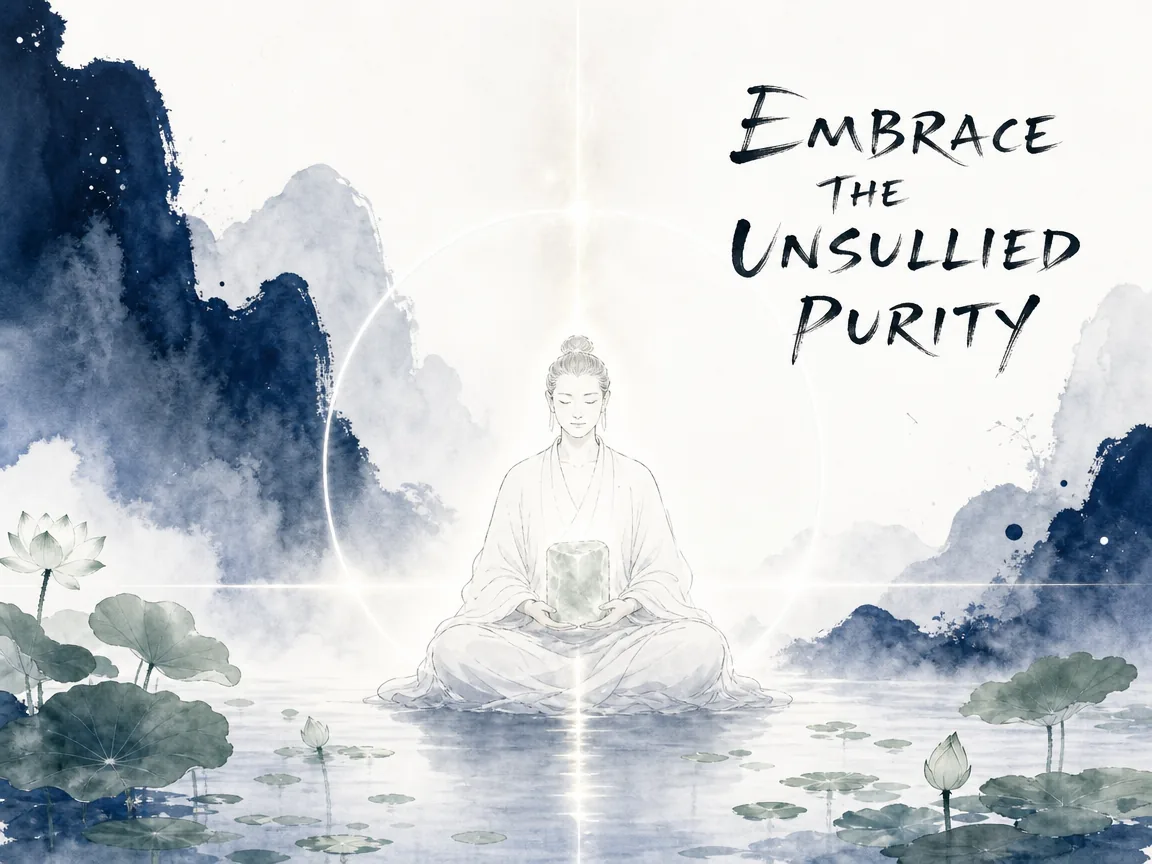
Hence it is said (once again), 'To be guileless and pure, and free from all admixture; to be still and uniform, without undergoing any change; to be indifferent and do nothing; to move and yet to act like Heaven: this is the way to nourish the spirit.
Now he who possesses a sword made at Gan-Yue preserves it carefully in a box, and does not dare to use it – it is considered the perfection of valuable swords. But the human spirit goes forth in all directions, flowing on without limit, reaching to heaven above, and wreathing round the earth beneath. It transforms and nourishes all things, and cannot be represented by any form. Its name is "the Divinity (in man)." It is only the path of pure simplicity which guards and preserves the Spirit. When this path is preserved and not lost, it becomes one with the Spirit; and in this ethereal amalgamation, it acts in harmony with the orderly operation of Heaven.' There is the vulgar saying, 'The multitude of men consider gain to be the most important thing; pure scholars, fame; those who are wise and able value their ambition; the sage prizes essential purity.'
Therefore simplicity is the denomination of that in which there is no admixture; purity of that in which the spirit is not impaired. It is he who can embody simplicity and purity whom we call the True Man.
Continue to the next chapter of the classical text in Zhuangzi’s next profound exploration in Correcting the Nature: Reversing Social Conditioning to Reclaim Original Virtue.
For a deeper comparative examination of these ideas, explore our related study on Perfect Enjoyment: Singing with a Bashed Tub and the Skull’s Serenity.






