

辨德章第三十三
Key Takeaway: "He who knows others is clever; he who knows himself is wise. He who overcomes others has force; he who overcomes himself is strong." — Laozi, Daodejing Chapter 33
Understanding others demonstrates worldly insight, but understanding oneself constitutes true enlightenment. Conquering others demands physical force, but conquering oneself requires invincible power—a foundational perspective explored in Daodejing Chapter 33 Translation.
Daodejing Chapter 33 Translation: Mastering Others Requires Force; Mastering Oneself Requires Authentic Strength
The wisdom of Daodejing Chapter 33 Translation addresses a fundamental human dynamic: how we navigate ambition, quietude, and the natural flow of existence. In the classical tradition, this passage serves as both a metaphysical mirror and a practical compass for daily living and leadership. Explore how this principle translates into contemporary daily life in our guide to What It Means to Be Truly Strong: Laozi’s Answer Is Not What Most People Think.
By shifting our focus from outer coercion to internal stillness, we uncover a more resilient way of relating to ourselves and the world around us.
Complete Chapter Translation: Modern Western Reading
To understand others is to have knowledge; To understand oneself is to be illumined. To conquer others needs strength; To conquer oneself is harder still.
To be content with what one has is to be rich. one who works through violence may get his way; But only what stays in its place Can endure.
When one dies one is not lost, there is no other longevity.
道德经中文原文与对照
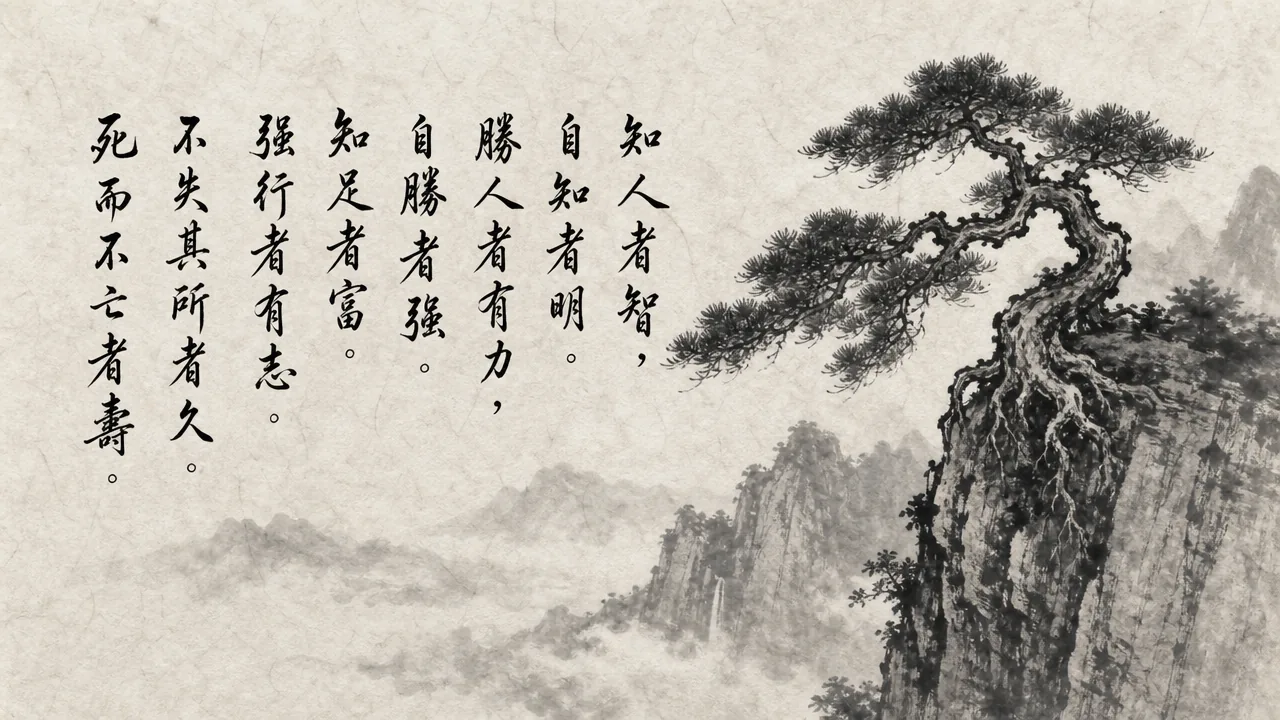
【原文】 知人者智,自知者明。勝人者有力,自勝者強。知足者富。強行者有志。不失其所者久。死而不亡者壽。
核心要义解析 (Philosophical Insights)
- 道义发微:本章通过“辨德章第三十三”阐发了《道德经》的核心精髓。从“有”与“无”、“动”与“静”的辩证转化中,提醒我们在日用常行中摒弃过度的功利执念,回归纯粹本真的生命状态。
- 现代启示:当外界喧嚣与评判标准不断施加压力时,保持内心的虚静与不争,反而是最强大的定力与智慧。
Follow the sequential development of the text in Laozi’s next philosophical movement in Nurturing Without Domination: The Great Tao Drifting Left and Right.
For a deeper comparative examination of these ideas, explore our related study on Metaphorical Language: Parables, Quotations, and the Goblet Words.






