
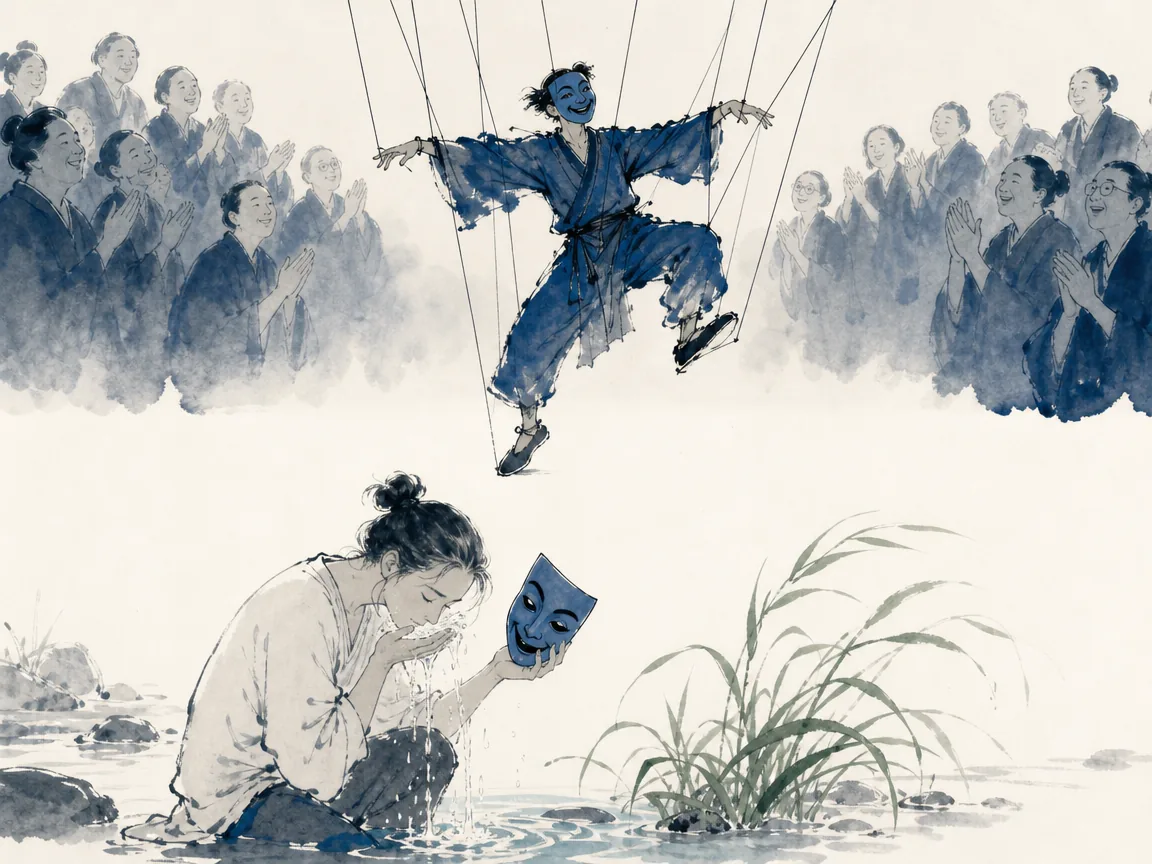
There is a quiet kind of exhaustion that no vacation cures. It does not come from doing too much, or from having too many obligations. It comes from the slow, constant effort of keeping up an image of who you should be — the conscientious employee, the emotionally composed partner, the person who always has the right answer, the one whose life looks put together on the outside even as something inside grows increasingly numb.
We live in an age that rewards performance. Professionalism demands we never show fatigue. Social media trains us to package our lives into digestible, likable content. Even self-improvement culture has become a marketplace of identities to try on: the disciplined one, the mindful one, the high-achiever who also meditates and drinks matcha. The danger is not that we are failing to meet these standards. The danger is that we are succeeding at them — and in the process, losing contact with what actually feels alive—a foundational perspective explored in Zhuangzi Chapter 32 Meaning.
Over two thousand years ago, a text within the Zhuangzi offered a diagnosis that still cuts to the bone. In a story classified among the Miscellaneous Chapters of the received thirty-three-chapter edition of the work [2], a fisherman observes Confucius — the ancient teacher revered for his dedication to ritual, moral cultivation, and social order — and asks a devastating question. Not "are you righteous?" but "are you serving your true nature, or are you wearing yourself out for an external standard?" The fisherman's concern was not that Confucius was immoral. It was that he was sincerely performing correctness, and in doing so, endangering something far more fundamental: the authentic self.
Zhuangzi Chapter 32 Meaning: The Fisherman Who Interrupted a Master
The story opens with Confucius resting in a wooded grove. His disciples are reading, and he is playing the zither and singing. A fisherman steps out of a boat, listens, and then calls for Confucius's senior students. When they approach, he asks who this man is and what he is doing. They describe Confucius's life work: cultivating benevolence and righteousness, establishing ritual and music, seeking to transform society through moral education. The fisherman listens and then offers a remark that reframes everything: the man is exhausting his heart and wearying his body, and in doing so, he is endangering his true self [3].
This is the core of the passage. The fisherman is not condemning morality. He is not saying that Confucius's values are wrong or that social responsibility is pointless. He is pointing to a subtler catastrophe — the kind that happens when a person invests so fully in an external script that the inner life starves. The term often discussed in relation to this passage refers to a state where the heart is worn down and the body is overtaxed, with what is harmed being the authentic nature itself [3]. Whether or not one accepts a particular Chinese rendering of this idea, the observation is unmistakable: there is a form of self-destruction that looks exactly like virtue.
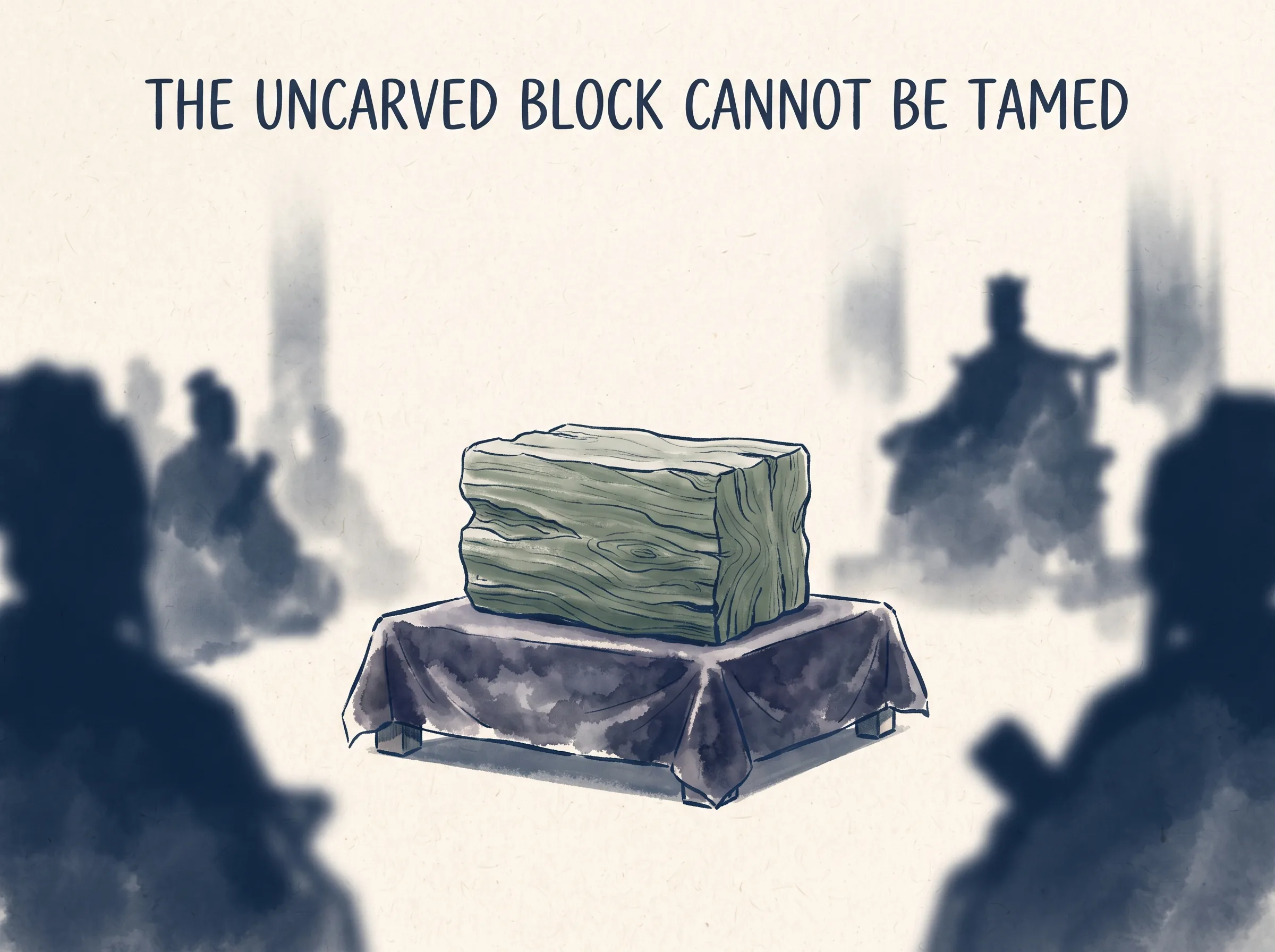
The fisherman's perspective is significant precisely because of who he is. He is not a fellow philosopher, not a court official, not a member of the scholarly tradition that Confucius represents. He is someone who lives by the water — outside the hierarchy, outside the reputation system, outside the economy of social approval. In the symbolic logic of the text, this positioning matters. Water does not compete. It does not perform. It simply flows according to its nature [3]. The fisherman judges Confucius not by the standards of the world Confucius is trying to improve, but by a deeper criterion: does this way of living preserve or deplete the person living it?
Continue with the deeper interpretation and practical application.
ChiDestiny members get access to the full analysis, modern applications, and the growing Chinese Wisdom Library.
FAQ
Is the Fisherman chapter really part of the Zhuangzi?
Yes. In the received thirty-three-chapter edition of the Zhuangzi, compiled and organized by the third-century scholar Guo Xiang, the Fisherman chapter is numbered thirty-one and classified among the Miscellaneous Chapters rather than the Outer Chapters [1]****[2]. Scholars generally understand the extant Zhuangzi as a layered text accumulated over time, with many passages attributed to later followers rather than to Zhuangzi himself [1]**.
What is the difference between the Fisherman's view and Confucius's view?
The Fisherman represents a perspective that prioritizes the preservation of one's authentic nature over the performance of social roles and moral duties. Confucius represents a tradition that emphasizes ritual, ethical cultivation, and active efforts to improve society. The text does not simply declare one side correct; rather, it uses the encounter to show what is lost when social performance replaces inner vitality [3].
Does Zhuangzi oppose morality and social responsibility?
No. The Fisherman does not argue that benevolence, righteousness, or social order are worthless. The critique is specifically directed at the kind of moral performance that exhausts the self and sacrifices authenticity on the altar of external approval. The text acknowledges the functional role of social conventions while warning against letting them become the sole measure of a life well lived [3].
How does this apply to modern life?
The pattern the Fisherman describes — exhausting oneself through sincere performance of correctness — is remarkably familiar today. It appears in workplace culture that rewards constant availability, social media that incentivizes curated positivity, and self-help industries that sell ever more refined versions of the same performative ideal. The ancient text offers not a specific solution but a diagnostic lens: asking whether your activities are sustaining your true self or slowly replacing it with a more socially acceptable substitute, reflecting the enduring wisdom of Zhuangzi Chapter 32 Meaning.
Discover the historical and philosophical roots in the classical foundation in The Old Fisherman: The Fisherman’s Scolding and the Meaning of Natural Truth.
For a deeper comparative examination of these ideas, explore our related study on True Cultivation Is Not Adding—It’s Recovering: Zhuangzi’s Lost Art of Restoring Inborn Nature (*Shàn Xìng*, 缮性).
Sources & Further Reading
[1] Stanford Encyclopedia of Philosophy — Zhuangzi — Scholarly overview of the Zhuangzi text, its composition history, and the Guo Xiang edition that established the current thirty-three-chapter structure with Inner, Outer, and Miscellaneous sections.
[2] Columbia University Press — Zhuangzi — Source for the chapter numbering and classification confirming that the Fisherman (Yufu) is Chapter 31 within the Miscellaneous Chapters (chapters 23–33).
[3] [Wikisource — Chuang Tzŭ (Giles)/Chapter 31](https://en.wikisource.org/wiki/Chuang_Tz%C5%AD_%28Giles%29/Chapter 31) — A. W. Giles's English translation of the Fisherman chapter, including the encounter between Confucius and the fisherman, the discussion of authenticity, and the contrast between forced and genuine expressions of emotion.






