
知北遊第二十二
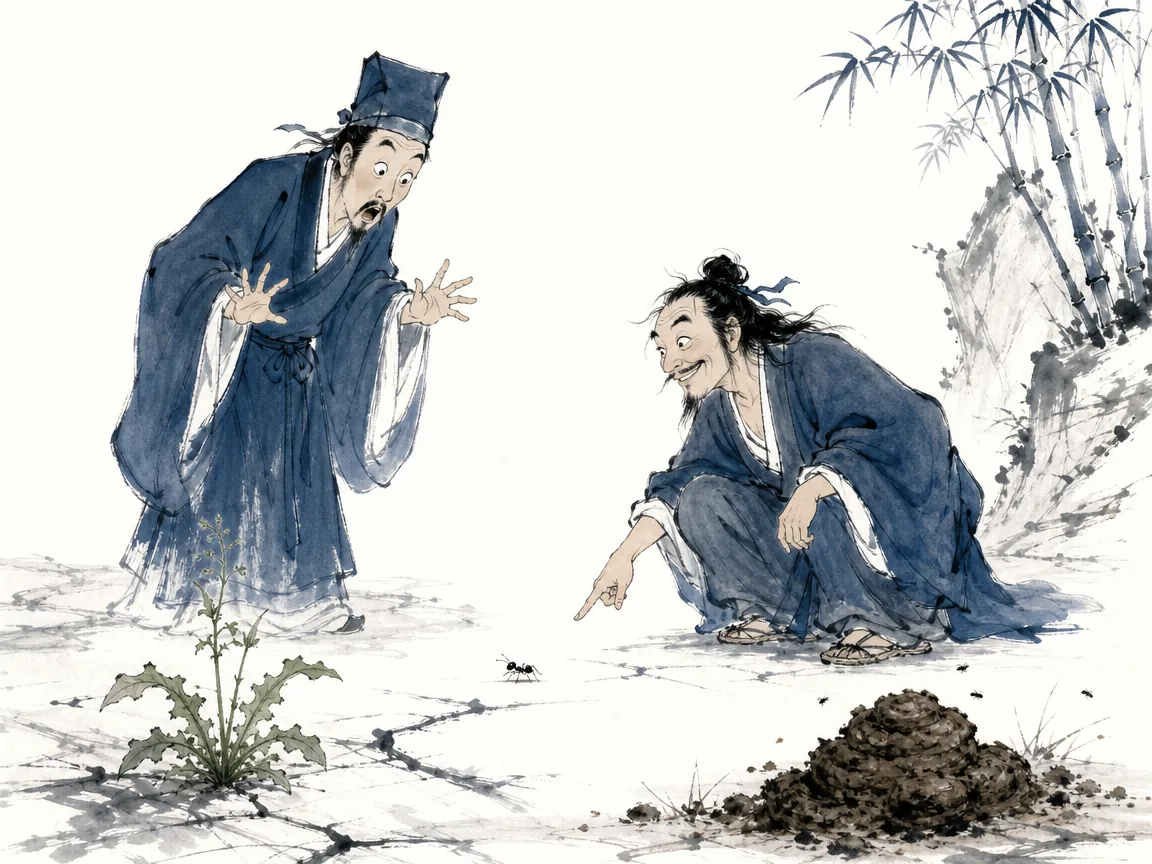
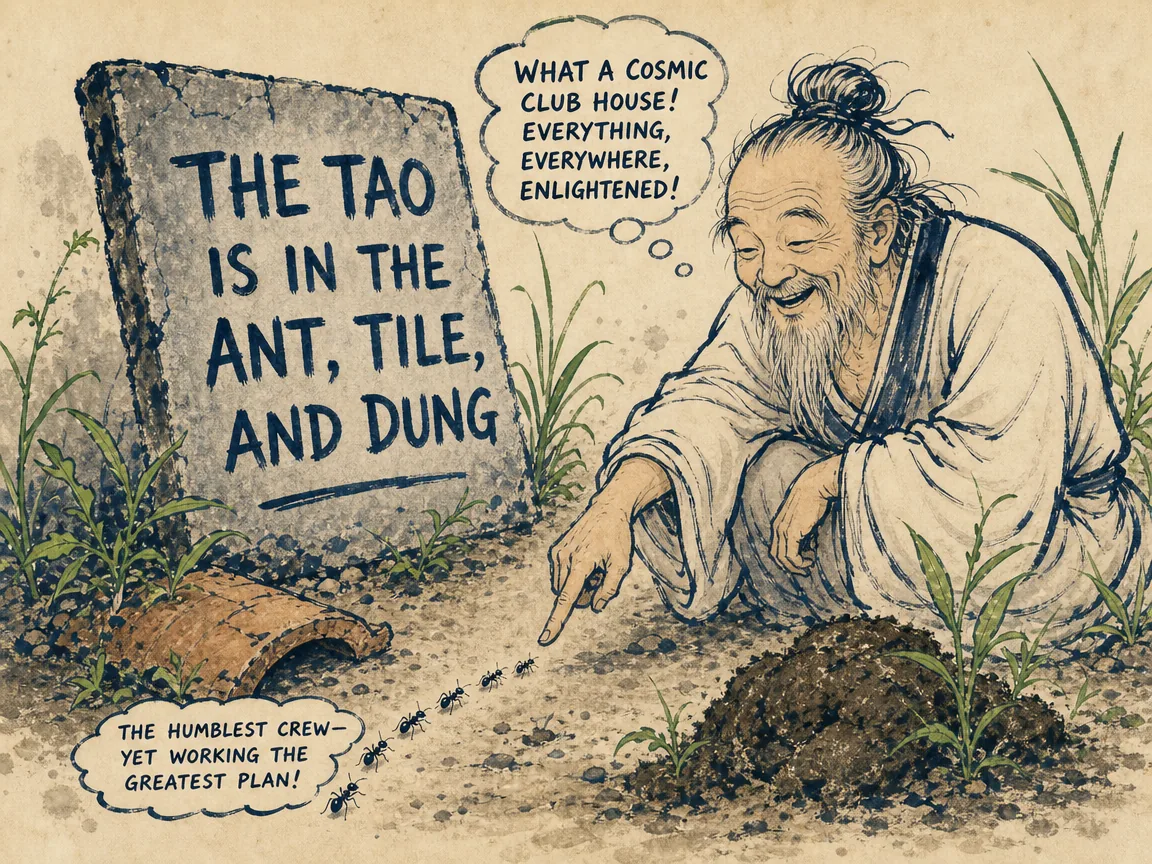
Core Insight: "Dongguo Zi asked Zhuangzi: 'Where is the Tao?' Zhuangzi said: 'There is nowhere it is not.' 'Name a place.' 'It is in the ant.' 'Can it be lower?' 'In the weeds.' 'Lower yet?' 'In earthenware and tile.' 'At the lowest?' 'In dung and urine!' Dongguo Zi fell silent." — Zhuangzi, 知北遊第二十二
Knowledge rambles north to the Black Waters and asks Non-Action how to perceive the Tao, but Non-Action remains silent. Dongguo Zi asks Zhuangzi: 'Where is this Tao of which you speak?' Zhuangzi replies: 'It is everywhere.' Dongguo Zi presses: 'Name a specific place.' 'It is in the ant,' says Zhuangzi. 'Can it be lower?' 'It is in the panic-grass.' 'Lower still?' 'In the broken tile.' 'Even lower?' 'In dung and urine!' The Tao pervades the lowest and humblest—a foundational perspective explored in Zhuangzi Chapter 22.
Zhuangzi Chapter 22: Where Does the Supreme Way Truly Reside?
Zhuangzi Chapter 22 (知北遊第二十二) invites us to step back from our everyday conditioned assumptions. For modern readers living in an achievement-driven world, Zhuangzi does not offer more techniques for self-improvement; instead, he asks what would happen if we stopped measuring our worth entirely by external usefulness and societal approval. To see how this ancient insight translates to everyday life, read our practical modern reflection on Why the Dao Is Already Here: Letting Go of the Quest for Something Far Away.
Complete Chapter Translation: Modern Western Reading
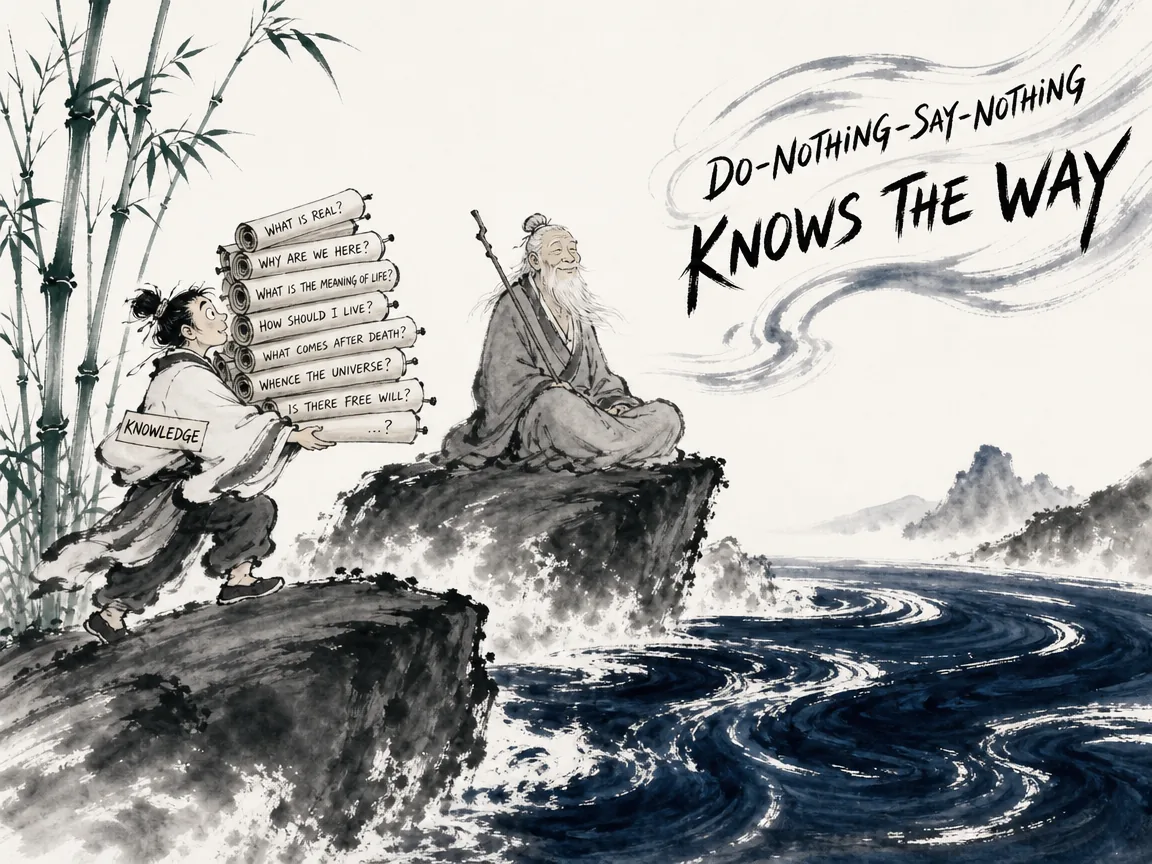
Knowledge had rambled northwards to the region of the Dark Water, where he ascended the height of Imperceptible Slope, when it happened that he met with Dumb Inaction. Knowledge addressed him, saying, 'I wish to ask you some questions: By what process of thought and anxious consideration do we get to know the Dao? Where should we dwell and what should we do to find our rest in the Dao? From what point should we start and what path should we pursue to make the Dao our own?' He asked these three questions, but Dumb Inaction gave him no reply. Not only did he not answer, but he did not know how to answer. Knowledge, disappointed by the fruitlessness of his questions, returned to the south of the Bright Water, and ascended the height of the End of Doubt, where he saw Heedless Blurter, to whom he put the same questions, and who replied, 'Ah! I know, and will tell you.' But while he was about to speak, he forgot what he wanted to say. Knowledge, (again) receiving no answer to his questions, returned to the palace of the Di, where he saw the Yellow Emperor, and put the questions to him. the Yellow Emperor said, 'To exercise no thought and no anxious consideration is the first step towards knowing the Dao; to dwell nowhere and do nothing is the first step towards resting in the Dao; to start from nowhere and pursue no path is the first step towards making the Dao your own.'
Knowledge then asked the Yellow Emperor, saying, 'I and you know this; those two did not know it; which of us is right?' The reply was, 'Dumb Inaction is truly right; Heedless Blurter has an appearance of being so; I and you are not near being so. (As it is said), "Those who know (the Dao) do not speak of it; those who speak of it do not know it;" and "Hence the sage conveys his instructions without the use of speech." The Dao cannot be made ours by constraint; its characteristics will not come to us (at our call). Benevolence may be practised; Righteousness may be partially attended to; by Ceremonies men impose on one another.
Hence it is said, "When the Dao was lost, its Characteristics appeared. When its Characteristics were lost, Benevolence appeared. When Benevolence was lost, Righteousness appeared. When Righteousness was lost, Ceremonies appeared. Ceremonies are but (the unsubstantial) flowers of the Dao, and the commencement of disorder."
Hence (also it is further said), "He who practises the Dao, daily diminishes his doing. He diminishes it and again diminishes it, till he arrives at doing nothing. Having arrived at this non-inaction, there is nothing that he does not do." Here now there is something, a regularly fashioned utensil – if you wanted to make it return to the original condition of its materials, would it not be difficult to make it do so? Could any but the Great Man accomplish this easily?' Life is the follower of death, and death is the predecessor of life; but who knows the Arranger (of this connexion between them)? The life is due to the collecting of the breath. When that is collected, there is life; when it is dispersed, there is death. Since death and life thus attend on each other, why should I account (either of) them an evil?'
Therefore all things go through one and the same experience. (Life) is accounted beautiful because it is spirit-like and wonderful, and death is accounted ugly because of its foetor and putridity. But the foetid and putrid is transformed again into the spirit-like and wonderful, and the spirit-like and wonderful is transformed again into the foetid and putrid.
Hence it is said, "All under the sky there is one breath of life, and therefore the sages prized that unity."'
Knowledge said to the Yellow Emperor, 'I asked Dumb Inaction, and he did not answer me. Not only did he not answer me, but he did not know how to answer me. I asked Heedless Blurter, and while he wanted to tell me, he yet did not do so. Not only did he not tell me, but while he wanted to tell me, he forgot all about my questions. Now I have asked you, and you knew (all about them) – why (do you say that) you are not near doing so?' the Yellow Emperor replied, 'Dumb Inaction was truly right, because he did not know the thing. Heedless Blurter was nearly right, because he forgot it. I and you are not nearly right, because we know it.'
Heedless Blurter heard of (all this), and considered that the Yellow Emperor knew how to express himself (on the subject).
(The operations of) Heaven and Earth proceed in the most admirable way, but they say nothing about them; the four seasons observe the clearest laws, but they do not discuss them ; all things have their complete and distinctive constitutions, but they say nothing about them. The sages trace out the admirable operations of Heaven and Earth, and reach to and understand the distinctive constitutions of all things; and thus it is that the Perfect Man (is said to) do nothing and the Greatest Sage to originate nothing, such language showing that they look to Heaven and Earth as their model.
Even they, with their spirit-like and most exquisite intelligence, as well as all the tribes that undergo their transformations, the dead and the living, the square and the round, do not understand their root and origin, but nevertheless they all from the oldest time by it preserve their being. Vast as is the space included within the six cardinal points, it all (and all that it contains) lies within (this twofold root of Heaven and Earth); small as is an autumn hair, it is indebted to this for the completion of its form. All things beneath the sky, now rising, now descending, ever continue the same through this. The Yin and Yang, and the four seasons revolve and move by it, each in its proper order. Now it seems to be lost in obscurity, but it continues; now it seems to glide away, and have no form, but it is still spirit-like. All things are nourished by it, without their knowing it. This is what is called the Root and Origin; by it we may obtain a view of what we mean by Heaven.
Nie Que asked about the Dao from Bei-yi, who replied, 'If you keep your body as it should be, and look only at the one thing, the Harmony of Heaven will come to you. Call in your knowledge, and make your measures uniform, and the spiritual (belonging to you) will come and lodge with you; the Attributes (of the Dao) will be your beauty, and the Dao (itself) will be your dwelling-place. You will have the simple look of a new-born calf, and will not seek to know the cause (of your being what you are).' Bei-yi had not finished these words when the other dozed off into a sleep. Bei-yi was greatly pleased, and walked away, singing as he went,'Like stump of rotten tree his frame,Like lime when slaked his mind became. Real is his wisdom, solid, true,Nor cares what's hidden to pursue.0 dim and dark his aimless mind! No one from him can counsel find. What sort of man is he?'
Shun asked (his attendant) Cheng, saying, 'Can I get the Dao and hold it as mine?' The reply was, 'Your body is not your own to hold – how then can you get and hold the Dao?' Shun resumed, 'If my body be not mine to possess and hold, who holds it?'
Cheng said, 'It is the bodily form entrusted to you by Heaven and Earth. Life is not yours to hold. It is the blended harmony (of the Yin and Yang), entrusted to you by Heaven and Earth. Your nature, constituted as it is, is not yours to hold. It is entrusted to you by Heaven and Earth to act in accordance with it. Your grandsons and sons are not yours to hold. They are the exuviae entrusted to you by Heaven and Earth.
Therefore when we walk, we should not know where we are going; when we stop and rest, we should not know what to occupy ourselves with when we eat, we should not know the taste of our food – all is done by the strong Yang influence of Heaven and Earth'. How then can you get (the Dao), and hold it as your own?'
Confucius asked Lao Dan, saying, 'Being at leisure to-day, I venture to ask you about the Perfect Dao.'
Lao Dan replied, 'You must, as by fasting and vigil, clear and purge your mind, wash your spirit white as snow, and sternly repress your knowledge. The subject of the Dao is deep, and difficult to describe – I will give you an outline of its simplest attributes.
The Luminous was produced from the Obscure; the Multiform from the Unembodied; the Spiritual from the Dao; and the bodily from the seminal essence. After this all things produced one another from their bodily organisations. Thus it is that those which have nine apertures are born from the womb, and those with eight from eggs. But their coming leaves no trace, and their going no monument; they enter by no door; they dwell in no apartment: they are in a vast arena reaching in all directions. They who search for and find (the Dao) in this are strong in their limbs, sincere and far-reaching in their thinking, acute in their hearing, and clear in their seeing. They exercise their minds without being toiled; they respond to everything aright without regard to place or circumstance. Without this heaven would not be high, nor earth broad; the sun and moon would not move, and nothing would flourish: such is the operation of the Dao.
Moreover, the most extensive knowledge does not necessarily know it; reasoning will not make men wise in it – the sages have decided against both these methods. However you try to add to it, it admits of no increase; however you try to take from it, it admits of no diminution – this is what the sages maintain about it. How deep it is, like the sea! How grand it is, beginning again when it has come to an end! If it carried along and sustained all things, without being overburdened or weary, that would be like the way of the superior man, merely an external operation; when all things go to it, and find their dependence in it – this is the true character of the Dao.
Here is a man (born) in one of the middle states. He feels himself independent both of the Yin and Yang, and dwells between heaven and earth; only for the present a mere man, but he will return to his original source. Looking at him in his origin, when his life begins, we have (but) a gelatinous substance in which the breath is collecting. Whether his life be long or his death early, how short is the space between them! It is but the name for a moment of time, insufficient to play the part of a good Yao or a bad Jie in.
The fruits of trees and creeping plants have their distinctive characters, and though the relationships of men, according to which they are classified, are troublesome, the sage, when he meets with them, does not set himself in opposition to them, and when he has passed through them, he does not seek to retain them; he responds to them in their regular harmony according to his virtue; and even when he accidentally comes across any of them, he does so according to the Dao. It was thus that the Dao flourished, thus that the kings arose.
Men's life between heaven and earth is like a white colt's passing a crevice, and suddenly disappearing. As with a plunge and an effort they all come forth; easily and quietly they all enter again. By a transformation they live, and by another transformation they die. Living things are made sad (by death), and mankind grieve for it; but it is (only) the removal of the bow from its sheath, and the emptying the natural satchel of its contents. There may be some confusion amidst the yielding to the change; but the intellectual and animal souls are taking their leave, and the body will follow them: This is the Great Returning home.
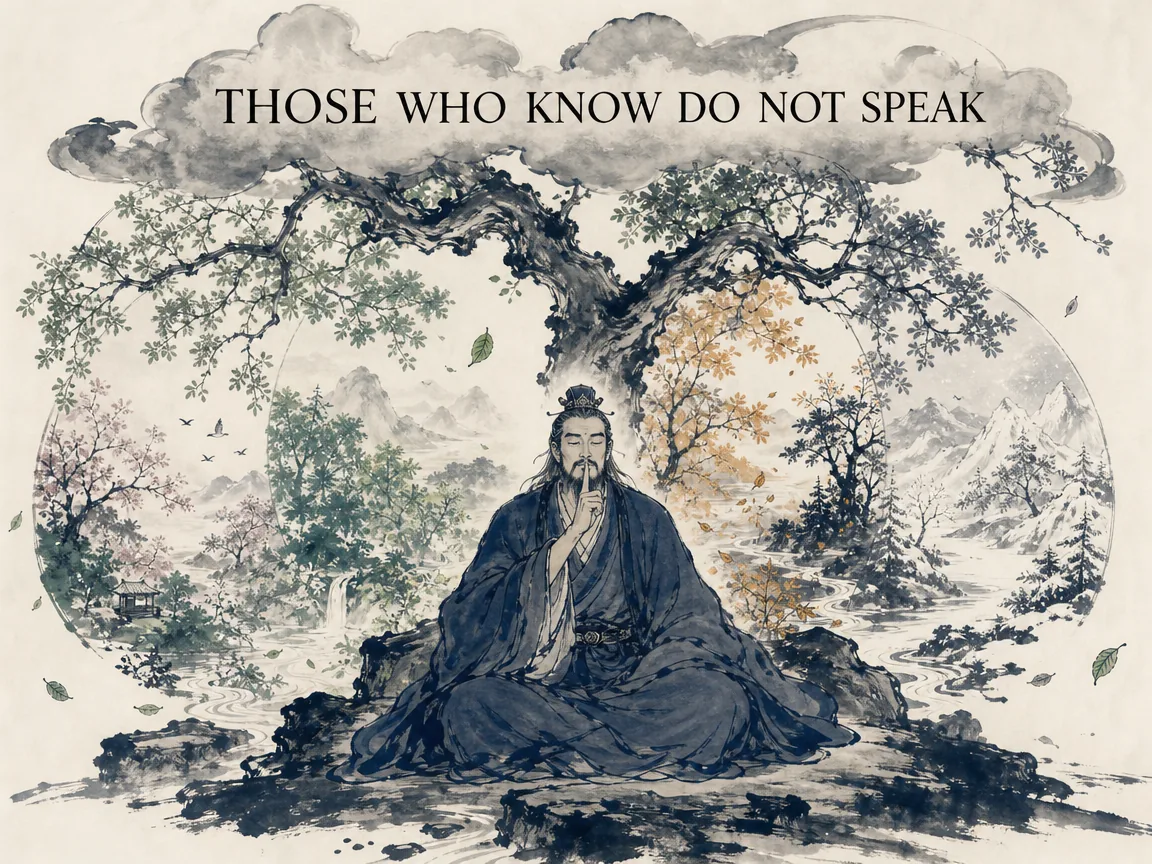
That the bodily frame came from incorporeity, and will return to the same, is what all men in common know, and what those who are on their way to (know) it need not strive for. This is what the multitudes of men discuss together. Those whose (knowledge) is complete do not discuss it – such discussion shows that their (knowledge) is not complete. Even the most clear-sighted do not meet (with the Dao) – it is better to be silent than to reason about it. The Dao cannot be heard with the ears – it is better to shut the ears than to try and hear it. This is what is called the Great Attainment.'
Dong-guo Zi asked Zhuangzi, saying, 'Where is what you call the Dao to be found?' Zhuangzi replied, 'Everywhere.' The other said, 'Specify an instance of it. That will be more satisfactory.' ' It is here in this ant.' 'Give a lower instance.' 'It is in this panic grass.' 'Give me a still lower instance.' 'It is in this earthenware tile.' 'Surely that is the lowest instance?' 'It is in that excrement.' To this Dong-guo Zi gave no reply.
Zhuangzi said, 'Your questions, my master, do not touch the fundamental point (of the Dao). They remind me of the questions addressed by the superintendents of the market to the inspector about examining the value of a pig by treading on it, and testing its weight as the foot descends lower and lower on the body. You should not specify any particular thing. There is not a single thing without (the Dao). So it is with the Perfect Dao. And if we call it the Great (Dao), it is just the same. There are the three terms, "Complete," "All-embracing," "the Whole." These names are different, but the reality (sought in them) is the same; referring to the One thing. 'Suppose we were to try to roam about in the palace of No-where – when met there, we might discuss (about the subject) without ever coming to an end. Or suppose we were to be together in (the region of) Non-action – should we say that (the Dao was) Simplicity and Stillness? or Indifference and Purity? or Harmony and Ease? My will would be aimless. If it went nowhere, I should not know where it had got to; if it went and came again, I should not know where it had stopped; if it went on going and coming, I should not know when the process would end. In vague uncertainty should I be in the vastest waste. Though I entered it with the greatest knowledge, I should not know how inexhaustible it was. That which makes things what they are has not the limit which belongs to things, and when we speak of things being limited, we mean that they are so in themselves. (The Dao) is the limit of the unlimited, and the boundlessness of the unbounded. 'We speak of fulness and emptiness; of withering and decay. It produces fulness and emptiness, but is neither fulness nor emptiness; it produces withering and decay, but is neither withering nor decay. It produces the root and branches, but is neither root nor branch; it produces accumulation and dispersion, but is itself neither accumulated nor dispersed.'
A-he Gan and Shen Nong studied together under Lao-long Ji. Shen Nong was leaning forward on his stool, having shut the door and gone to sleep in the day time. At midday A-he Gan pushed open the door and entered, saying, 'Lao-long is dead.' Shen Nong leant forward on his stool, laid hold of his staff and rose. Then he laid the staff aside with a clash, laughed and said, 'That Heaven knew how cramped and mean, how arrogant and assuming I was, and therefore he has cast me off, and is dead. Now that there is no Master to correct my heedless words, it is simply for me to die!'
Yan Gang, (who had come in) to condole, heard these words, and said, 'It is to him who embodies the Dao that the superior men everywhere cling. Now you who do not understand so much as the tip of an autumn hair of it, not even the ten-thousandth part of the Dao, still know how to keep hidden your heedless words about it and die – how much more might he who embodied the Dao do so! We look for it, and there is no form; we hearken for it, and there is no sound. When men try to discuss it, we call them dark indeed. When they discuss the Dao, they misrepresent it.'
Hereupon Grand Purity asked Infinitude, saying, 'Do you know the Dao?' 'I do not know it,' was the reply. He then asked Do-nothing, Who replied, 'I know it.' 'Is your knowledge of it determined by various points?' 'It is.' 'What are they?'
Do-nothing said, 'I know that the Dao may be considered noble, and may be considered mean, that it may be bound and compressed, and that it may be dispersed and diffused. These are the marks by which I know it.' Grand Purity took the words of those two, and asked No-beginning, saying, 'Such were their replies; which was right? and which was wrong? Infinitude's saying that he did not know it? or Do-nothing's saying that he knew it?'
No-beginning said, 'The "I do not know it" was profound, and the "I know it" was shallow. The former had reference to its internal nature; the latter to its external conditions.' Grand Purity looked up and sighed, saying, 'Is "not to know it" then to know it? And is "to know it" not to know it? But who knows that he who does not know it truly knows it?'
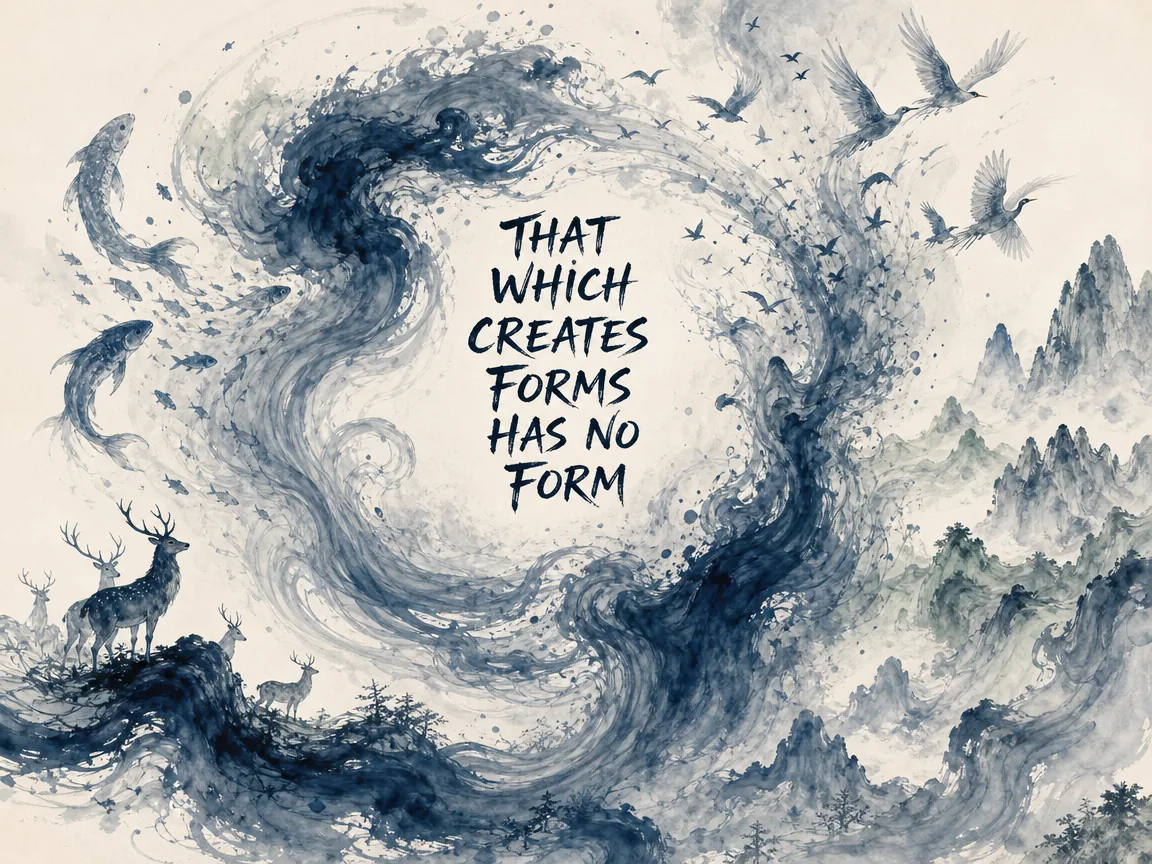
No-beginning replied, 'The Dao cannot be heard; what can be heard is not It. The Dao cannot be seen; what can be seen is not It. The Dao cannot be expressed in words; what can be expressed in words is not It. Do we know the Formless which gives form to form? In the same way the Dao does not admit of being named.'
No-beginning (further) said, 'If one ask about the Dao and another answer him, neither of them knows it. Even the former who asks has never learned anything about the Dao. He asks what does not admit of being asked, and the latter answers where answer is impossible. When one asks what does not admit of being asked, his questioning is in (dire) extremity. When one answers where answer is impossible, he has no internal knowledge of the subject. When people without such internal knowledge wait to be questioned by others in dire extremity, they show that externally they see nothing of space and time, and internally know nothing of the Grand Commencement.
Therefore they cannot cross over the Kun-lun, nor roam in the Grand Void.'
Starlight asked Non-entity, saying, 'Master, do you exist? or do you not exist?' He got no answer to his question, however, and looked stedfastly to the appearance of the other, which was that of a deep void. All day long he looked to it, but could see nothing; he listened for it, but could hear nothing; he clutched at it, but got hold of nothing.
Starlight then said, 'Perfect! Who can attain to this? I can (conceive the ideas of) existence and non-existence, but I cannot (conceive the ideas of) non-existing non-existence, and still there be a nonexisting existence. How is it possible to reach to this?'
The forger of swords for the Minister of War had reached the age of eighty, and had not lost a hair's-breadth of his ability. The Minister said to him, 'You are indeed skilful, Sir. Have you any method that makes you so?'
The man said, 'Your servant has (always) kept to his work. When I was twenty, I was fond of forging swords. I looked at nothing else. I paid no attention to anything but swords. By my constant practice of it, I came to be able to do the work without any thought of what I was doing. By length of time one acquires ability at any art; and how much more one who is ever at work on it! What is there which does not depend on this, and succeed by it?'
Ran Qiu asked Confucius, saying, 'Can it be known how it was before heaven and earth?' The reply was, 'It can. It was the same of old as now.' Ran Qiu asked no more and withdrew. Next day, however, he had another interview, and said, 'Yesterday I asked whether it could be known how it was before heaven and earth, and you, Master, said, "It can. As it is now, so it was of old." Yesterday, I seemed to understand you clearly, but to-day it is dark to me. I venture to ask you for an explanation of this.'
Confucius said, 'Yesterday you seemed to understand me clearly, because your own spiritual nature had anticipated my reply. Today it seems dark to you, for you are in an unspiritual mood, and are trying to discover the meaning. (In this matter) there is no old time and no present; no beginning and no ending. Could it be that there were grandchildren and children before there were (other) grandchildren and children?' Ran Qiu had not made any reply, when Confucius went on, 'Let us have done. There can be no answering (on your part). We cannot with life give life to death; we cannot with death give death to life. Do death and life wait (for each other)? There is that which contains them both in its one comprehension. Was that which was produced before Heaven and Earth a thing? That which made things and gave to each its character was not itself a thing. Things came forth and could not be before things, as if there had (previously) been things – as if there had been things (producing one another) without end. The love of the sages for others, and never coming to an end, is an idea taken from this.'
Yan Yuan asked Confucius, saying, 'Master, I have heard you say, "There should be no demonstration of welcoming; there should be no movement to meet" – I venture to ask in what way this affection of the mind may be shown.' The reply was, 'The ancients, amid (all) external changes, did not change internally; now-a-days men change internally, but take no note of external changes. When one only notes the changes of things, himself continuing one and the same, he does not change. How should there be (a difference between) his changing and not changing? How should he put himself in contact with (and come under the influence of) those external changes? He is sure, however, to keep his points of contact with them from being many. The park of Xi-wei, the garden of the Yellow Emperor, the palace of the Lord of Yu, and the houses of Tang and Wu – (these all were places in which this was done). But the superior men (so called, of later days), such as the masters of the Literati and of Mohism, were bold to attack each other with their controversies; and how much more so are the men of the present day! Sages in dealing with others do not wound them; and they who do not wound others cannot be wounded by them. Only he whom others do not injure is able to welcome and meet men. 'Forests and marshes make me joyful and glad; but before the joy is ended, sadness comes and succeeds to it. When sadness and joy come, I cannot prevent their approach; when they go, I cannot retain them. How sad it is that men should only be as lodging-houses for things, (and the emotions which they excite)! They know what they meet, but they do not know what they do not meet; they use what power they have, but they cannot be strong where they are powerless. Such ignorance and powerlessness is what men cannot avoid. That they should try to avoid what they cannot avoid, is not this also sad? Perfect speech is to put speech away; perfect action is to put action away; to digest all knowledge that is known is a thing to be despised.'
Continue to the next chapter of the classical text in Zhuangzi’s next profound exploration in Geng-sang Chu: The Unlocked Mind and Escaping the Net of Prestige.
For a deeper comparative examination of these ideas, explore our related study on The Floods of Autumn: The Frog in the Well and the Ocean of Tao.






