
駢拇第八
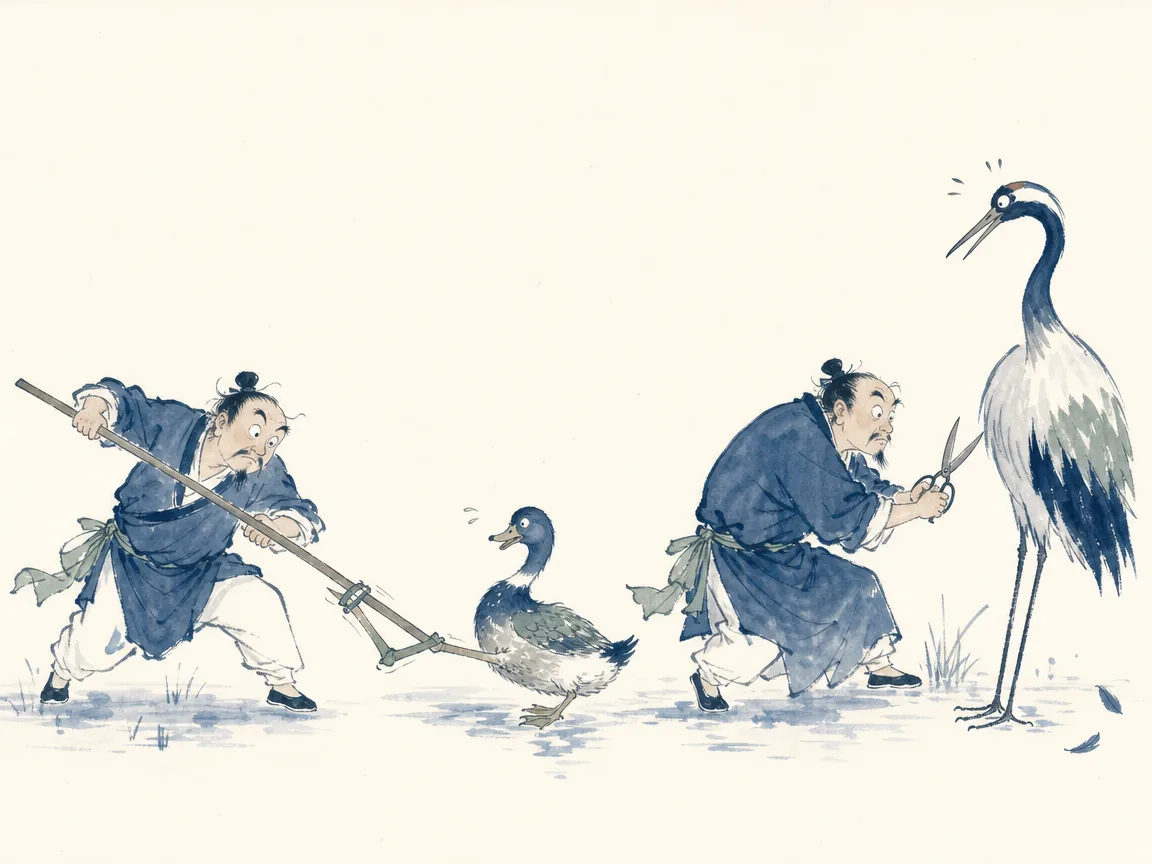
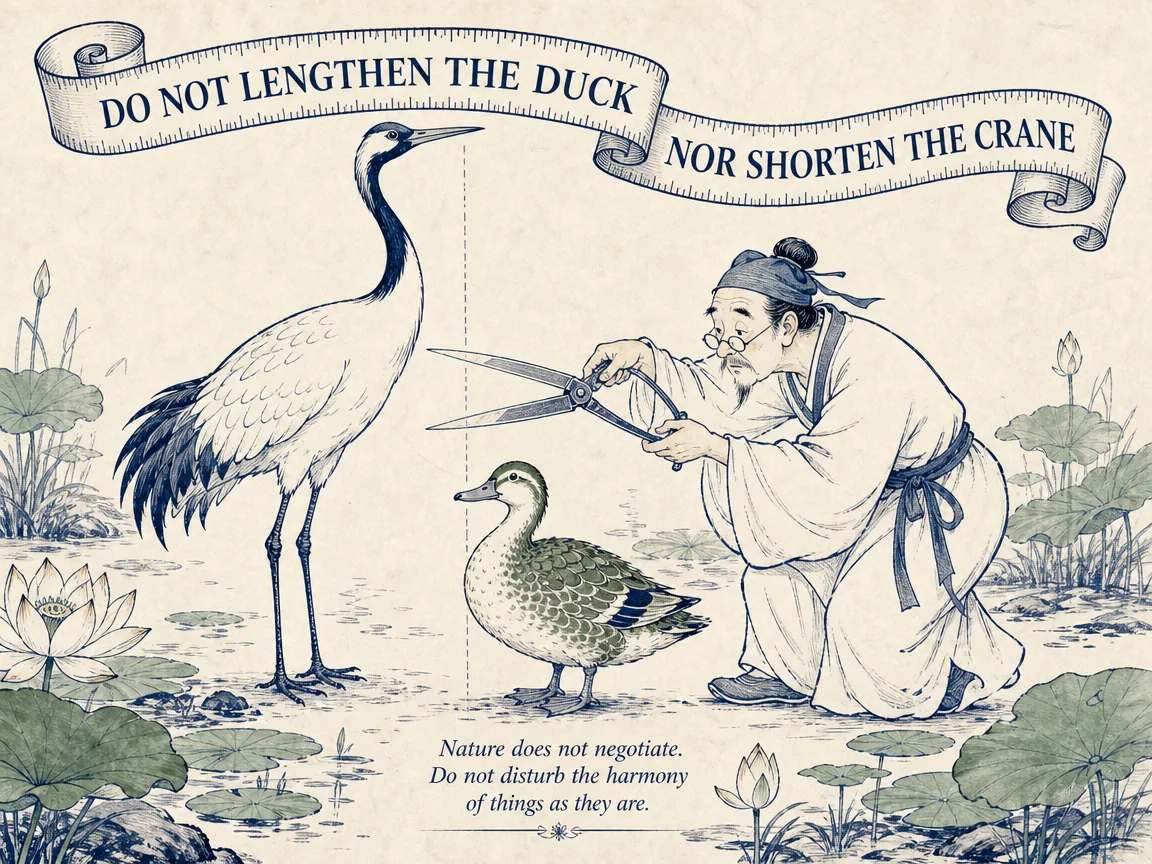
Core Insight: "A duck's legs, though short, cannot be lengthened without pain to the duck; a crane's legs, though long, cannot be shortened without making the crane mourn. What is naturally long needs no cutting; what is naturally short needs no stretching." — Zhuangzi, 駢拇第八
A webbed toe or a sixth finger grows from natural flesh, yet it is superfluous; an extra ear or distorted eye confuses the senses. In the same way, forced doctrines of benevolence and righteousness sever human beings from their native simplicity. A crane's legs are long, but shortening them brings agony; a duck's legs are short, but stretching them causes grief—a foundational perspective explored in Zhuangzi Chapter 8.
Zhuangzi Chapter 8: Why Moral Excess Violates Nature
Zhuangzi Chapter 8 (駢拇第八) invites us to step back from our everyday conditioned assumptions. For modern readers living in an achievement-driven world, Zhuangzi does not offer more techniques for self-improvement; instead, he asks what would happen if we stopped measuring our worth entirely by external usefulness and societal approval. To see how this ancient insight translates to everyday life, read our practical modern reflection on How to Tell What’s Yours and What Was Grafted Onto You — Lessons from Zhuangzi.
Complete Chapter Translation: Modern Western Reading
A ligament uniting the big toe with the other toes and an extra finger may be natural growths, but they are more than is good for use. Excrescences on the person and hanging tumours are growths from the body, but they are unnatural additions to it. There are many arts of benevolence and righteousness, and the exercise of them is distributed among the five viscera; but this is not the correct method according to the characteristics of the Dao. Thus it is that the addition to the foot is but the attachment to it of so much useless flesh, and the addition to the hand is but the planting on it of a useless finger. (So it is that) the connecting (the virtues) with the five viscera renders, by excess or restraint, the action of benevolence and righteousness bad, and leads to many arts as in the employment of (great) powers of hearing or of vision.
Therefore an extraordinary power of vision leads to the confusion of the five colours and an excessive use of ornament. (Its possessor), in the resplendence of his green and yellow, white and black, black and green, will not stop till he has become a Li Zhu. An extraordinary power of hearing leads to a confusion of the five notes, and an excessive use of the six musical accords. (Its possessor), in bringing out the tones from the instruments of metal, stone, silk, and bamboo, aided by the Huang-zhong and Da-lu (tubes), will not stop till he has become a Shi Kuang. (So), excessive benevolence eagerly brings out virtues and restrains its (proper) nature, that (its possessor) may acquire a famous reputation, and cause all the organs and drums in the world to celebrate an unattainable condition; and he will not stop till he has become a Zeng (Shen) or a Shi (Qiu). An extraordinary faculty in debating leads to the piling up of arguments like a builder with his bricks, or a netmaker with his string. (Its possessor) cunningly contrives his sentences and enjoys himself in discussing what hardness is and what whiteness is, where views agree and where they differ, and pressing on, though weary, with short steps, with (a multitude of) useless words to make good his opinion; nor will he stop till he has become a Yang (Zhu) or Mo (Di). But in all these cases the parties, with their redundant and divergent methods, do not proceed by that which is the correct path for all under the sky. That which is the perfectly correct path is not to lose the real character of the nature with which we are endowed.
Hence the union (of parts) should not be considered redundance, nor their divergence superfluity; what is long should not be considered too long, nor what is short too short. A duck's legs, for instance, are short, but if we try to lengthen them, it occasions pain; and a crane's legs are long, but if we try to cut off a portion of them, it produces grief. Where a part is by nature long, we are not to amputate, or where it is by nature short, we are not to lengthen it. There is no occasion to try to remove any trouble that it may cause. The presumption is that benevolence and righteousness are not constituents of humanity; for to how much anxiety does the exercise of them give rise! Moreover when another toe is united to the great toe, to divide the membrane makes you weep; and when there is an extra finger, to gnaw it off makes you cry out. In the one case there is a member too many, and in the other a member too few; but the anxiety and pain which they cause is the same. The benevolent men of the present age look at the evils of the world, as with eyes full of dust, and are filled with sorrow by them, while those who are not benevolent, having violently altered the character of their proper nature, greedily pursue after riches and honours. The presumption therefore is that benevolence and righteousness are contrary to the nature of man – how full of trouble and contention has the world been ever since the three dynasties began!
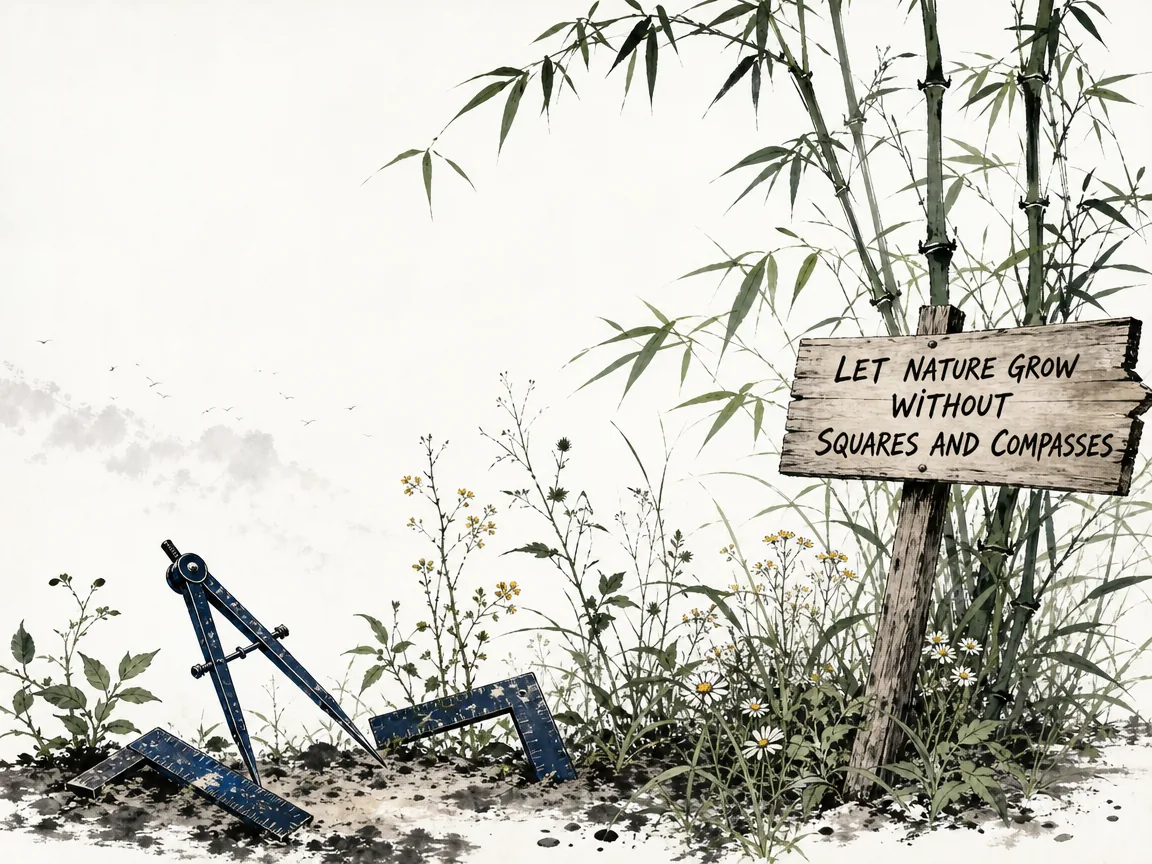
And moreover, in employing the hook and line, the compass and square, to give things their correct form you must cut away portions of what naturally belongs to them; in employing strings and fastenings, glue and varnish to make things firm, you must violently interfere with their qualities. The bendings and stoppings in ceremonies and music, and the factitious expression in the countenance of benevolence and righteousness, in order to comfort the minds of men – these all show a failure in observing the regular principles (of the human constitution). All men are furnished with such regular principles; and according to them what is bent is not made so by the hook, nor what is straight by the line, nor what is round by the compass, nor what is square by the carpenter's square. Nor is adhesion effected by the use of glue and varnish, nor are things bound together by means of strings and bands. Thus it is that all in the world are produced what they are by a certain guidance, while they do not know how they are produced so; and they equally attain their several ends while they do not know how it is that they do so. Anciently it was so, and it is so now; and this constitution of things should not be made of none effect. Why then should benevolence and righteousness be employed as connecting (links), or as glue and varnish, strings and bands, and the enjoyment arising from the Dao and its characteristics be attributed to them? It is a deception practised upon the world. Where the deception is small, there will be a change in the direction (of the objects pursued); where it is great, there will be a change of the nature itself. How do I know that it is so? Since he of the line of Yu called in his benevolence and righteousness to distort and vex the world, the world has not ceased to hurry about to execute their commands – has not this been by means of benevolence and righteousness to change (men's views) of their nature?
I will therefore try and discuss this matter. From the commencement of the three dynasties downwards, nowhere has there been a man who has not under (the influence of external) things altered (the course of) his nature. Small men for the sake of gain have sacrificed their persons; scholars for the sake of fame have done so; great officers, for the sake of their families; and sagely men, for the sake of the kingdom. These several classes, with different occupations, and different reputations, have agreed in doing injury to their nature and sacrificing their persons. Take the case of a male and female slave; they have to feed the sheep together, but they both lose their sheep. Ask the one what he was doing, and you will find that he was holding his bamboo tablets and reading. Ask the other, and you will find that she was amusing herself with some game. They were differently occupied, but they equally lose their sheep. (So), Bo-yi died at the foot of Shou-yang to maintain his fame, and the robber Zhi died on the top of Dong-ling in his eagerness for gain. Their deaths were occasioned by different causes, but they equally shortened their lives and did violence to their nature; why must we approve of Bo-yi, and condemn the robber Zhi? In cases of such sacrifice all over the world, when one makes it for the sake of benevolence and righteousness, the common people style him 'a superior man,' but when another does it for the sake of goods and riches, they style him 'a small man.' The action of sacrificing is the same, and yet we have 'the superior man' and 'the small man!' In the matter of destroying his life, and doing injury to his nature, the robber Zhi simply did the same as Bo-yi – why must we make the distinction of 'superior man' and 'small man' between them? Moreover, those who devote their nature to (the pursuit) of benevolence and righteousness, though they should attain to be like Zeng (Shen) and Shi (Qiu), I do not pronounce to be good; those who devote it to (the study of) the five flavours, though they attain to be like Shu-er, I do not pronounce to be good; those who devote it to the (discrimination of the) five notes, though they attain to be like Shi Kuang, I do not pronounce to be quick of hearing; those who devote it to the (appreciation of the) five colours, though they attain to be like Li Zhu, I do not pronounce to be clear of vision. When I pronounce men to be good, I am not speaking of their benevolence and righteousness; the goodness is simply (their possession of) the qualities (of the Dao). When I pronounce them to be good, I am not speaking of what are called benevolence and righteousness; but simply of their allowing the nature with which they are endowed to have its free course. When I pronounce men to be quick of hearing, I do not mean that they hearken to anything else, but that they hearken to themselves; when I pronounce them to be clear of vision, I do not mean that they look to anything else, but that they look to themselves. Now those who do not see themselves but see other things, who do not get possession of themselves but get possession of other things, get possession of what belongs to others, and not of what is their own; and they reach forth to what attracts others, and not to that in themselves which should attract them. But thus reaching forth to what attracts others and not to what should attract them in themselves, be they like the robber Zhi or like Bo-yi, they equally err in the way of excess or of perversity. What I am ashamed of is erring in the characteristics of the Dao, and therefore, in the higher sphere, I do not dare to insist on the practice of benevolence and righteousness, and, in the lower, I do not dare to allow myself either in the exercise of excess or perversity.
Continue to the next chapter of the classical text in Zhuangzi’s next profound exploration in Horses’ Hoofs: The Native Wildness and the Tyranny of Training.
For a deeper comparative examination of these ideas, explore our related study on Heaven and Earth: The Farmer Who Refused the Machine.






