
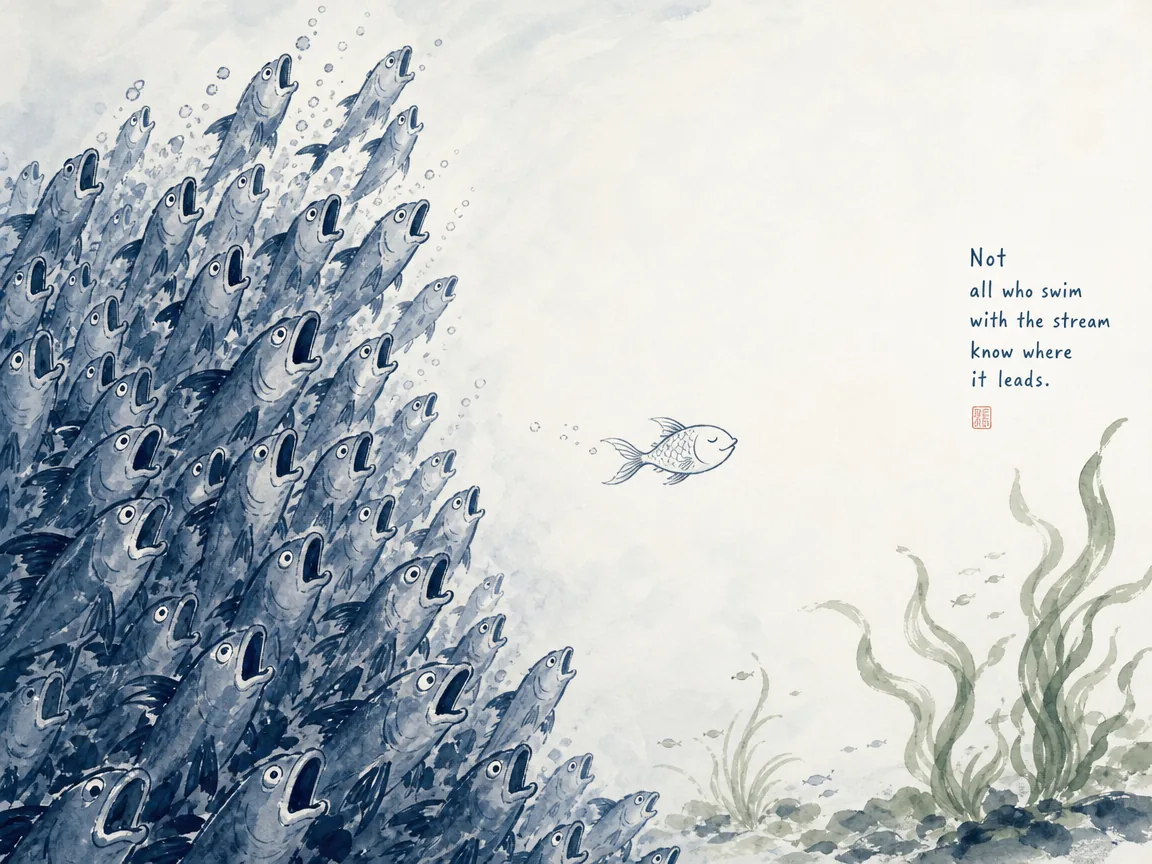
You've noticed it, or perhaps you've felt it yourself: the person who seems genuinely at peace with life often appears strange in a world that measures worth by productivity, status, and visible achievement. They don't seem anxious about catching up. They don't perform enthusiasm for pursuits that clearly exhaust everyone around them. In a culture that equates busyness with meaning and accumulation with success, someone who looks content without chasing any of those things can seem almost invisible — or worse, like they're falling behind.
What if that sense of being out of place isn't a failure to adapt, but the natural consequence of having seen through an artificial system of comparison? Ancient Chinese philosophy offers one of the most piercing critiques of this very phenomenon — not as a rejection of society, but as an invitation to question where our anxieties about belonging actually come from. The Tao Te Ching, traditionally attributed to Laozi, contains a chapter that reads almost like a diagnosis of modern life written 2,500 years ago.Its central observation is startling: much of what we experience as anxiety about our place in the world may not be natural to human life at all, but learned — absorbed from a culture that rewards performance over presence and measurement over meaning—a foundational perspective explored in Daodejing Chapter 21.
This isn't a call to retreat from the world. It's a call to understand what's driving the relentless need to prove ourselves, and whether there might be a deeper source of belonging that doesn't depend on keeping up.
Daodejing Chapter 21: The Anxiety of Belonging Was Learned, Not Innate
One of the most provocative openings in Daodejing Chapter 21 of the Tao Te Ching suggests that many of our deepest worries — about status, income, relationships, purpose — are not inherent to human existence but acquired through exposure to systems of comparison The text introduces this idea with the phrase often translated as "abandoning learning brings no worry," a statement easily misunderstood as a rejection of knowledge itself. But a closer reading reveals something more subtle: the worry Laozi addresses is not produced by learning in general, but by a particular kind of learning — one that teaches us to measure our worth against external yardsticks.
A child does not wake up anxious about whether they are succeeding, whether they have enough, whether they are ahead or behind. That anxiety arrives through socialization — through entering systems that rank, compare, and judge. What the text calls "learning" in this context is precisely this process: the internalization of societal standards that tell us what a successful life looks like and punish us internally when we fall short of it. The worry isn't in the world; it's in the lens through which we've been taught to see ourselves.
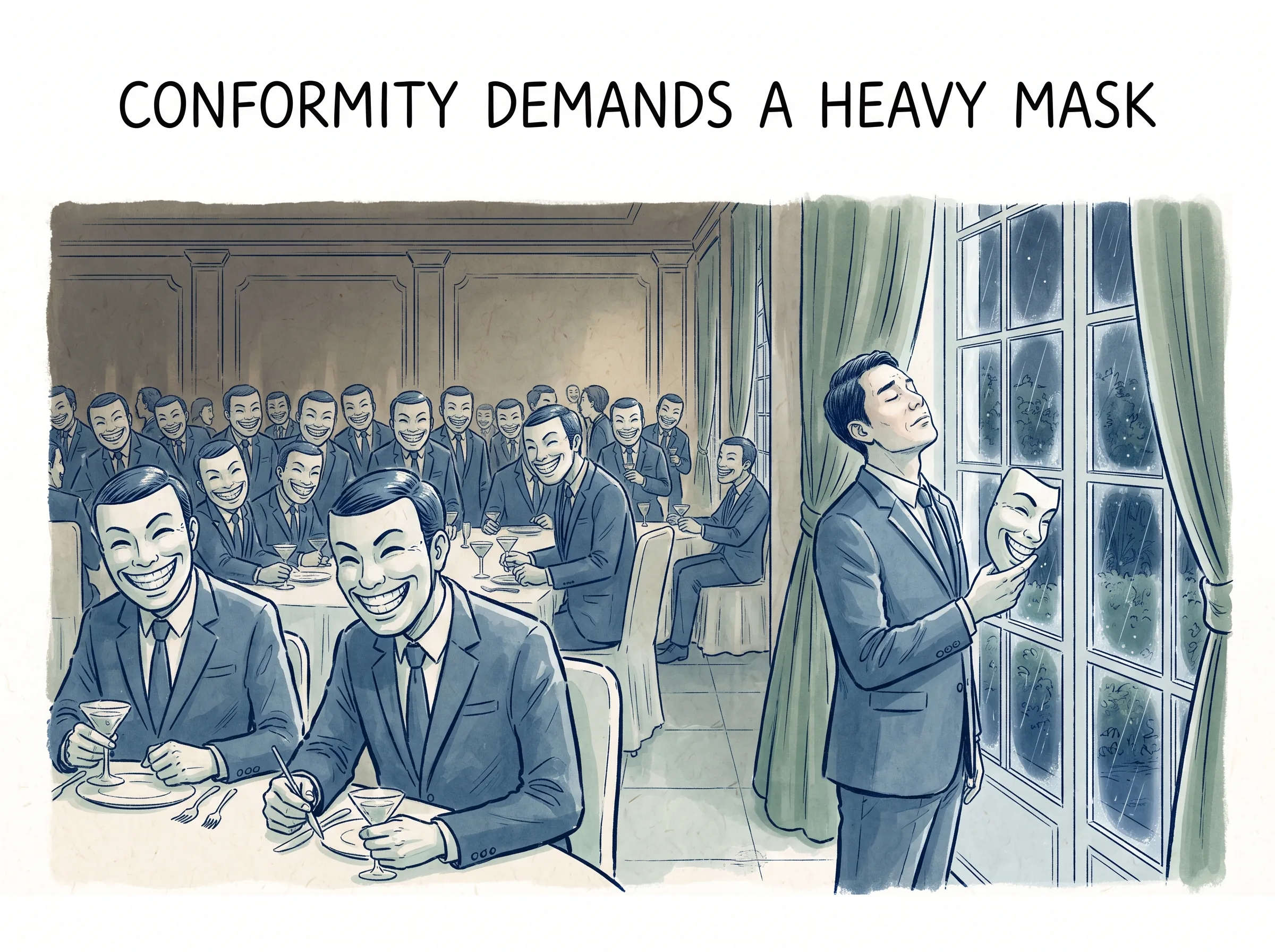
Modern culture has amplified this mechanism enormously. Research into social networking behavior shows that upward social comparison — measuring oneself against others who appear to have more positive qualities or achievements — is significantly associated with higher levels of depression and anxiety. The platforms that promise connection often deliver a continuous stream of curated highlights, turning every scroll into an unconscious comparison exercise. The ancient critique and the modern evidence converge on the same point: the anxiety of falling behind is largely a product of the systems we've built to measure belonging, not a natural response to life itself.
Continue with the deeper interpretation and practical application.
ChiDestiny members get access to the full analysis, modern applications, and the growing Chinese Wisdom Library.
FAQ
Does this mean I should reject modern society and its values?
No. The text explicitly warns against defining yourself in opposition to society — that's still being controlled by society's categories. The point isn't to reject ambition, achievement, or social participation, but to examine whether your sense of worth depends on them. You can engage with the world without letting the world define you.
Is this about being passive or unmotivated?
Not at all. The text distinguishes between action driven by external pressure and action that arises from a grounded place. The person described in Chapter 20 is not lazy or apathetic — they are simply not moved by the same urgencies that move the crowd. Their actions, when they come, are their own rather than reactive.
How do I find this "source" or "Mother" if I don't have a spiritual framework?
The concept doesn't require any particular religious commitment. It can be understood simply as the part of you that existed before you learned to measure yourself against others — the instinctive sense that you are worthy simply because you exist, not because of what you've achieved. Meditation, time in nature, honest self-reflection, and creative practice are all ways people connect with something deeper than performance.
What if I feel like I'm failing by not chasing success?
That feeling itself may be the learned anxiety the text describes. Ask yourself: who taught you that success is the measure of a life well-lived? Where did that standard come from, and does it actually serve you? The discomfort of questioning these assumptions is real, but it's often the discomfort of something outdated loosening its grip — not a sign that you're on the wrong path.
In Closing
The person who seems out of place in a world obsessed with success is not broken. They are responding differently to a world that has confused measurement with meaning. Ancient Chinese wisdom offers not an escape from modern life but a clearer lens for seeing through it — reminding us that the anxieties we carry about belonging are often not our own, but inherited, and that a deeper source of worth is always available to those willing to look beneath the surface.
The next step isn't dramatic. It begins with a single question: where am I performing instead of living? Notice the answer without judgment. From there, the path forward isn't about rejecting the world but about finding your ground within it — on your own terms.
Discover the historical and philosophical roots in the classical foundation in Ruling from the Center: Governing a Great Nation Like Cooking Small Fish.
For a deeper comparative examination of these ideas, explore our related study on Restraining Sensory Indulgence: Guarding the Quiet Belly over the Greedy Eye.
Sources & Further Reading
[1] Laozi (Stanford Encyclopedia of Philosophy) — Provides scholarly context on the Tao Te Ching, its textual traditions, and core philosophical concepts including the metaphors of the uncarved block and the Mother
[2] Social Networking Sites, Depression, and Anxiety: A Systematic Review (PMC) — Documents the association between upward social comparison on social media and higher levels of depression and anxiety
Further Reading
- Tao Te Ching, Chapter 20 — The primary text referenced throughout this article, available in multiple English translations including those by Robert Henricks and David Hawkes
- Tao Te Ching, Chapter 1 and Chapter 25 — For the conceptual development of "the Mother" as the source of all things
- Chinese Text Project — Daodejing (Wang Bi text)






